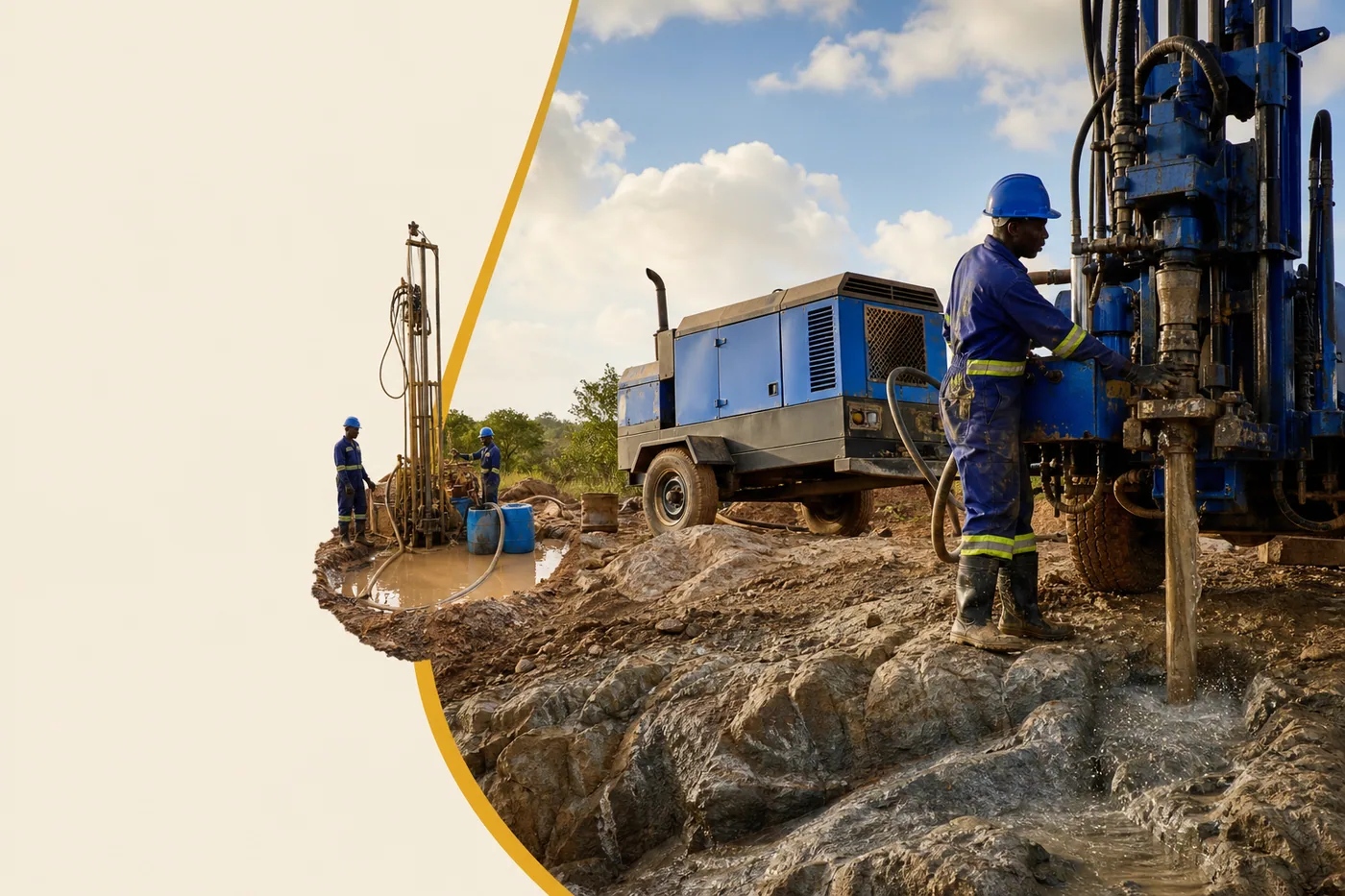
The 100 metre borehole cost in Kenya is not simply 100 multiplied by a drilling rate. A responsible budget separates the hydrogeological survey, approvals, mobilisation, drilling method, casing and screens, development, test pumping, laboratory analysis, pump, power, storage and distribution so the owner can see what is included and what remains provisional. Continue with our technical guide and verify context at Water Resources Authority — water-use allocation and permitting.
What does drilling 100 metres cost?
Using the current planning rate, 100 metres of air drilling in suitable stable rock produces a drilling allowance of KSh 650,000. If loose formations require mud drilling at the published KSh 14,050 per metre planning rate, the drilling line alone becomes KSh 1,405,000. Neither figure is a complete project quotation. Continue with our drilling services and verify context at Kenya Water Resources Regulations, 2021.
The appropriate method cannot be chosen from a county name or online calculator. A hydrogeological assessment, site access review and the formations encountered during construction determine the defensible method and any need for temporary support, changed diameter or additional work. Continue with our project quote and verify context at Kenya Ministry of Water, Sanitation and Irrigation.
Add the hydrogeological survey and authorization work
Allow from KSh 45,000 for the hydrogeological survey, subject to the exact location, travel, field method, professional scope, reporting and application support. The report should identify the investigated site, explain the evidence and interpretation, recommend a target and state uncertainty rather than guaranteeing water. Continue with our cost calculator and verify context at Water Resources Authority — groundwater assessment and monitoring.
The applicant should confirm the current WRA application, authorization and later permit requirements for the project. Keep official charges separate from professional service fees and ask for receipts or portal evidence instead of accepting an unexplained “permit package.” Continue with our technical guide and verify context at Water Resources Authority — water-use allocation and permitting.
How casing changes a 100 metre borehole budget
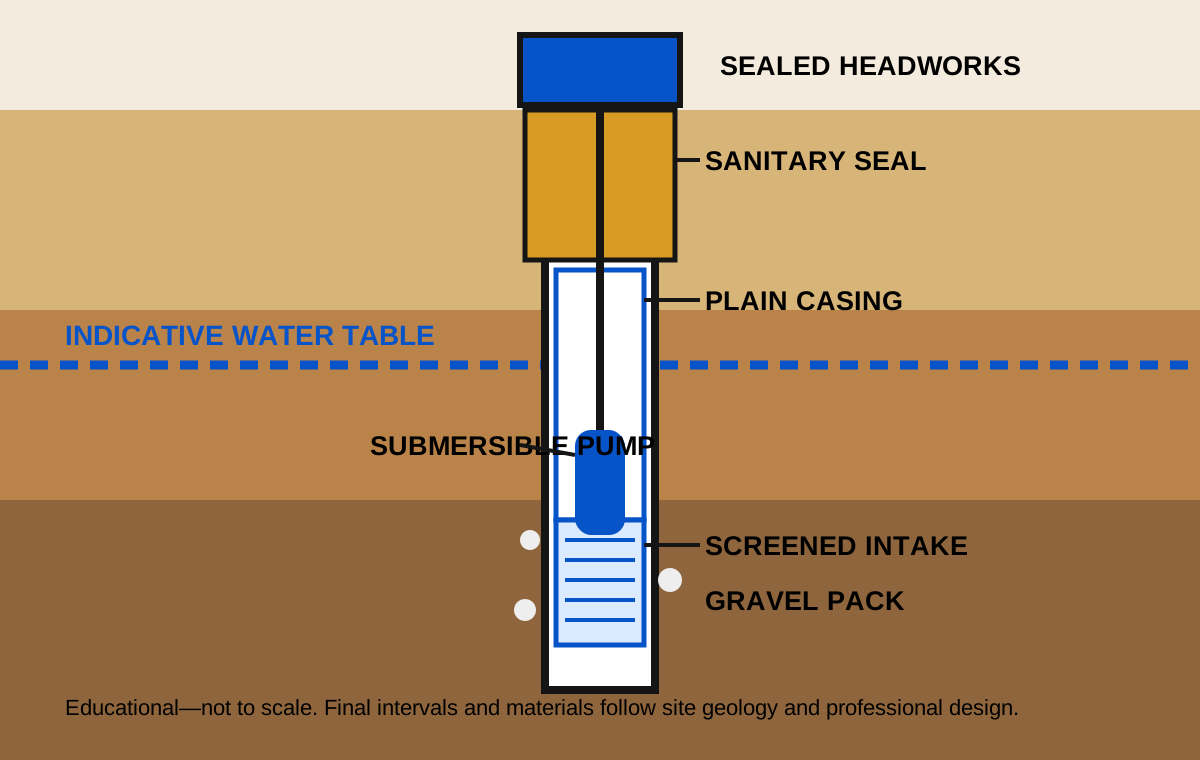
Drilled depth and permanent casing length are not automatically equal. Installed plain casing, screens, surface casing, gravel pack and sanitary seals should follow the encountered formations and construction design. A quotation should identify diameter, material, wall specification, joints, unit rate and provisional quantity. Continue with our drilling services and verify context at Kenya Water Resources Regulations, 2021.
A cheap drilling line can be offset by omitted construction materials. Compare bidders on a common schedule and require the drilling log and as-built casing and screen intervals at handover. Continue with our project quote and verify context at Kenya Ministry of Water, Sanitation and Irrigation.
Testing, pump, solar and storage costs
After construction and development, a controlled pumping test measures discharge and water-level response, followed by recovery observations. Laboratory analysis assesses suitability for the intended use. These results inform the sustainable operating recommendation, pump duty and any necessary treatment. Continue with our cost calculator and verify context at Water Resources Authority — groundwater assessment and monitoring.
The pump price depends on discharge, pumping water level, installation depth, elevation, pipe losses and delivery pressure—not merely the 100 metre drilled depth. Solar modules, controller, protection, structure, cable, storage, tower and distribution should be itemised as a separate system. Continue with our technical guide and verify context at Water Resources Authority — water-use allocation and permitting.
A practical 100 metre cost-checking method
Use the online cost calculator to create an initial scenario, then send the complete assumptions through the connected quote form. Ask the contractor to replace allowances with quantities and rates after reviewing the survey, access and required water system. Continue with our drilling services and verify context at Kenya Water Resources Regulations, 2021.
Retain a contingency for geological change and define written variation control before mobilisation. The most useful budget is transparent about uncertainty and can be updated as survey, drilling, testing and laboratory evidence becomes available. Continue with our project quote and verify context at Kenya Ministry of Water, Sanitation and Irrigation.
What “100 metre borehole cost in Kenya” should mean before you spend
A search for 100 metre borehole cost in Kenya often begins with a price or supplier name, but the decision has to start with the outcome: a lawful, constructible and maintainable groundwater system. Define the site, intended use, daily and peak demand, target service life, available power and storage before comparing an equipment price or drilling rate. This turns a broad search into a procurement brief that contractors can answer consistently. Continue with our cost calculator and verify context at Water Resources Authority — groundwater assessment and monitoring.
The Water Resources Authority describes siting, construction, supervision and pumping tests as distinct groundwater-development disciplines. That matters commercially because an offer covering only drilling metres is not the same as a completed water system. Identify who supplies each professional stage, who carries the risk of incomplete information and which records will be handed over. Continue with our technical guide and verify context at Water Resources Authority — water-use allocation and permitting.
Evidence behind 100 metre borehole cost in Kenya
Desk research should separate primary evidence from advertising. Legislation, regulator guidance, public specifications, signed quotations, manufacturer data and measured project records have different authority. A provider webpage can confirm what that provider publicly offers, but it cannot independently prove universal success, the best price or suitability for a particular geology. Date every source because fees, models, staff, branches and commercial offers change. Continue with our drilling services and verify context at Kenya Water Resources Regulations, 2021.
Public borehole tenders illustrate the detail expected in serious procurement: drilling technique, poorly consolidated horizons, casing, centralisers, development, testing, materials and supervision may all be specified. A private client does not need a government-length tender, but should borrow the discipline—defined units, measurable acceptance criteria and named documents. Continue with our project quote and verify context at Kenya Ministry of Water, Sanitation and Irrigation.
| Budget component | Planning basis | Main driver |
|---|---|---|
| Hydrogeological survey | From KSh 45,000 | Assessment scope, site and method |
| Air drilling | KSh 6,500/m | Stable ground with proper rock formation |
| Mud drilling | KSh 14,050/m | Loose ground with little or no rock |
| Casing and screens | By installed metre | Diameter, material and construction design |
| Pump and controls | After test results | Yield, head, demand and power source |
Build a complete scope before requesting prices
Start with site coordinates, land authority, access width and gradients, overhead or underground services, nearby contamination risks and any existing survey or borehole records. Add expected demand by use, preferred operating hours, available electricity or solar area, storage objectives and distribution distance. Contractors can then distinguish assumptions from measured facts rather than hiding uncertainty inside one large contingency. Continue with our cost calculator and verify context at Water Resources Authority — groundwater assessment and monitoring.
Divide the scope into assessment, approvals, mobilisation, drilling, construction, development, test pumping, laboratory analysis, equipping, power, storage, distribution, civil works and handover. State whether VAT, security, water for works, accommodation, access improvement and waste management are included. A complete schedule also makes later quotations easier to audit. Continue with our technical guide and verify context at Water Resources Authority — water-use allocation and permitting.
Air drilling, mud drilling and formation risk
Air drilling at the published planning rate of KSh 6,500 per metre is intended here for stable ground with a suitable rock formation. Mud drilling at KSh 14,050 per metre is intended for loose ground with little or no competent rock. These are commercial planning rates, not a geological diagnosis. The method should follow professional interpretation and the formation encountered by the rig. Continue with our drilling services and verify context at Kenya Water Resources Regulations, 2021.
A Kenyan public borehole specification may require rotary drilling with bentonite through poorly consolidated sediments, demonstrating why one universal method cannot be imposed on every site. Diameter, depth, stability, fluid management, compressor demand, penetration rate and casing programme affect both productivity and cost. Agree how a necessary method change will be authorised and priced. Continue with our project quote and verify context at Kenya Ministry of Water, Sanitation and Irrigation.
Hydrogeological survey and uncertainty
The calculator carries a hydrogeological survey allowance starting from KSh 45,000. That is a budget entry, not a guarantee of depth, yield or quality. A competent assessment combines available records, site reconnaissance, geological reasoning and suitable field measurements to identify a defensible target and explain limitations. Ask for the author, methods, coordinates, interpretation and recommended drilling point. Continue with our cost calculator and verify context at Water Resources Authority — groundwater assessment and monitoring.
WRA states that adherence to groundwater codes can reduce failure risk and support long-term investment. The wording is important: reduce risk, not eliminate it. Underground conditions are confirmed progressively through drilling, logging, development, pumping and analysis. Contracts and marketing should preserve that distinction rather than promise certainty before evidence exists. Continue with our technical guide and verify context at Water Resources Authority — water-use allocation and permitting.
Cost model for 100 metre borehole cost in Kenya
A useful cost model multiplies the selected drilling method by chargeable metres, then adds casing and screens by installed metre, survey, mobilisation, gravel and seals, development, tests, pump, cable, controls, power, storage, distribution, civil works, taxes and contingency. It should prevent double counting where a per-metre rate already includes a component. Continue with our drilling services and verify context at Kenya Water Resources Regulations, 2021.
Model at least three cases: expected depth, a deeper case and a changed-construction case. For machinery acquisition, substitute landed equipment, tooling, compressor, crew, fuel, transport, maintenance, finance and idle time. For contractor selection, compare evaluated whole-project cost rather than the lowest visible line. Assumptions should remain editable and travel into the quote request. Continue with our project quote and verify context at Kenya Ministry of Water, Sanitation and Irrigation.
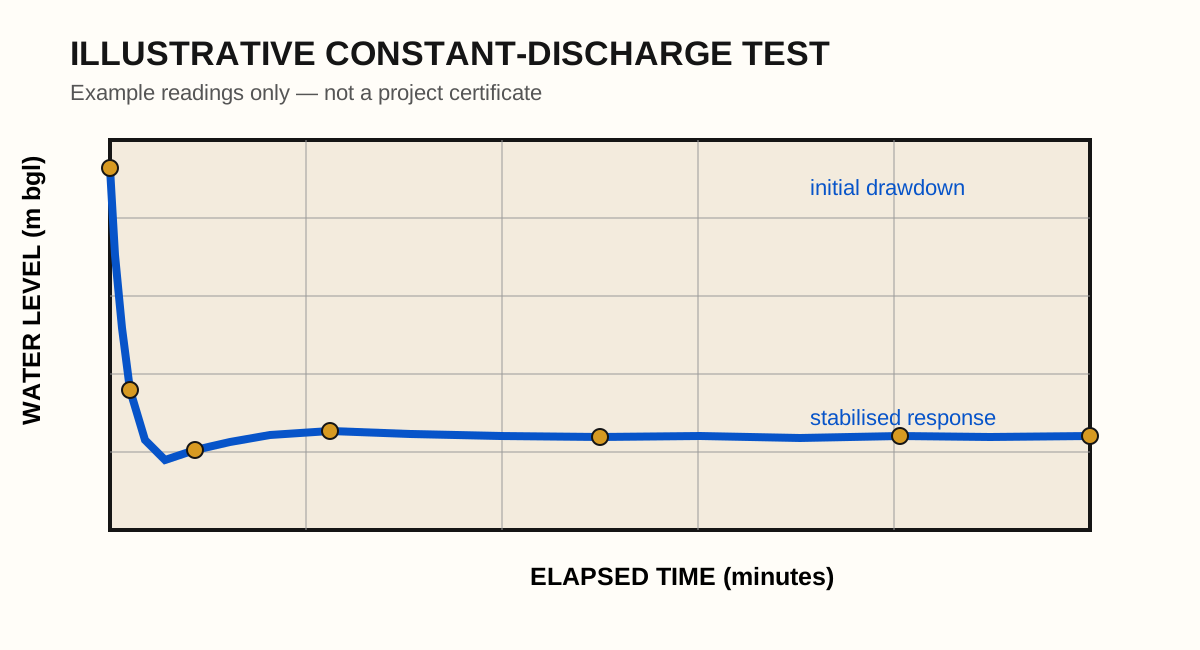
What a constant-discharge record can contain
Illustrative training extract only—not an actual result for your site and not a pumping-test certificate.
| Elapsed (min) | Water level (m bgl) | Drawdown (m) | Discharge (m³/hr) | Observation |
|---|---|---|---|---|
| 0 | 46.89 | — | 28.6 | Gate valve fully open |
| 5 | 51.40 | 4.51 | 28.4 | Brown water clearing |
| 30 | 50.03 | 3.14 | 28.0 | Slightly clear water |
| 120 | 49.86 | 2.97 | 26.8 | Clear water |
| 360 | 50.38 | 3.49 | 26.6 | Clear water |
| 660 | 50.31 | 3.42 | 26.4 | Clear water |
| 1,380 | 50.34 | 3.45 | 25.8 | Clear water |
| 1,440 | 50.34 | 3.45 | — | Water sampled |
Technical records that protect the buyer
Request the hydrogeological report, authorisations, daily drilling log, formation and water-strike record, final construction details, installed material schedule, development record, test-pumping data, recovery observations, laboratory certificate, pump model and curve, setting depth, electrical protection settings, warranties and as-built information. These records make future maintenance faster and disputes more evidence-based. Continue with our cost calculator and verify context at Water Resources Authority — groundwater assessment and monitoring.
The 2021 Water Resources Regulations include groundwater protection and monitoring provisions, including metering and dipper-tube requirements for borehole abstractors. Project-specific conditions must be confirmed with WRA, but provision for measurement and access should not be discovered after the headworks are permanently completed. Continue with our technical guide and verify context at Water Resources Authority — water-use allocation and permitting.
Commercial comparison without misleading rankings
Use the same request for proposal and deadline for every bidder. Check legal identity, current professional and drilling credentials, equipment availability, relevant geology, safety arrangements, supervision, references, programme, subcontractors, insurance, payment milestones, variations, warranty and exclusions. Verify recent references directly rather than accepting a list at face value. Continue with our drilling services and verify context at Kenya Water Resources Regulations, 2021.
A “best” or “cheapest” claim is a marketing statement until the evaluation criteria and evidence are visible. Publish why a company appears in a shortlist, disclose commercial relationships, avoid invented customer ratings and allow readers to visit the named company’s own current page. This is particularly important when the publisher also offers the service. Continue with our project quote and verify context at Kenya Ministry of Water, Sanitation and Irrigation.
Lifecycle performance after handover
The lowest capital cost can produce high operating cost if the pump is oversized, the rising main creates avoidable losses, controls do not protect against dry running, storage is too small or maintenance access is poor. Pump selection should use tested discharge, pumping water level, installation depth, elevation, pipe losses, delivery pressure and operating schedule. Continue with our cost calculator and verify context at Water Resources Authority — groundwater assessment and monitoring.
Keep monthly meter readings, pumping hours, energy use, water levels where required, faults, maintenance and laboratory results. Investigate changes in sand, colour, odour, flow, pressure, current or filling time before total failure. Responsible abstraction and preventive maintenance protect the aquifer, borehole, equipment and users. Continue with our technical guide and verify context at Water Resources Authority — water-use allocation and permitting.
Separate measured results from interpretation
Illustrative values only. Sampling, methods, limits and conclusions must come from an appropriate accredited laboratory and the current standard for the intended use.
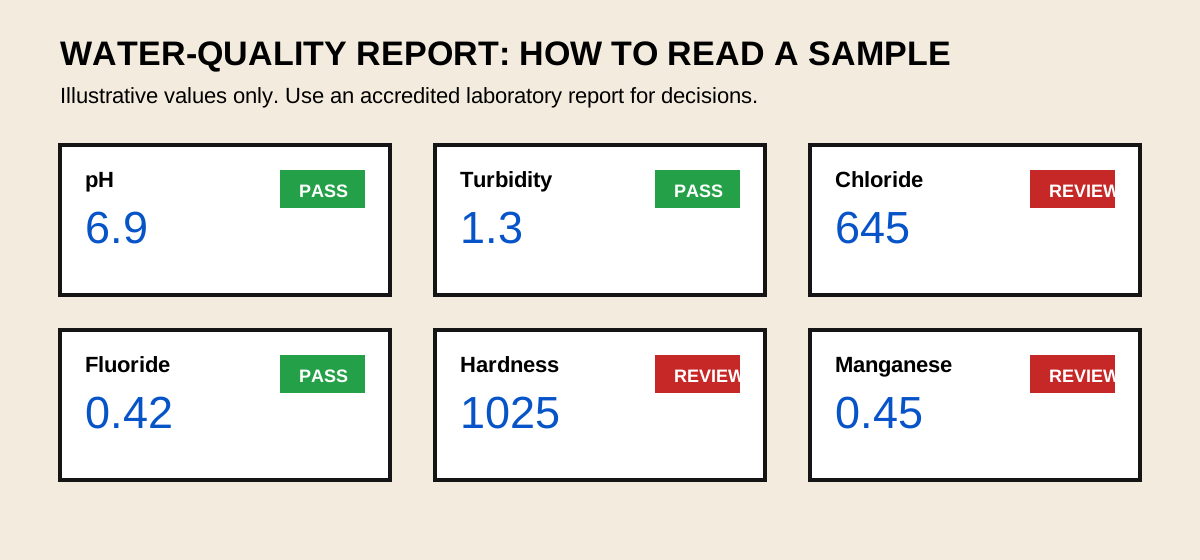
| Parameter | Example value | Example reference | Reading note |
|---|---|---|---|
| pH | 6.93 | 5.5–9.5 | Review against intended-use standard |
| Turbidity | 1.33 NTU | 25 NTU | Illustrative pass |
| Chloride | 645 mg/L | 250 mg/L | Illustrative review |
| Fluoride | 0.42 mg/L | 1.5 mg/L | Illustrative pass |
| Total hardness | 1,025 mg/L | 600 mg/L | Illustrative review |
A defensible next step
Convert this research into a one-page site brief and a line-by-line request. Attach location, use, demand, existing reports, access notes, target programme and the assumptions you want priced. Ask bidders to flag missing information and offer alternatives separately rather than silently changing the base scope. Continue with our drilling services and verify context at Kenya Water Resources Regulations, 2021.
Use the calculator as a conversation starter, not a contract. Commission the appropriate professional assessment, confirm current approvals, compare written scopes and retain a contingency for geological change. That sequence gives 100 metre borehole cost in Kenya a practical meaning: an informed decision supported by evidence rather than a search-result headline. Continue with our project quote and verify context at Kenya Ministry of Water, Sanitation and Irrigation.
Site access, mobilisation and programme
Mobilisation is not merely the truck journey from a yard. A contractor must consider route restrictions, bridges, gates, turning radius, overhead cables, gradients, soft ground, rig setup space, compressor position, water supply, fuel, crew welfare, security and reinstatement. Photograph the access route and working area, share dimensions honestly and identify seasonal constraints. If grading, crane assistance or towing may be required, price it before equipment is dispatched rather than negotiating with an immobilised rig. Continue with our cost calculator and verify context at Water Resources Authority — groundwater assessment and monitoring.
The programme should distinguish approvals, survey, mobilisation, drilling, construction, development, testing, laboratory turnaround, pump procurement, installation and commissioning. Some activities depend on results from the previous stage, so a promised completion date may be conditional. Ask who communicates delays, how standby is treated, when materials are ordered and what happens when geology requires extra depth or a different construction decision. Continue with our technical guide and verify context at Water Resources Authority — water-use allocation and permitting.
Casing, screens, gravel and sanitary protection
A borehole is a constructed intake, not an unsupported hole. Casing stabilises selected intervals; screens admit water while controlling formation material; gravel pack supports filtration around suitable screen sections; seals help prevent contaminated surface water from moving down the annulus. Material, diameter, wall thickness, slot selection, joints, centralisation and installed intervals must follow the design and conditions encountered—not an arbitrary percentage chosen only to make a quotation cheaper. Continue with our drilling services and verify context at Kenya Water Resources Regulations, 2021.
Ask whether the per-metre drilling rate includes temporary casing, permanent plain casing, screens, gravel, sanitary seal, welding or threaded joints and installation labour. Record actual installed lengths and material identification at handover. Public specifications separate many of these components because they are measurable and materially affect performance. A client comparing two totals without construction detail may unknowingly compare two different boreholes. Continue with our project quote and verify context at Kenya Ministry of Water, Sanitation and Irrigation.
Test pumping, water level and sustainable operation
A water strike observed during drilling is not a proven operating yield. Test pumping applies controlled abstraction while discharge and water levels are measured, followed by recovery observations. The data supports an operating recommendation and provides inputs for pump selection. Duration, discharge steps, instruments and reporting should suit the project and applicable requirements. Ask for raw readings as well as the interpreted conclusion so a future professional can review the basis. Continue with our cost calculator and verify context at Water Resources Authority — groundwater assessment and monitoring.
Static water level, pumping water level, drawdown, recovery and tested discharge answer different questions. Total drilled depth alone cannot select a pump. A pump also has to overcome elevation and pipe losses while delivering the required flow at the destination. Operating above sustainable yield risks excessive drawdown, dry running, energy waste and accelerated equipment wear; conservative evidence-led operation often produces better lifetime value. Continue with our technical guide and verify context at Water Resources Authority — water-use allocation and permitting.
Water quality, treatment and intended use
Clear water is not proof of safe or suitable water. Sampling and laboratory parameters should reflect intended use: potable supply, irrigation, livestock, institutional occupation, food processing and industrial processes do not present identical questions. Protect the sample chain, record the sampling point and date, and interpret results against the appropriate current standard or agronomic requirement rather than relying on taste, colour or a single headline measurement. Continue with our drilling services and verify context at Kenya Water Resources Regulations, 2021.
Treatment should respond to measured parameters and design flow. Iron, manganese, hardness, salinity, fluoride, nitrate and microbiological contamination require different responses, while some technologies create reject water or recurring consumable costs. Keep treatment as a provisional design stage until representative results exist. Request performance targets, maintenance tasks, consumables, waste handling and post-treatment verification before accepting a system. Continue with our project quote and verify context at Kenya Ministry of Water, Sanitation and Irrigation.
Contract, payment and variation controls
The agreement should identify the contracting parties, site, scope, rates, taxes, payment milestones, programme assumptions, client responsibilities, ownership of reports, safety obligations, warranty, suspension rights, failed-hole provisions, dispute process and authorised payment account. Pay only against the company details stated in the contract or official invoice. A broker or introducer is not automatically authorised to change scope or receive money. Continue with our cost calculator and verify context at Water Resources Authority — groundwater assessment and monitoring.
Variations are normal when genuine underground evidence changes the required work, but they should not be invisible. Define who can authorise extra metres, changed drilling method, additional casing, recovery work or standby; require the quantity, rate, reason and programme effect in writing where practicable. Preserve daily records and approvals. Commercial discipline protects both parties and prevents technical decisions from becoming arguments after irreversible work is completed. Continue with our technical guide and verify context at Water Resources Authority — water-use allocation and permitting.
Final buyer checklist for handover
Before accepting completion, walk through the wellhead, drainage, cap, access, electrical panel, protection devices, meter, storage controls and distribution operation. Reconcile the final depth and installed materials with the daily log and invoice. Collect reports, laboratory results, test data, equipment manuals, serial numbers, warranty contacts and recommended service intervals in one digital and physical handover file. Continue with our drilling services and verify context at Kenya Water Resources Regulations, 2021.
Agree the normal operating schedule, warning signs and escalation contacts. Record baseline flow, pressure, energy use and filling time, then compare future performance against that baseline. The finished project should leave the owner able to operate responsibly and a future technician able to diagnose it. That is a stronger definition of value than a low initial number or a machine photographed beside an unfinished hole. Continue with our project quote and verify context at Kenya Ministry of Water, Sanitation and Irrigation.
How to keep the research current
Treat every published price, licence statement, company service list and equipment specification as dated evidence. Before signing, revisit the regulator, obtain a current written quotation, verify the proposed personnel and equipment, and ask whether taxes, transport or material rates have changed. Save the source date beside each decision so another reviewer can distinguish verified facts from planning assumptions. Continue with our cost calculator and verify context at Water Resources Authority — groundwater assessment and monitoring.
Create a short decision log showing the alternatives considered, evidence received, questions raised and reason for selection. Update it when the survey, drilling log, test pumping or laboratory results reveal new conditions. This simple practice prevents an early internet estimate from overriding stronger site-specific evidence and gives the owner, contractor and technical advisers a shared record of how the final solution developed. Continue with our technical guide and verify context at Water Resources Authority — water-use allocation and permitting.
Before authorising irreversible work, hold a documented review with the owner, contractor and relevant technical adviser. Confirm the latest target, method, diameter, material schedule, test plan, payment milestone, safety arrangements and variation authority. After each evidence-producing stage, compare actual findings with the assumptions used in the budget. This control does not remove geological uncertainty, but it makes changes visible early, reduces avoidable misunderstandings and keeps the final installation connected to measured site conditions rather than an outdated search result. Continue with our drilling services and verify context at Kenya Water Resources Regulations, 2021.
Questions readers ask before committing
How much is 100 metres of air drilling in Kenya?
At the current KSh 6,500 per metre planning rate, the drilling line is KSh 650,000 before survey, approvals, mobilisation, casing, testing, pump, power, storage, taxes and site works. Continue with our project quote and verify context at Kenya Ministry of Water, Sanitation and Irrigation.
Is a 100 metre borehole guaranteed to reach water?
No. Expected depth is a planning range. A hydrogeological assessment reduces uncertainty, while drilling and testing confirm the actual conditions. Continue with our cost calculator and verify context at Water Resources Authority — groundwater assessment and monitoring.
Does the whole borehole need 100 metres of casing?
Not automatically. Permanent casing and screen intervals should follow the formations encountered and the professional construction design. Continue with our technical guide and verify context at Water Resources Authority — water-use allocation and permitting.
When is the final pump selected?
Final selection should follow pumping-test evidence and a hydraulic calculation using demand, water levels, installation depth, elevation and pipe losses. Continue with our drilling services and verify context at Kenya Water Resources Regulations, 2021.