borehole water tank size Kenya should be chosen from daily demand, tested borehole yield, pumping hours, reserve needs and the way water is distributed. A tank that is too small can force frequent pumping and leave users without reserve, while an unnecessarily large tank can add cost, structural load and slow turnover, so this guide shows you how to size storage logically.

Why borehole water tank size Kenya is not a one-number answer
Two properties with the same number of people can need different storage. A farm may have irrigation and livestock demand. An apartment may have strong morning and evening peaks. A school can use most of its water during occupied hours. A hotel or clinic may need a larger service reserve because an interruption has greater operational impact.
The tank should therefore be selected from the water balance. Start with how much water is required in a day, then compare that with the amount the borehole can pump during the planned operating window. Storage should absorb the difference between steady pumping and short peak demand.
Use borehole yield in Kenya and borehole test pumping Kenya to understand the source before selecting the tank.
Borehole water tank size Kenya: calculate daily demand first
Create a list of all regular water uses. For a home, include domestic activities and any garden or livestock use. For a farm, separate livestock, irrigation, staff and washing. For an institution, include users, kitchens, sanitation, cleaning and any process demand. For a commercial site, include operational water as well as staff demand.
In plain English, daily demand is the sum of every water-use category. Use your own measured or planned consumption where possible instead of copying a generic number.
Borehole water tank size Kenya and peak demand
Daily volume is only part of the design. A site can use most of its daily water within a short period. That peak matters because the tank may need to discharge faster than the borehole should be pumped. Storage creates a buffer between those two rates.
If demand is spread evenly, a smaller operational buffer may be practical. If demand is concentrated into irrigation blocks, shift changes, school breaks or morning apartment peaks, the tank must carry more of the short-term load.
Compare borehole output with pumping hours
In plain English, the volume pumped during an operating window equals the selected pumping rate multiplied by the pumping time.
Do not use the maximum short-term test rate automatically. Use the operating rate supported by the pumping-test interpretation and pump design. If a solar system is planned, useful pumping hours may be concentrated during the day. If grid power is used, the pump may have more timing flexibility, but storage is still valuable for peak demand and outages.
The solar vs electric borehole pump Kenya guide explains how power source affects the storage strategy.
How reserve storage changes the calculation
A tank can include operational storage, peak-demand storage and reserve. Reserve gives the site time to respond to a short pump, power or maintenance interruption. The amount of reserve should be chosen from the consequences of running out of water rather than from a universal percentage.
A home may accept a smaller reserve if alternative water is easy to obtain. A school, clinic, livestock unit or apartment block may need more resilience because many users are affected. The reserve decision should be written into the design so the team knows what the tank is intended to achieve.
Choosing the right approach for borehole water tank size Kenya
| Site type | Storage priority | Questions to ask |
|---|---|---|
| Home | Daily use, morning/evening peaks, short outage reserve | How many users and what non-domestic loads exist? |
| Farm | Irrigation/livestock peaks and pumping schedule | Can irrigation be zoned and shifted? |
| Apartment | Peak occupancy and service continuity | What are the morning/evening demand patterns? |
| School/institution | Occupied-hours demand and operational reserve | How long can the site operate during pump downtime? |
| Commercial site | Process demand and business-continuity reserve | Which activities stop when water is unavailable? |
Worked example: storage for a solar borehole system
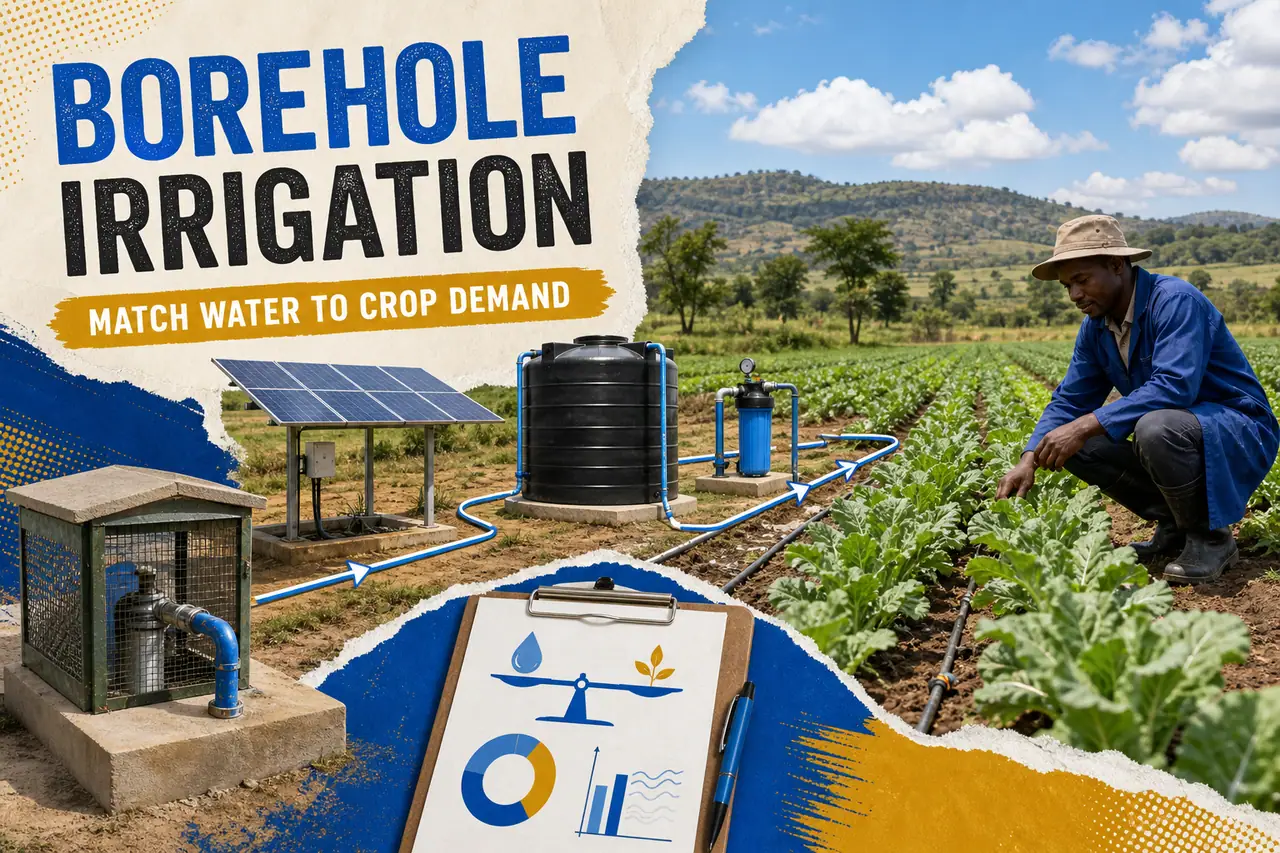
Imagine a farm where the borehole is tested and the pump is designed to operate mainly during useful solar hours. Livestock need water throughout the day, while irrigation is scheduled in the evening. If the tank is sized only for livestock, evening irrigation may empty it quickly. If the pump is then unable to refill after sunset, the site starts the next morning with insufficient reserve.
A better design separates daily volume, evening peak and reserve. The pump fills storage steadily during the day. Irrigation is zoned so the tank discharge stays within the distribution capacity. Livestock demand is protected with a minimum operating reserve.
| Illustrative storage component | Relative index |
|---|---|
| Daily operational volume | 65 |
| Peak-demand buffer | 35 |
| Reserve | 25 |
Features of our borehole water tank size Kenya planning service
| Feature | Benefit |
|---|---|
| Demand schedule | Separates daily volume from short peaks |
| Borehole-yield review | Keeps storage consistent with tested source performance |
| Pumping-window review | Accounts for solar, grid, generator or timed operation |
| Reserve planning | Defines how the site should respond to interruptions |
| Tank location/elevation review | Coordinates storage with gravity or booster pressure |
| Pipe and control planning | Links tank level, pump controls and distribution |
| Expansion allowance | Checks whether future demand should influence the design |
Advantages of calculating borehole water tank size Kenya instead of guessing include:
- Fewer water shortages because peak demand and reserve are visible.
- More stable pumping because the borehole does not need to chase every demand spike.
- Better solar operation because daytime pumping can be stored for later use.
- Lower cycling when tank level controls are coordinated with the pump.
- Clearer future expansion because the original water balance is documented.
Borehole water tank size Kenya pricing
Tank price depends on material, capacity, brand, transport and whether the scope includes a slab, tower, fittings, valves, float controls, pipework or installation. The shop currently lists several storage options, including a 3,000 L water storage tank, a 5,000 L Kentank and a 10,000 L heavy-duty water tank. Check the live product pages for current equipment pricing.
| Scope | Indicative price | What to confirm |
|---|---|---|
| Ground-level tank | $— | Capacity, base/slab, valves, overflow and pipe connections |
| Elevated gravity tank | $— | Tank, tower, foundation, structural design and access |
| Tank plus pressure system | $— | Storage, booster/pressure tank, controls and commissioning |
Ground tank versus elevated tank
A ground-level tank provides storage but little gravity pressure unless the property is lower than the tank. It may therefore feed a separate booster pump. An elevated tank can create gravity pressure, but the tower, foundation and structural loads become part of the project.
Do not choose tower height only by appearance. The available elevation relative to the highest fixture influences static head, while pipe losses reduce pressure further. The site lists a 6 m galvanised tank tower as an equipment option, but final tower design must suit the tank, site and structural requirements.
How pressure systems relate to tank size
Storage volume and pressure are different design questions. A large tank at ground level can hold plenty of water while still providing poor pressure. A pressure tank, booster system or elevated tank may be required to supply fixtures at the desired pressure.
Read low borehole water pressure Kenya before replacing the borehole pump to solve a downstream pressure problem.
How to size tank controls
Tank controls should stop pumping when storage is full and restart at a suitable level. A float switch or level controller can automate this function. The switching range should avoid excessive pump cycling and should preserve the intended reserve.
Borehole Drillers Kenya lists a 5 m tank float switch. The final control arrangement must match the pump/controller and electrical design.
What happens if the tank is too small?
- The pump may start and stop frequently.
- Peak demand can empty storage faster than the borehole refills it.
- Solar systems may run short after sunset.
- Maintenance or power outages leave little reserve.
- Future users can push the system beyond its original design.
A small tank is not automatically wrong. If the borehole has ample capacity, power is reliable and demand is low, modest storage can be adequate. The point is to choose from the water balance.
What happens if the tank is too large?
Oversizing can tie up capital, increase foundation or tower requirements and create long storage periods if demand is low. Water age can matter where quality and disinfection are concerns. A very large tank also needs suitable overflow, drain, access and cleaning provisions.
Do not choose the largest tank that fits the budget unless the reserve and future-demand strategy justify it.
Borehole water tank size Kenya for irrigation
Irrigation demand should be calculated by crop area, irrigation method, scheduling and application requirement rather than by tank size alone. A tank can buffer a borehole whose steady flow is lower than the short irrigation-zone flow, but total daily water still must come from the source.
Use the borehole water for irrigation in Kenya guide to connect safe yield, storage and crop demand. Zoning often makes a storage-and-pumping plan easier to manage.
Borehole water tank size Kenya for apartments
Apartment demand can be peaky. Record occupancy, common-area use, cleaning, laundry arrangements and any commercial units. Size storage for the operating strategy and desired service reserve, then design the booster or gravity system separately.
For apartment projects, meter data can later reveal whether actual consumption matches design assumptions. If occupancy grows, recalculate before adding a larger pump.
Borehole water tank size Kenya for schools and institutions
Schools and institutions should consider occupied hours, sanitation, kitchens, boarding where applicable, cleaning and service continuity. A pump failure during a busy day can affect many people, so reserve strategy deserves more weight than on a small private property.
Document the minimum tank level at which the site should trigger maintenance or alternative supply. Operational planning is as important as nominal tank capacity.
How to use measured consumption to refine borehole water tank size Kenya
If the property is already occupied, measured consumption is more useful than a generic estimate. Record the tank level or meter total at the same time each day for several representative operating days. Note unusual events such as irrigation, guest occupancy, laundry, construction or livestock watering so they can be separated from the normal baseline.
Then compare average daily use with the largest observed peak period. For an apartment property, the peak may occur before work and again in the evening. For a school, it may follow meal or sanitation periods. For a farm, irrigation can dominate. The tank should be able to handle the planned peak without encouraging the borehole pump to exceed its tested operating rate.
After installation, repeat the measurement. If actual demand is lower than expected, the reserve may be generous. If demand is higher, adjust pumping hours or usage patterns before automatically installing a larger pump. This measured approach keeps borehole water tank size Kenya connected to real site behaviour.
Planning for future expansion without oversizing today
Future demand deserves attention, but an uncertain expansion should not automatically justify the largest tank available. Identify what is reasonably planned: additional rental units, more livestock, a second irrigation block, a new school wing or another commercial process. Estimate how that change affects daily volume and peak demand, then decide whether to build the full storage now or leave space and pipe connections for a second tank later.
Modular storage can be useful when the timing of growth is uncertain. However, tanks connected in parallel need compatible levels, pipework and controls so they fill and drain as intended. A future tank should not be added as an isolated afterthought.
Document the original calculation and the expansion trigger. For example, the site can plan to review storage when measured daily consumption reaches a chosen operational threshold. That creates a defensible upgrade point instead of relying on complaints that “the tank feels too small.”
How water quality affects storage design
Tank design should allow inspection and cleaning. Covers, screened vents where appropriate, overflow routing and sanitary pipe connections help protect stored water. The borehole water may also require treatment before or after storage depending on test results and system design.
Use borehole water testing and treatment in Kenya to plan treatment from laboratory evidence rather than appearance alone.
Monitoring tank performance
After commissioning, record how long the tank takes to refill and how quickly it falls during known demand periods. Those observations become a simple operating baseline. If refill time increases, investigate the borehole pump or source. If the tank empties faster with the same users, look for leaks or increased consumption.
A flow meter can improve the record by measuring pumped volume. The site lists a 2-inch digital water flow meter for monitoring applications.
Common borehole water tank size Kenya mistakes
- Choosing tank size only from household headcount.
- Ignoring irrigation, livestock or commercial loads.
- Using the maximum pumping-test rate instead of the planned operating rate.
- Confusing storage volume with water pressure.
- Failing to define reserve for power or pump downtime.
- Buying a tower without checking structural and hydraulic requirements.
- Ignoring float controls and overflow management.
- Failing to plan for future expansion.
How to get started
- List all daily water uses.
- Identify morning, evening or irrigation peaks.
- Collect the pumping-test report.
- Define planned pumping hours.
- Decide how much interruption reserve the site needs.
- Choose a practical tank location and elevation.
- Design pressure and distribution separately from storage volume.
- Request an itemised tank, civil works, pipe and control quotation.
Borehole water tank size Kenya FAQs
What is the best borehole water tank size Kenya for a home?
There is no universal size. Use actual daily demand, peak use, pumping hours and desired reserve. Include garden, livestock or other non-domestic use.
Should the tank equal one full day of demand?
Not automatically. Daily demand is a useful reference, but the correct reserve depends on pumping availability, site risk and how long the property needs to operate during interruptions.
Can a larger tank fix a low-yield borehole?
A tank can buffer peak demand if the borehole produces enough total daily volume. It cannot create water when daily demand exceeds the source.
Do solar borehole pumps need larger tanks?
Solar systems often rely more heavily on daytime pumping and storage, but the tank should still be calculated from demand, pumping window and reserve rather than a fixed rule.
Does an elevated tank increase pressure?
Yes, elevation creates static head, but available pressure also depends on pipe losses and the height of the fixtures being served.
What controls should I install on the tank?
Use level controls compatible with the pump and controller to prevent overflow, protect reserve and reduce unnecessary cycling.
Can I add a second tank later?
Often yes, but review pipework, balancing, levels, structural support and controls so the tanks work as one intended system.
Choose borehole water tank size Kenya from the water balance
borehole water tank size Kenya should connect measured borehole performance to daily demand, peak use, pumping hours and reserve. Calculate the water balance first, then choose tank capacity, elevation, controls and pressure equipment as one system. That produces storage that is useful rather than simply large.