
borehole drilling cost in Meru should be planned as the cost of a complete water system rather than a drilling-only rate. Whether the site is a home, farm, school, rental property or commercial project, this guide shows you how to separate assessment, mobilisation, drilling, construction, testing, pump equipment, storage and distribution so each quotation can be compared on equivalent scope.

Why borehole drilling cost in Meru depends on complete scope
A search for borehole drilling cost in Meru often produces a drilling-rate answer, yet a finished project usually contains more stages. Survey and planning happen before drilling. Permanent construction, development and test pumping happen around completion. Pump equipment, controls, storage and distribution happen after the source has been tested. A quote that includes all of these cannot be compared directly with one that stops at drilled depth.
The intended water use should therefore be defined before pricing. A household can prioritise reserve storage and pressure. A farm may need domestic water, livestock supply or irrigation on different schedules. An institution can have concentrated peak demand and operating responsibility. Those differences affect storage, pumping hours, distribution and sometimes power choice.
Use what you need before drilling a borehole in Kenya to prepare a common site brief. The same brief should go to every bidder before you compare borehole drilling cost in Meru.
borehole drilling cost in Meru: step-by-step budget method
A disciplined borehole drilling cost in Meru budget separates each project stage and identifies which quantities are fixed, provisional or dependent on field evidence.
- Define intended use. State domestic, farm, livestock, irrigation, institutional or commercial needs separately where relevant.
- Estimate demand. Record daily use, peak periods, reserve storage and planned expansion.
- Share the site. Provide the exact location, access, proposed tank area, power options and existing records.
- Price the assessment stage. Keep fieldwork, reporting and project-specific support visible.
- Price mobilisation. Clarify rig, compressor, support vehicles, security and site preparation.
- Separate drilling from construction. Ask how method, depth, diameter, casing, screens, gravel, seals and headworks are measured.
- Keep development and testing visible. These create source-performance evidence.
- Price equipping after testing. Include pump, cable, rising main, controls, protection and power.
- Price storage and distribution. Include capacity, elevation, pipe route, pressure and booster needs.
- Define handover. Require as-built, test, equipment, warranty and maintenance records.
The project budget can be represented as:
In plain English, the total project cost is the sum of the agreed stages. The formula helps reveal exclusions; it is not a claim about a universal local price.
How to compare borehole drilling cost in Meru quotations
Put every borehole drilling cost in Meru quotation into one comparison sheet. Use the same headings for every bidder, then mark each line as included, excluded, provisional or owner-supplied. This makes it easier to see whether a smaller total reflects better value or less scope.
Next, read the variation terms. Actual drilling conditions can change depth, method or construction quantities. Test pumping can change pump selection. Water testing can create a treatment requirement. The contract should explain how those changes are measured, approved and priced rather than leaving the process undefined.
After scope is normalised, use how to compare borehole drilling companies in Kenya to evaluate technical suitability, supervision, safety, documentation, warranty and handover.
Choosing the right approach to borehole drilling cost in Meru
The accuracy of borehole drilling cost in Meru should improve as evidence arrives. Early budgeting starts with demand and access. Pre-drilling work adds a site assessment. Construction adds real drilling and installed-material records. Test pumping adds source-performance evidence. Final equipping then uses the measured duty and the distribution requirement.
| Stage | Evidence available | Best decision |
|---|---|---|
| Feasibility | Demand, location, access and existing records | Set the budget envelope |
| Pre-drilling | Site assessment and proposed scope | Agree method and provisional quantities |
| Construction | Actual drilling log and installed materials | Control approved variations |
| Testing | Discharge, water levels, recovery and water quality | Define operating limits and treatment needs |
| Equipping | Test data, elevation, friction, pressure and storage plan | Select pump, controls, power and distribution |
Pump sizing should use total system head:
In plain English, pumping lift, elevation, friction and required pressure combine to define pump duty. Drilled depth alone is not the pump head.
Review borehole pump sizing in Kenya before final equipment is added to borehole drilling cost in Meru.
Assessment, access and mobilisation
The pre-drilling assessment deserves its own budget line. It supports a defensible target and documents the basis for the proposed drilling point. It should reduce uncertainty without being presented as a guarantee of a particular depth, yield or water quality.
Use hydrogeological survey cost in Kenya to review the expected deliverables. For regulatory planning, WRA borehole permit process in Kenya gives project context; confirm current requirements before mobilisation.
Access also belongs in borehole drilling cost in Meru. Clarify the route for the rig and compressor, turning room, working area, security, drilling-water arrangements, temporary access work and reinstatement. If the final users are far from the borehole, keep the distribution route separate so it can be designed and priced rather than hidden inside mobilisation.
Drilling and permanent construction
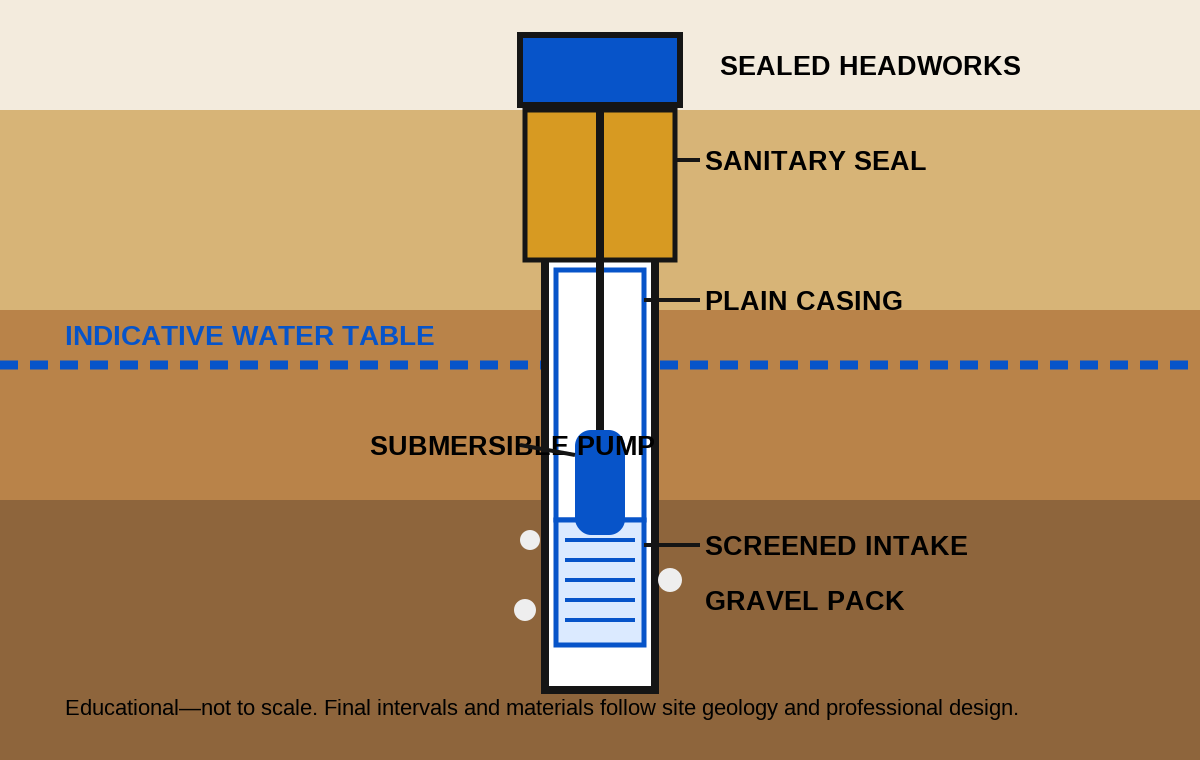
Drilling creates the hole, while permanent construction turns it into a functioning intake. A useful borehole drilling cost in Meru quotation states the proposed method, working diameter and depth basis, then separately identifies casing, screens, gravel pack, seals and headworks.
Review borehole casing in Kenya and borehole headworks in Kenya. Ask for the final installed quantities and construction record rather than accepting only a drilled-depth invoice.
The construction record also supports future maintenance. If the borehole is inspected or rehabilitated later, technicians need to understand the completed structure and not merely the original quotation.
Development, test pumping and water quality
Development prepares the intake for testing. Test pumping then measures source performance under stated conditions. Keep the discharge, static water level, pumping water level, drawdown and recovery data because they support operating decisions and create a maintenance baseline.
Use borehole test pumping Kenya to understand the evidence. A borehole drilling cost in Meru offer that omits testing may simply shift an important cost to later.
Water quality is a separate question. Representative laboratory testing should guide treatment for the intended use. Do not buy a treatment system from appearance or assumptions. Review borehole water testing and treatment in Kenya before final treatment procurement.

Pump, storage and farm-water planning
Final borehole drilling cost in Meru should connect the borehole to the actual users. The pump should be selected after testing, with the model, duty point, installation depth, cable, rising main, controls and protection clearly stated.
Where a project has domestic and farm demand, separate the demand categories before sizing storage. Irrigation, livestock and household use do not always peak at the same time. A storage strategy can allow the pump to operate within an appropriate source limit while the tank absorbs short-term demand variation.
Distribution also matters. Pipe route, elevation and outlet pressure affect friction and pump duty. If solar pumping is considered, compare the complete system and pumping window using solar vs electric borehole pump in Kenya.
Worked example: compare complete outcomes
Imagine three Meru offers. One includes drilling only. Another adds permanent construction and development. The third adds test pumping, pump equipment, controls, storage and commissioning. The first can look cheapest because it buys the least complete outcome.
The chart below uses illustrative data, not prices. It shows why borehole drilling cost in Meru should be evaluated after missing scope is identified.
| Illustrative scope | Relative completeness index |
|---|---|
| Drilling only | 42 |
| Drilling + construction | 72 |
| Complete water system | 100 |
Features of our borehole drilling cost in Meru planning service
| Feature | Benefit |
|---|---|
| Common project brief | All bidders price the same intended outcome |
| Demand separation | Domestic, farm and institutional uses can be planned clearly |
| Itemised stages | Missing scope is easy to identify |
| Variation controls | Changed quantities have a written approval basis |
| Test-led pump selection | Equipment follows measured source performance |
| Storage and distribution review | The system is planned beyond the wellhead |
| Handover checklist | Records support maintenance and future expansion |
Advantages of a structured borehole drilling cost in Meru process include:
- Comparable quotations because scope is normalised.
- Better demand planning because different water uses are separated.
- Fewer surprise exclusions because testing, equipping and distribution remain visible.
- Better pump decisions because test evidence comes first.
- Clear budget control because variations are documented.
- Stronger lifecycle records because the handover file remains useful.
borehole drilling cost in Meru pricing
Each project is site-specific, so this guide does not invent one local market figure. The table uses $— until a site quotation or verified site price is available. Use it to confirm the complete scope behind borehole drilling cost in Meru.
| Budget line | Indicative price | What to confirm |
|---|---|---|
| Assessment and planning | $— | Fieldwork, report and project support |
| Mobilisation | $— | Rig, compressor, access, support vehicles and standby |
| Drilling | $— | Method, diameter, depth basis and variation rules |
| Construction | $— | Casing, screens, gravel, seals and headworks |
| Development and testing | $— | Development, pumping test, sampling and reports |
| Pump and controls | $— | Duty, cable, rising main, protection and commissioning |
| Storage and distribution | $— | Capacity, route, elevation, pipe size and pressure |
| Treatment if required | $— | Only after representative water-quality evidence |
What can change borehole drilling cost in Meru
- Different final depth, drilling method or working diameter.
- Different casing, screen, gravel or sealing quantities.
- Additional site access work or mobilisation.
- Additional development or test work.
- A different pump duty after testing.
- A longer distribution route or different tank elevation.
- Changes in storage after demand is clarified.
- Water treatment justified by laboratory results.
- Additional solar, electrical, booster or civil work.
These possibilities are why borehole drilling cost in Meru should be managed using transparent assumptions and variation rules.
Questions to ask before approving a Meru quotation
- What is included in the assessment?
- What mobilisation assumptions are included?
- What drilling method and diameter are proposed?
- How are construction quantities measured?
- Is development included?
- What test-pumping evidence is delivered?
- When will the pump be selected?
- How are different water uses reflected in storage?
- How is distribution priced?
- What warranties and handover records are included?
Using the same questions for every bidder makes borehole drilling cost in Meru easier to compare.
Final commercial checks and handover
Before final payment, reconcile the completed work against the original schedule. Check actual drilling quantities, installed construction, testing, pump equipment, storage and distribution. If a provisional quantity changed, record the approved variation and final quantity.
Keep the assessment, applicable approvals, drilling log, construction record, development notes, pumping-test data, water-quality results, pump and controller details, storage and distribution information, warranties and maintenance guidance. Those records protect the value of borehole drilling cost in Meru over the system lifecycle.
If the property expands later, the handover file helps determine whether the source, pump, tank or distribution system needs modification. Use borehole maintenance in Kenya to turn commissioning values into a service baseline.
How to get started with borehole drilling cost in Meru
Send the site pin, intended use, demand estimate, access notes, power options, proposed storage and delivery points, and any existing reports. Keep unknown values as assumptions rather than inventing precision.
Then request itemised quotations using the same budget lines. Update the scope as assessment, drilling and testing evidence becomes available. This is the practical path from an early borehole drilling cost in Meru budget to a controlled final account.
borehole drilling cost in Meru FAQs
What is included in borehole drilling cost in Meru?
A complete budget can include assessment, mobilisation, drilling, construction, development, test pumping, water testing, pump equipment, power, storage, distribution, treatment where justified and handover.
Is a per-metre rate the complete cost?
No. The rate may exclude assessment, mobilisation, construction, testing, pump equipment, storage and distribution.
Can I know the final price before drilling?
You can build an early budget with transparent assumptions. Final quantities and equipment can depend on field evidence, so variations should be defined in the contract.
Should farm and domestic demand be separated?
Yes. Different uses can peak at different times and can require different storage or distribution strategies.
When should the pump be selected?
Final selection should follow test-pumping evidence and the complete delivery duty.
Does distribution affect pump duty?
Yes. Elevation, pipe size, route length, friction and required outlet pressure contribute to total system head.
What records should I keep?
Keep assessment, drilling, construction, testing, water-quality, equipment, storage, distribution, warranty and maintenance records.
Make borehole drilling cost in Meru a complete-project decision
borehole drilling cost in Meru becomes clearer when demand, source, pump, storage and distribution are planned together. Define the requirement, assess the site, compare equivalent quotations, retain development and testing, select equipment from measured duty and finish with a documented handover.
The result is a budget that becomes more accurate as evidence improves and a system that is easier to operate, maintain and expand.
Detailed procurement checks for borehole drilling cost in Meru
Before approving the contract, turn borehole drilling cost in Meru into a schedule that can be measured. A useful schedule states the unit for drilled depth, the basis for permanent casing and screen, the scope of gravel packing and sealing, the development and test-pumping deliverables, and the exact equipment included in the pump, storage and distribution stages. This makes the final account easier to audit because each change can be traced back to an agreed item rather than an undefined “complete borehole” line.
Payment milestones should also be connected to clear deliverables. The commercial terms can vary by project, but the owner should know what evidence marks completion of mobilisation, drilling progress, permanent construction, test pumping, equipment installation and commissioning. This approach makes borehole drilling cost in Meru easier to control and gives both parties a shared record of what has been achieved before the next milestone is paid.
For a farm or mixed-use property, document the demand assumptions used to size storage and distribution. If irrigation is expected to run only during particular hours, state that operating pattern. If domestic or livestock demand continues throughout the day, record that separately. These details matter because a tank and pumping schedule can be designed around how water is actually used rather than around one undifferentiated daily total. A well-documented borehole drilling cost in Meru budget therefore connects procurement to operation.
Keep the same discipline when buying the pump or any treatment equipment. Early budgets can include provisional allowances, but final equipment should follow measured test results and the required delivery duty. This avoids paying for a pump that does not match the source or for treatment that does not address the measured water quality. The principle is simple: use early estimates for budgeting and measured evidence for final selection.
At completion, reconcile the original assumptions with the final quantities and keep that reconciliation with the handover file. If the property expands, a new irrigation block is added, the pump is replaced or the storage system changes, the original borehole drilling cost in Meru record provides a useful baseline for deciding which part of the system needs review rather than starting again from guesswork.