
borehole drilling cost in Narok should be planned as the cost of a complete water system, not a single drilling rate. This guide helps you define the project, compare equivalent quotations, control changes, and budget the route from assessment and drilling to testing, equipping, storage, distribution, and handover.

Why borehole drilling cost in Narok matters
A search for Narok borehole cost planning is usually a buying-stage question. You want to know what to reserve, which work belongs in the contractor scope, and whether two quotations are genuinely comparable. The first step is to split the project into measurable stages and make every exclusion visible.
The site location, intended users, access, working area, available reports, final construction, test results, pump duty, power choice, storage target, and delivery points all influence the project scope. For that reason, do not treat a county figure as a final quotation. Give every bidder the same brief and ask them to identify assumptions.
Start with what you need before drilling a borehole in Kenya. It gives you the project information needed before a Narok borehole cost planning comparison becomes useful.
Planning tip: a quotation is easier to evaluate when drilling, construction, testing, equipping, storage, and distribution are separate lines.
borehole drilling cost in Narok: step-by-step budget method
A structured Narok borehole cost planning budget begins with the water requirement and ends with a documented handover. Keep pre-drilling work, mobilisation, drilling, permanent construction, development, test pumping, water testing, pump equipment, controls, power, storage, distribution, and any evidence-led treatment visible.
- Define intended use. Separate household, livestock, irrigation, institutional, commercial, and other demands where they apply.
- Define the site. Share the location, access notes, working-space limits, security requirements, and existing records.
- Define pre-drilling deliverables. Clarify assessment, report, planning, and applicable application-support scope.
- Define mobilisation. State what equipment movement, temporary access, crew support, and site preparation are included.
- Separate drilling from construction. Require method, diameter, casing, screen, gravel pack, seals, and headworks to be identifiable.
- Keep development and testing visible. These stages create the operating evidence needed before final pump selection.
- Price the delivery system. Include pump, controls, power, rising main, storage, and distribution.
- Define handover. List records, settings, warranties, commissioning information, and maintenance guidance.
The first formula for Narok borehole cost planning is a scope equation:
In plain English, total project cost is the sum of the agreed stages. The equation is a completeness check, not a promise of what any stage will cost.
How to compare borehole drilling cost in Narok quotes
Rebuild each Narok borehole cost planning quotation into the same headings. Mark every line as included, excluded, provisional, or owner-supplied. Then ask how changes in depth, method, construction quantities, testing, pump duty, storage, or distribution will be approved.
After the technical scopes are aligned, use how to compare borehole drilling companies in Kenya to review contractor capability and the commercial offer. This sequence reduces the risk of choosing a low total that simply buys less.
Choosing the right approach to borehole drilling cost in Narok
Different decisions require different levels of evidence. Early budgeting can use clearly labelled assumptions. Construction decisions should use field records. Pump selection should follow test pumping and the required delivery duty. Storage and distribution should follow the actual use pattern. This staged process keeps Narok borehole cost planning realistic without inventing precision.
| Decision point | Best information | What to avoid |
|---|---|---|
| Feasibility | Site brief, intended use, access, existing records | Using a generic figure as a final site price |
| Pre-drilling | Assessment, proposed method, assumptions | Ordering final equipment too early |
| Construction | Logged progress and installed details | Unrecorded scope changes |
| Equipping | Test results, delivery point, power and storage | Selecting from depth alone |
| Handover | As-built records, settings and baseline readings | Operating without documented starting conditions |
The second formula supports pump-duty planning after testing:
In plain English, the pump must overcome lift, elevation, friction losses, and the pressure required at the destination. Use borehole pump sizing in Kenya before converting borehole depth into a pump choice.
Narok demand planning before the quote
For Narok borehole cost planning, the finished use of the water should be defined before the system is priced. A domestic compound, livestock project, farm, school, lodge, rental property, or commercial facility may have a different daily pattern and reserve requirement.
Where one project has several uses, separate them. Do not combine domestic use, livestock, irrigation, cleaning, and commercial demand into one unexplained number. The designer needs to know which uses can occur at the same time and which can be supplied from stored water.
Storage is part of this planning decision. A larger reserve objective changes the above-ground scope even when the borehole itself is unchanged. Likewise, multiple delivery points can change the distribution design. Defining these needs makes Narok borehole cost planning more useful as a whole-project budget.
Survey, access, and mobilisation
Pre-drilling work should remain visible in Narok borehole cost planning. The assessment provides a project basis before the rig arrives, while the quotation should state exactly which field and reporting deliverables are included. See hydrogeological survey cost in Kenya for the purpose of that stage.
Access also deserves written assumptions. Clarify the route for the rig and support vehicles, working space, temporary access needs, gates, clearing, security, temporary water, spoil management, and reinstatement where applicable. If a bidder has assumed easy access, that assumption should be visible before mobilisation.
A good Narok borehole cost planning quote states what mobilisation includes and what would trigger a change. This makes later discussions evidence-led rather than improvised.
Drilling and permanent construction
The drilling line is only one part of Narok borehole cost planning. Ask for the proposed method, working diameter, depth-measurement basis, and variation process. Permanent construction should identify casing, screen, gravel pack, seals, and headworks.
Use borehole casing in Kenya when reviewing casing and screen decisions, and borehole headworks in Kenya for the finished wellhead. The objective is an auditable as-built record, not only a final drilled depth.
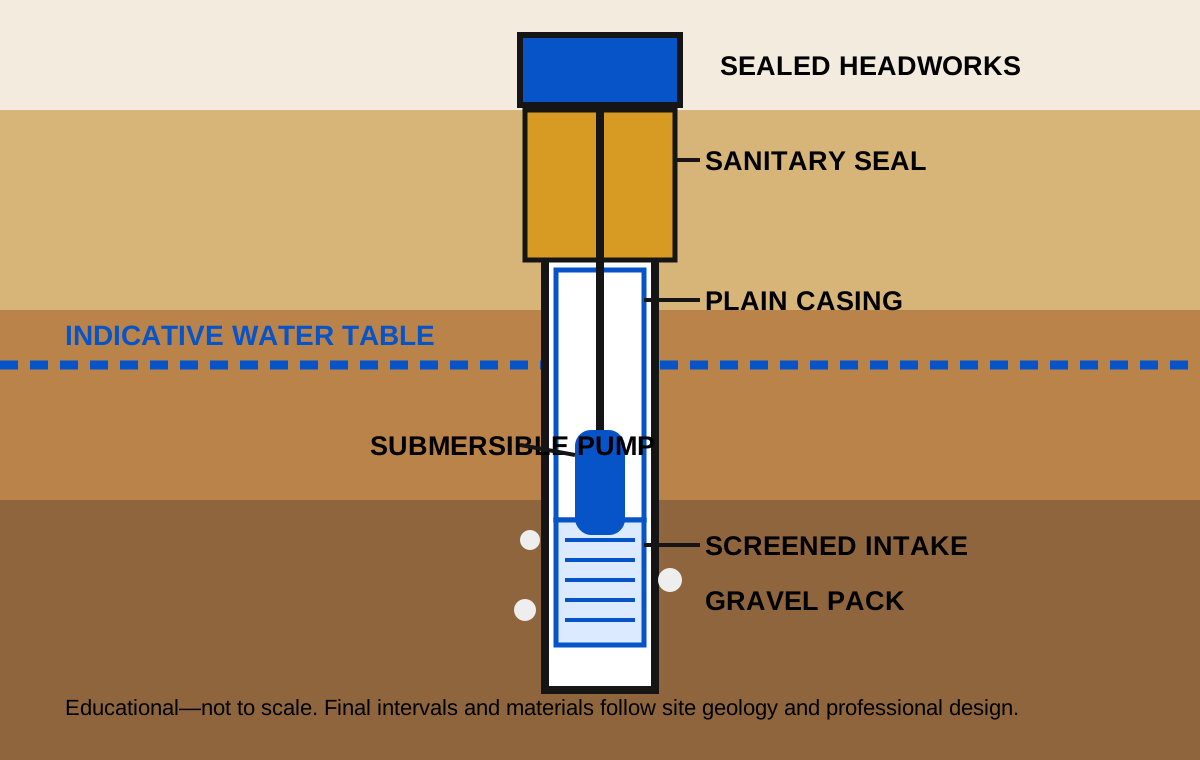
Ask which construction quantities are provisional and how the installed quantities will be recorded. This is one of the most important controls inside Narok borehole cost planning.
Development, test pumping, and water testing
Development and test pumping should be separate, visible stages in Narok borehole cost planning. Development prepares the completed borehole for testing. Test pumping then records discharge and water-level response under stated conditions, creating evidence for final operating decisions.
Read borehole test pumping Kenya to understand the information you should retain. Do not lock the final pump decision to an early assumption when measured performance can be used instead.
Water-quality testing is a different question from yield. Representative results should guide treatment for the intended use. See borehole water testing and treatment in Kenya. Treatment should be added to Narok borehole cost planning when evidence justifies it, not because another project used the same equipment.

Pump, power, storage, and distribution
The complete Narok borehole cost planning includes the system that moves water from the source to the users. Ask for pump model, duty point, setting depth, rising main, cable, controls, and protection. Then connect those choices to storage and distribution.
Power should be evaluated as part of the operating plan. If solar pumping is considered, compare the complete system and the intended pumping schedule. Use solar vs electric borehole pump in Kenya for a structured comparison.
Keeping pump, power, storage, and distribution separate from drilling makes Narok borehole cost planning easier to update when test data becomes available.
Worked example for borehole drilling cost in Narok
Suppose three contractors quote the same site. The first includes planning support, mobilisation, and drilling. The second also includes permanent construction and development. The third includes testing, equipping, storage, distribution, and handover. Comparing only the totals would hide the difference in outcome.
The chart below uses illustrative data to show scope completeness for Narok borehole cost planning. It is not a price forecast.
| Illustrative offer | Scope-completeness index |
|---|---|
| Drilling-focused | 44 |
| Drilling + construction | 73 |
| Complete system | 100 |
The exercise makes Narok borehole cost planning a comparison of equivalent deliverables rather than unmatched headline totals.
Features of our borehole drilling cost in Narok service
| Feature | What it provides |
|---|---|
| Common project brief | A consistent basis for every quotation |
| Site-specific assumptions | Scope tied to the actual property and intended use |
| Itemised project stages | Clear planning, drilling, testing, and equipping lines |
| Variation process | A method for approving changed quantities or work |
| Test-led pump decision | Equipment selected from measured evidence |
| Storage and distribution review | Planning for water at the point of use |
| Handover checklist | A documented baseline for future operation |
Advantages of a structured Narok borehole cost planning process include:
- Comparable quotations built around the same scope.
- Visible exclusions before contract award.
- Better equipment timing after source testing.
- Controlled variations when assumptions change.
- Whole-system budgeting that includes storage and delivery.
- Useful handover records for future troubleshooting and maintenance.
borehole drilling cost in Narok pricing
This Narok borehole cost planning guide does not invent a county price. Until a verified site price or site-specific quotation exists, the indicative amounts remain $—. Use the table to compare scope.
| Budget line | Indicative price | Confirm before approval |
|---|---|---|
| Assessment and planning | $— | Fieldwork, reporting, deliverables |
| Mobilisation | $— | Equipment, crew, access, standby assumptions |
| Drilling | $— | Method, diameter, measurement, variation basis |
| Construction | $— | Casing, screen, gravel pack, seals, headworks |
| Development and testing | $— | Development, pumping test, report, sampling |
| Equipping | $— | Pump, controls, cable, rising main, commissioning |
| Storage and distribution | $— | Tank, pipe route, pressure and delivery points |
| Treatment if justified | $— | Water-quality evidence and intended use |
What can change borehole drilling cost in Narok
A Narok borehole cost planning budget can change when actual field information replaces an initial assumption. The solution is not to pretend change cannot happen; it is to define how a change is measured, approved, and documented.
- Access or mobilisation different from the agreed brief.
- A justified change in drilling method or working diameter.
- Installed construction quantities different from provisional quantities.
- Additional development or testing required for reliable evidence.
- A revised pump duty, power plan, storage requirement, or distribution route.
- Treatment required by representative water-quality results.
- Additional civil, electrical, security, protection, or reinstatement work.
Managing those changes in writing protects the usefulness of Narok borehole cost planning as a project-control tool.
Questions to ask before accepting a Narok quotation
- What is included before drilling begins?
- Which mobilisation and access assumptions are included?
- What method and diameter are proposed?
- How will a change in depth, method, or quantity be approved?
- Are casing, screen, gravel pack, seals, and headworks identifiable?
- What development and test-pumping records will be supplied?
- When will the final pump decision be made?
- What power, storage, controls, and distribution work is included?
- Which site works remain the owner’s responsibility?
- What commissioning information and warranties are supplied?
Lifecycle planning after the initial Narok project
A well-managed Narok borehole cost planning project leaves the owner with more than a working pump. It leaves records that make future service decisions easier. Keep the construction details, test information, water-quality results, pump identification, setting depth, control settings, storage details, and distribution layout together.
Define who will observe the system, who keeps the records, and which changes should trigger a technical review. A maintenance visit is more useful when current pressure, flow, water quality, or control behaviour can be compared with the commissioning baseline.
Use borehole maintenance in Kenya for routine planning and borehole rehabilitation Kenya when source condition or performance needs a structured review.
Budget governance for borehole drilling cost in Narok
A strong Narok borehole cost planning plan also defines who can approve project changes and what evidence must support them. Before mobilisation, name the person who can approve a variation, require the proposed change to identify the original assumption that has changed, and record the effect on scope before work proceeds. This simple governance step helps the owner distinguish an evidence-led adjustment from an unexplained extra.
Keep one project file containing the accepted quotation, site assessment, agreed scope, progress records, delivery notes, approved variations, test results, equipment details, and commissioning information. When several family members, managers, or project representatives are involved, use one approval route so instructions remain consistent. Good records make Narok borehole cost planning easier to control because each commercial decision has a technical reason and a dated record.
At each milestone, compare work completed with the agreed deliverable. For drilling, review the recorded progress and permanent construction. For testing, confirm the report and baseline measurements. For equipping, confirm the selected duty and installed components. For storage and distribution, check that the delivery points in the brief are actually served. This keeps payment decisions linked to visible outcomes rather than assumptions.
Storage and operating reserve within borehole drilling cost in Narok
Storage deserves a separate decision inside Narok borehole cost planning because it affects how the source, pump, and users work together. Define why storage is required: balancing daily pumping, covering peak use, supporting livestock or institutional routines, or creating a practical operating reserve. Then size and position the storage system from the project demand and delivery arrangement rather than copying another property.
Also define how water moves from storage to the users. A gravity-fed layout, booster arrangement, or multiple delivery zones can create different pipe, control, and pressure requirements. The relevant question is not only tank capacity; it is whether the complete system can supply the intended users reliably within the adopted operating plan. Review borehole water tank size in Kenya when translating demand and operating reserve into a storage decision.
Document normal operating settings at commissioning, including the pump and control information supplied by the installer and the intended storage operating range. These records give future maintenance teams a baseline. In that way, Narok borehole cost planning becomes a maintainable asset plan rather than a one-time construction expense.
How to get started with borehole drilling cost in Narok
Prepare the location pin, intended use, approximate demand, access notes, available reports, preferred power source, storage objective, and known delivery points. Label missing information as an assumption rather than filling the gap with a generic figure.
Issue the same brief to each bidder and ask them to separate the stages in this guide. Update the budget as assessment, drilling, and testing evidence becomes available. This keeps Narok borehole cost planning linked to the real project.
borehole drilling cost in Narok FAQs
What is included in borehole drilling cost in Narok?
A complete budget can include assessment, mobilisation, drilling, construction, development, test pumping, water testing, equipping, power, storage, distribution, justified treatment, commissioning, and handover.
Is a drilling rate the full borehole drilling cost in Narok?
No. A drilling rate can exclude other major project stages. Compare equivalent scope before comparing totals.
Can the final price be known before drilling?
You can create a useful budget using stated assumptions, while final quantities and equipment can depend on field evidence.
When should the pump be selected?
Final pump selection should follow test-pumping evidence and the delivery duty. See borehole pump sizing in Kenya.
Should water treatment be added automatically?
No. Treatment should follow representative water-quality results and the intended use.
How can I compare Narok quotations fairly?
Place each offer under the same headings, identify exclusions and provisional items, and compare the evaluated complete scope.
What records should I keep?
Keep assessment, drilling, construction, test, water-quality, equipment, commissioning, warranty, and maintenance information.
Make borehole drilling cost in Narok a scope decision
borehole drilling cost in Narok becomes easier to manage when every stage has a defined outcome. Start with the requirement, use site-specific evidence, compare equivalent scopes, keep testing visible, choose equipment from measured duty, and finish with a documented baseline.
The result is a budget that can be updated responsibly as evidence improves, instead of a generic number that hides uncertainty.