
school borehole Kenya planning should start with how the school actually uses water, not with a pump size or a generic daily allowance. This guide shows school owners, administrators and project teams how to turn enrollment, boarding, kitchens, sanitation, cleaning and peak demand into a complete borehole, storage, pumping, treatment and distribution brief.

Why school borehole Kenya planning matters
A school borehole Kenya project supports more than taps. Water may be needed for drinking, kitchens, toilets, handwashing, cleaning, boarding facilities, laundry, staff housing, landscaping and sometimes community use. Demand also changes sharply through the day. Breaks, meals, bathing periods and cleaning can create short peaks even when the average daily volume appears manageable.
That is why the borehole pump should not be expected to chase every short demand peak directly. A better plan separates source production from school consumption by using storage, appropriate controls and a distribution network designed for the buildings and elevations on the site.
The source itself should be operated from measured evidence. See borehole test pumping Kenya before selecting the final pump. Tested yield and pumping water level provide a stronger basis than drilled depth or enrollment alone.
School planning tip: treat sanitation, kitchen and boarding water as critical services and size reserve storage around the consequence of interruption.
school borehole Kenya: step-by-step method
A complete school borehole Kenya design follows a sequence that connects the school’s operating pattern to the water source and distribution system.
- Map water uses. List pupils, staff, boarders, kitchens, sanitation, cleaning, laundry, gardens and any other users.
- Build a daily demand schedule. Record when the major uses occur rather than relying on one daily total only.
- Define critical uses. Identify the functions that must continue during power loss, pump service or a short supply interruption.
- Review tested source performance. Use pumping-test evidence to set the borehole operating basis.
- Size storage. Provide reserve and peak-demand buffering without forcing the borehole pump to cycle unnecessarily.
- Map buildings and elevations. Include classrooms, dormitories, kitchens, administration, toilets and future blocks.
- Confirm water quality. Test representative water and select treatment for the actual school use.
- Commission with the school team. Verify tank recovery, pressure, controls, water quality and operating responsibility.
A first planning formula for school borehole Kenya converts school daily demand into an average pumping duty:
In plain English, required average pumping flow equals the school’s daily volume divided by the realistic pumping time. Storage then handles short periods when school demand is higher than the steady pumping rate.
How to evaluate school borehole Kenya without guessing
For school borehole Kenya, separate three questions: how much the borehole can produce, how much water the school must hold in reserve, and how quickly the distribution network must deliver water at peak times. These are related, but they are not the same design problem.
Collect existing drilling records, pumping-test results, water-quality reports, pump details, tank capacities and building plans where available. If the school already uses a borehole, record when shortages or pressure complaints occur. A pattern tied to specific times or buildings can reveal a storage or distribution problem even when daily source production is adequate.
Choosing the right approach to school borehole Kenya
The right school borehole Kenya arrangement depends on enrollment, boarding status, building layout, operating hours, reserve expectations and available power. A compact day school and a multi-block boarding school should not receive the same water-system template.
| Design decision | Evidence to use | Avoid this mistake |
|---|---|---|
| Borehole operating rate | Pumping-test results | Using drilled depth as a yield figure |
| Pump duty | Required flow and total head | Choosing horsepower before calculating the duty |
| Storage | Demand schedule and reserve objective | Sizing only for average hourly use |
| Pressure zones | Building heights and pipe routes | Treating every block as one identical zone |
| Treatment | Representative water testing | Installing equipment before defining the water-quality problem |
A second formula helps school borehole Kenya pump and booster planning:
In plain English, the pump must overcome lift, elevation, pipe friction and the pressure required at the final outlet. Read borehole pump sizing in Kenya before choosing equipment.
Build the school water-demand schedule first
A useful school borehole Kenya brief describes when water is needed, not only how much is needed in a day. Morning preparation, break times, meals, bathing, cleaning and laundry can overlap. The demand schedule helps determine whether a shortage comes from inadequate daily production, insufficient storage or a distribution bottleneck.
Separate potable uses from other uses so water-quality requirements are clear. If the school serves drinking water from the borehole, representative testing and suitable treatment decisions are essential. If some uses are non-potable, document the pipework and management arrangement so systems are not confused later.
Include planned growth. New classrooms, dormitories, kitchens or staff housing can alter the school borehole Kenya duty. A future-use note in the original brief is easier to manage than discovering later that the tank or distribution line was sized with no expansion allowance.
Storage protects critical school functions
Storage is one of the most important parts of school borehole Kenya design because it protects sanitation and kitchen functions when demand peaks or the pump is temporarily unavailable. The tank should be sized from demand, pumping hours and the acceptable interruption period rather than from a catalogue size alone.
Use borehole water tank size in Kenya to frame the reserve decision. The tank arrangement should also include safe access for cleaning, overflow, isolation, level control and the delivery method to school buildings.
If both ground and elevated storage are used, document how transfer pumps, gravity supply and booster systems interact. The school borehole Kenya handover should make it clear which tank controls the borehole pump and which controls the building supply.
Distribution and pressure across school buildings
A school borehole Kenya system can have enough water in storage but still deliver poorly if the pipe network is undersized or the site has significant elevation differences. Long runs to dormitories, kitchens or field facilities can create pressure losses that are invisible when only the pump room is tested.
Map building elevations, major branch lengths, pipe sizes and expected simultaneous use. Test representative distant and high points during commissioning. If one pressure zone cannot serve the whole site reliably, consider a zoned arrangement rather than increasing pressure everywhere.
Low pressure should be diagnosed systematically. See low borehole water pressure in Kenya for a troubleshooting framework that separates source, pump, storage and distribution issues.
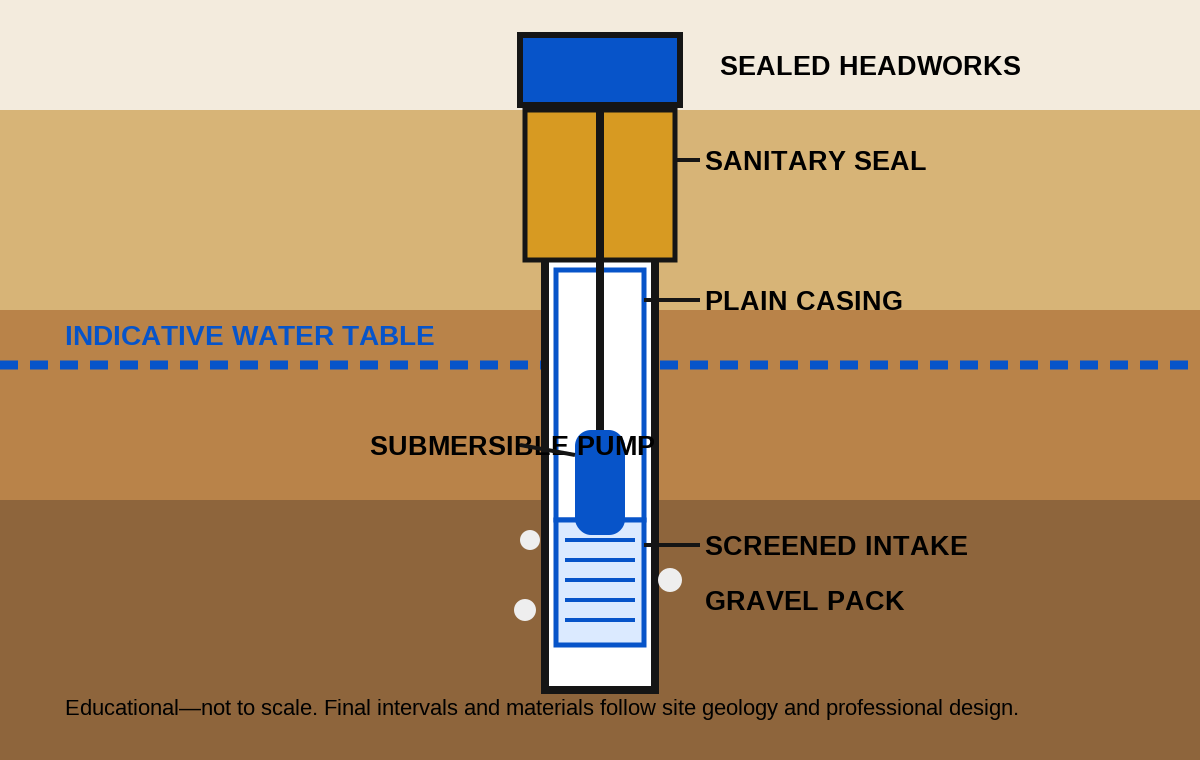
Water quality and treatment for a school borehole
Water quality is a core part of school borehole Kenya planning. Clear water should not be assumed suitable simply because it looks acceptable. Use representative testing for the intended uses and select treatment only after the problem is defined.
For a school, distinguish raw-borehole sampling from treated-water or point-of-use sampling. If water is stored or treated before reaching pupils, the sampling plan should reflect that path. Keep results with the school’s asset records and define who is responsible for follow-up testing and treatment maintenance.
See borehole water testing and treatment in Kenya for the site’s broader decision guide. The school borehole Kenya treatment brief should also include design flow, maintenance requirements, consumables and how performance will be verified after service.
Controls, monitoring and school operating responsibility
Controls make school borehole Kenya easier to operate safely. Tank-level automation, pump protection and clear isolation points reduce reliance on manual switching. However, every control should be documented so school staff know what a normal status looks like and when to call a technician.
Assign responsibility. A school water system often passes through several hands: management, caretaker, plumber, electrical technician and borehole contractor. One named person should keep the operating file, report faults and ensure maintenance is recorded.
Do not bypass protection devices to keep water flowing during a fault. Repeated trips are diagnostic information. See borehole dry run protection for why the cause should be investigated instead of simply changing settings.
Common school borehole Kenya mistakes
Most expensive school borehole Kenya mistakes occur when a component is selected without the full operating brief.
- Using enrollment alone. Kitchens, staff, boarding, cleaning and future expansion also affect demand.
- Ignoring peak periods. Average daily volume does not describe break-time or bathing demand.
- Too little reserve. A small service interruption can immediately affect sanitation and meals.
- One pressure zone for every building. Elevation and long pipe runs can make delivery uneven.
- Treatment before testing. Equipment should solve a defined water-quality problem.
- No operating owner. Systems deteriorate when nobody owns the records and maintenance schedule.
Worked example for school borehole Kenya
Consider three illustrative approaches. The first installs a borehole and pump only. The second adds storage. The third connects tested source performance, reserve storage, building distribution, water-quality testing, controls and commissioning. The chart is illustrative data only, not a performance claim.
| Illustrative scope | Planning-completeness index |
|---|---|
| Borehole + pump | 38 |
| Pump + storage | 69 |
| Complete school system | 100 |
The school borehole Kenya lesson is that source production, reserve and delivery must be planned together if the school expects reliable water at the point of use.
Features of our school borehole Kenya service
| Feature | What it gives the school |
|---|---|
| Demand schedule | A water brief linked to school operations and peak periods |
| Test-led source design | Pump duty connected to measured borehole performance |
| Reserve-storage planning | Protection for critical functions during interruptions |
| Distribution review | Buildings, elevations and long pipe runs considered |
| Water-quality plan | Testing and treatment linked to intended use |
| Control and monitoring plan | Clear automation, protection and service indicators |
| Handover file | Records for school management and future technicians |
Advantages of a structured school borehole Kenya project include:
- Better resilience through demand-led reserve storage.
- Fewer pressure surprises because building elevation is included in design.
- Evidence-based equipment because pump selection follows testing.
- Clearer maintenance because controls and records are handed over.
- Safer expansion planning because the original capacity and assumptions are documented.
school borehole Kenya pricing
A responsible school borehole Kenya budget depends on the site, source evidence, enrollment and boarding profile, tank strategy, building layout, treatment and controls. Until those are verified, the indicative table uses $— rather than inventing a project price.
| Budget line | Indicative price | Confirm before approval |
|---|---|---|
| Assessment and school water brief | $— | Demand schedule, buildings, access and records |
| Drilling / source work | $— | Method, construction, testing and documentation |
| Pump and controls | $— | Duty point, protection, automation and commissioning |
| Storage | $— | Reserve, tank arrangement, controls and fittings |
| School distribution | $— | Pipe routes, pressure zones, isolation and future blocks |
| Water testing / treatment | $— | Representative testing and justified treatment |
| Handover and training | $— | Records, settings, operating responsibility and maintenance plan |
How to compare school borehole quotations
For school borehole Kenya, compare offers using the same project brief. One quotation may stop at drilling while another includes pump installation, storage, distribution, treatment and commissioning. Their totals should not be compared as if they purchase the same outcome.
Ask what is included, excluded and provisional. Define how depth, installed quantities and variations are recorded. Require the pumping-test and water-quality stages to remain visible rather than hidden inside an undefined “complete borehole” line.
Use how to compare borehole drilling companies in Kenya to structure contractor selection and handover expectations.
Maintenance and records after commissioning
Once the school borehole Kenya system is working, keep the drilling record, test data, water-quality reports, pump model, installation depth, controller settings, tank information, building distribution map and service history together.
Record normal tank refill, pressure at representative buildings and any protection trips. These baseline observations help future technicians distinguish source decline from pump, storage or pipework problems.
Use borehole maintenance in Kenya to build a regular service checklist. A school should also maintain clear access to equipment without creating conflicts with pupil movement or security.

How to get started with school borehole Kenya
Prepare enrollment and boarding information, the campus map, major water uses, existing supply problems, storage details, power availability and any previous borehole records. Mark planned buildings so the brief reflects realistic growth.
Then request an itemized school borehole Kenya proposal that separates source work, pumping, storage, distribution, testing, treatment and commissioning. Unknowns should be labelled as assumptions or provisional items rather than hidden in one total.
school borehole Kenya FAQs
How do you size a school borehole Kenya project?
Start with the school demand schedule, then match storage and pump duty to tested borehole performance and the building distribution system.
Does a school borehole need a storage tank?
Storage is normally important because school demand peaks at predictable times and reserve water protects critical sanitation and kitchen functions during service or power interruptions.
Should drinking water from a school borehole be treated?
Treatment should follow representative water-quality testing and the intended use. Do not select a treatment package before the water problem is defined.
Can one pump supply classrooms, dormitories and kitchens?
Possibly, but the design must account for total flow, elevation, pressure, pipe friction, peak demand and storage strategy.
What records should a school keep?
Keep drilling and construction records, pumping-test results, water-quality reports, pump details, control settings, tank information and maintenance history.
Who should operate the school water system?
The school should assign clear responsibility for routine monitoring, reporting faults, coordinating service and keeping the project records.
Make school borehole Kenya a complete water-system decision
school borehole Kenya becomes more reliable when demand, source capacity, storage, distribution, water quality and operating responsibility are designed together. Build the demand schedule first, use measured borehole evidence, protect critical functions with reserve, test the actual campus distribution and keep a commissioning baseline.
The objective is dependable water at the places the school needs it, supported by records that make maintenance and future expansion easier.
Campus resilience, backup planning and expansion
A reliable campus water system should continue to make sense when enrollment changes, a new block opens or a temporary equipment fault occurs. Keep the original demand schedule and commissioning readings so future expansion begins from documented capacity instead of assumptions. Before adding a dormitory, kitchen, laboratory or staff housing block, review the additional daily volume, the new peak period, the route from storage and the pressure available at the proposed connection. A small extension can create a large operational problem when it is added to a branch that was already close to its practical delivery limit.
Backup planning should focus on the functions that cannot wait. Identify the minimum water service needed to keep sanitation and food preparation operating through a short pump service or power interruption. Then check whether existing reserve storage, alternative supply and isolation valves support that objective. The answer is not always a larger tank. Better isolation, clearer operating responsibility, planned service timing and a practical temporary-supply connection can also improve resilience.
Label major valves, tanks, control panels and distribution zones where practical. Keep access routes clear for technicians and avoid locating service tasks where they conflict with normal pupil movement. If the system uses solar pumping, document the expected pumping window and how storage covers demand outside that period. If it uses grid power, document the response to an outage and how the pump is restarted after power returns.
Handover, training and annual review
Handover should include more than a demonstration that water reaches a tap. Give the school a concise operating file containing the drilling and construction records, pumping-test results, water-quality reports, pump and controller information, tank capacities, normal operating settings, distribution notes, warranty information and service contacts. Record representative tank-fill and pressure observations so later complaints can be compared with a known starting point.
Train the responsible staff member to recognize normal controller indications, tank levels, obvious leaks, unusual pump run patterns and the correct route for reporting a fault. Training should not encourage staff to open electrical enclosures or change protection settings. The goal is early observation and good communication with competent service personnel.
Review the water system whenever enrollment, boarding capacity, buildings or major operating routines change. Even when no expansion occurs, compare current performance with the baseline during planned maintenance. Updating a short campus water map and asset record after each material change makes future troubleshooting faster and reduces the chance that a contractor works from outdated information.
Review the system after major campus changes
After a new building is connected, verify the water system under a normal busy period rather than checking only one nearby tap. Compare tank recovery, pump run behavior and pressure at representative distant or elevated outlets with the original baseline. If performance changes, investigate whether the new demand altered storage recovery, booster duty or distribution losses before replacing major equipment.
Keep the updated campus map with the service record. Mark new branches, valves, tanks, treatment equipment and control changes, and record the date of the modification. This simple documentation helps management explain the system to a future technician and prevents later work from being based on an outdated drawing. It also gives the school a clearer basis for budgeting the next expansion instead of treating every new block as an isolated plumbing job.