
borehole commissioning checklist Kenya planning turns a newly drilled and equipped borehole into a water system you can operate, verify and maintain with confidence. This guide shows owners, schools, farms, apartments, institutions and businesses what to test, document, accept and hand over before the contractor leaves site.

Why borehole commissioning checklist Kenya matters
A borehole commissioning checklist Kenya is more than a final switch-on. It is the structured point where the project team checks that the source, pump, rising main, controls, storage, pressure system, treatment and distribution arrangement operate as the agreed water system. It also creates the baseline records that future technicians will need.
Without a defined close-out process, an owner can receive a system that runs today but has no clear pump settings, no performance baseline, no test records and no agreed route for resolving outstanding items. That makes later maintenance slower and can blur the difference between an installation fault, a source-performance issue and a change in user demand.
Use borehole test pumping Kenya to understand the source-performance evidence that should feed final pump selection. Then use borehole maintenance in Kenya to preserve the commissioning baseline after handover.
Project tip: treat commissioning as a measured acceptance stage, not as the moment water first reaches the tank.
borehole commissioning checklist Kenya: step-by-step method
A practical borehole commissioning checklist Kenya should move from documents to source performance, then to equipment, controls, storage and final delivery. That sequence helps the team separate what belongs to the borehole itself from what belongs to the pump or downstream system.
- Confirm the project record. Collect drilling, construction, development and test-pumping information that exists for the completed source.
- Verify the installed equipment. Record the pump model, motor rating, cable, rising main, valves, controller, sensors and installation depth where documented.
- Check source and pump operation together. Observe flow, water-level response, controller behavior and tank filling under the agreed operating condition.
- Check protection and automation. Confirm dry-run protection, overload protection, level controls and automatic start/stop behavior without bypassing safety devices.
- Check storage and pressure. Verify that tanks, float controls, booster equipment and pressure arrangements respond as intended.
- Review water-quality evidence. Confirm the sampling record and whether any treatment equipment was commissioned against the current laboratory result.
- Verify distribution points. Confirm the agreed delivery points receive water under the intended operating arrangement.
- Close defects and document settings. Record corrective items, final settings and post-correction verification.
- Complete handover. Transfer reports, equipment information, warranties, maintenance guidance and responsible contacts.
One useful borehole commissioning checklist Kenya relationship connects pump flow with the time needed to fill a known storage volume:
In plain English, average flow Q equals the measured volume V divided by the filling time t. Use the same measurement approach when creating a baseline for future comparison.
How to review borehole commissioning checklist Kenya before acceptance
Read the borehole commissioning checklist Kenya beside the contract, quotation and final installed scope. Each acceptance item should have a clear observation, measurement or document rather than a vague “done” status. If the project changed during drilling or equipping, the final checklist should reflect the actual installation rather than the original assumption.
Where the owner is not technically responsible for specialist electrical or borehole work, commissioning should be observed and documented without encouraging unsafe intervention. Protection devices, live panels and downhole equipment should be handled only by qualified personnel.
Choosing the right borehole commissioning checklist Kenya evidence
The best borehole commissioning checklist Kenya evidence depends on the completed system. A basic domestic borehole and a multi-building commercial supply do not need identical forms, but both need traceable source, pump, control and handover records.
| Commissioning area | Useful evidence | What the owner should receive |
|---|---|---|
| Source | Drilling/construction record and test results | Final source record and available baseline data |
| Pump | Model, duty point, setting depth and operating observations | Equipment details and commissioning settings |
| Controls | Protection status, automatic operation and alarm review | Panel information and operating guidance |
| Storage | Fill behavior, level controls and overflow checks | Tank/control configuration |
| Pressure/distribution | Delivery behavior at agreed points | Pressure arrangement and operating notes |
| Water quality | Sampling report and treatment verification where applicable | Laboratory report and treatment record |
| Close-out | Defect list, corrective actions and verification | Signed completion/handover record |
A second formula supports pump-system review. The pump must overcome the complete delivery duty, not simply the drilled depth:
In plain English, total head combines lift, elevation, friction and required delivery pressure. See borehole pump sizing in Kenya for the project context behind final equipment selection.
Start with the drilling and construction record
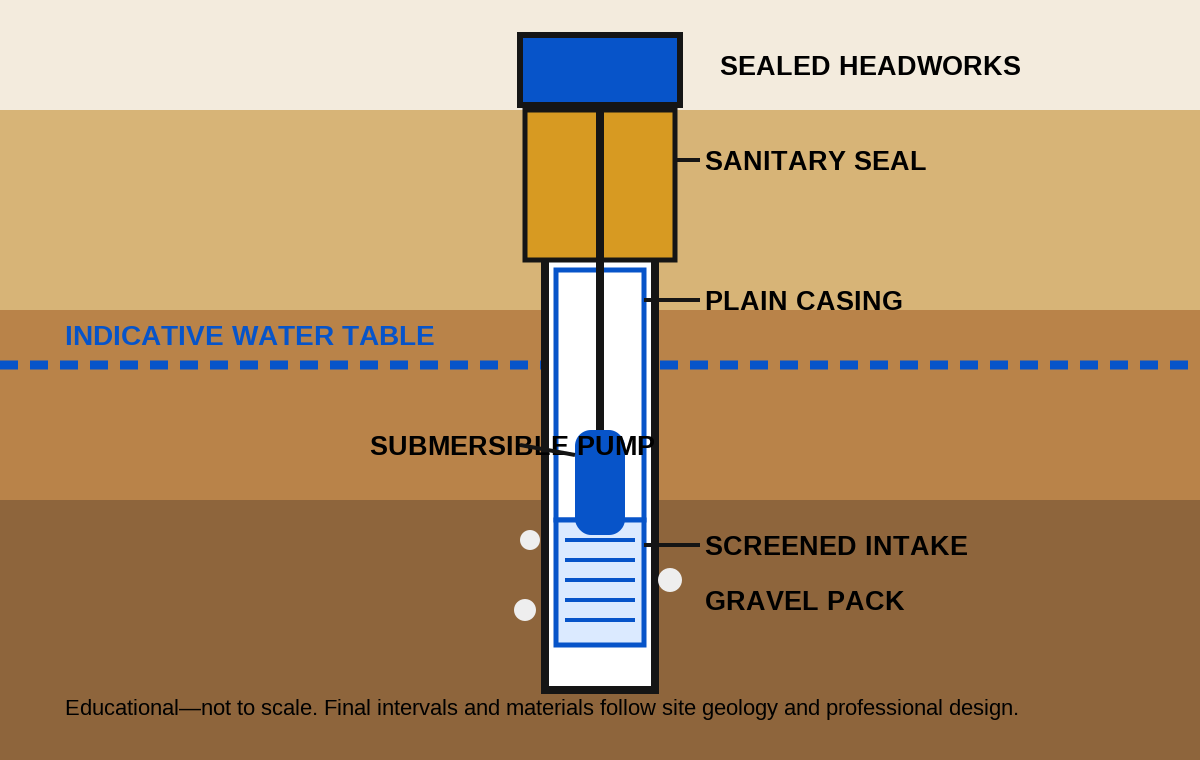
A borehole commissioning checklist Kenya should start before the pump is energized. Review the available drilling depth, formation log, casing and screen information, gravel-pack record, development notes, wellhead arrangement and test-pumping report. If a record is missing, list it explicitly rather than assuming it can be reconstructed later.
Permanent construction information matters because later technicians need to understand what is below ground. If casing, screen and gravel-pack decisions are relevant to the finished source, keep them with the project file. The borehole casing in Kenya and borehole headworks in Kenya guides explain why the completion record should stay with the owner.
Commission the pump against measured source performance
A borehole commissioning checklist Kenya should connect the installed pump to the source evidence. Record the pump model, installation depth, rising-main details, cable information and operating controls. Then compare delivered flow and operating behavior with the design basis and the available pumping-test results.
The goal is not to force the source to produce a target number during handover. The goal is to confirm that the installed equipment operates within the agreed design approach and does not rely on repeated protection trips or uncontrolled drawdown to deliver water.
Where a problem appears, separate the cause before changing settings. Low delivery can come from the source, pump, rising main, controls, storage arrangement or distribution restriction. A good borehole commissioning checklist Kenya records the condition that produces the issue so the correct component can be investigated.
Controls and protection belong in commissioning
Automatic control is part of the finished water system. The borehole commissioning checklist Kenya should record how tank-level signals, float switches, pressure switches, dry-run protection and overload protection are expected to behave. It should also record which devices are installed and where the user sees faults or alarms.
Do not normalize repeated resets during commissioning. A protection trip is information. Record the operating condition, identify the reason and verify the corrected system. The borehole dry run protection guide explains why protection should not be bypassed simply to keep water moving.
If the controller contains adjustable values that the owner needs for future support, record the final approved settings. This makes later fault diagnosis much easier than relying on memory.
Storage, pressure and distribution checks
A complete borehole commissioning checklist Kenya follows the water beyond the borehole. Confirm the tank filling behavior, float or level control, overflow route, isolation valves, booster equipment and pressure arrangement. If the project serves several buildings or irrigation zones, verify the agreed delivery points under the intended operating sequence.
Storage can hide a poorly coordinated system for a short time, so observe both filling and draw-off behavior. If tank filling is normal but building pressure is poor, the issue may sit downstream of the borehole. Use low borehole water pressure Kenya to separate source, storage and pressure-system symptoms.
If storage was sized for an operating plan, keep that basis in the project file. See borehole water tank size in Kenya for planning context.
Water quality and treatment verification
A borehole commissioning checklist Kenya should not assume that clear water is suitable for every intended use. Keep the relevant laboratory report with the handover file, record the sampling point and identify whether the result represents raw borehole water, treated water or another location.
If treatment equipment is installed, verify that the treatment train matches the water-quality problem it was selected to address. The commissioning record should list major equipment, flow direction, operating settings, consumables or maintenance requirements and the sampling points used for verification.
Use borehole water testing and treatment in Kenya before approving treatment changes. The borehole commissioning checklist Kenya should preserve the result used for the original treatment decision so future changes can be compared against it.

Defects, corrections and re-testing
A borehole commissioning checklist Kenya is useful only if outstanding items are visible. Create a short defect or completion list with the item, responsible party, target action and verification method. Do not close an item merely because work was attempted; close it when the relevant function or record has been checked again.
Examples include a leaking fitting, a float switch that does not stop the pump, an incorrect controller label, a missing pump model record, poor drainage around headworks or an absent laboratory report. Each needs a different close-out method.
When correction changes the operating condition, repeat the relevant measurement. This is especially important for flow, pressure, automatic control and protection settings because the post-correction result becomes the final commissioning baseline.
Worked example: commissioning completeness
Consider three illustrative handovers. The first only proves that water reaches a tank. The second adds pump and control checks. The third also includes source records, water quality, settings, defects and final documents. The chart below is illustrative data only; it is not a score for any real project.
| Illustrative handover | Completeness index |
|---|---|
| Water reaches tank | 35 |
| Pump + controls checked | 69 |
| Full records + verification | 100 |
The borehole commissioning checklist Kenya lesson is simple: first water is a milestone, but traceable records and verified operation make the system maintainable.
Features of our borehole commissioning checklist Kenya service
| Feature | What it adds to handover |
|---|---|
| Document review | Confirms the source and installation records available to the owner |
| Pump verification | Records model, setting, delivered flow and operating behavior |
| Control check | Confirms automatic operation and protection behavior |
| Storage/pressure check | Connects pumping to the actual delivery system |
| Water-quality review | Links testing and treatment records to the intended use |
| Defect close-out | Creates a visible route from issue to verified correction |
| Handover pack | Leaves the owner with equipment, settings and maintenance information |
Advantages of a structured borehole commissioning checklist Kenya include:
- Clear acceptance because each stage has evidence.
- Faster future diagnosis because baseline readings are retained.
- Better maintenance planning because equipment and settings are documented.
- Safer operation because controls and protection are checked rather than bypassed.
- Stronger handover because the project file stays with the property.
- Clearer accountability because defects and corrective actions remain visible.
borehole commissioning checklist Kenya pricing
borehole commissioning checklist Kenya pricing depends on project complexity, the records already available, the number of pumps or tanks, testing needs, travel, the amount of corrective work and whether specialist electrical or water-quality support is required. Where no verified site-specific amount exists, use $— until the scope is confirmed.
| Commissioning scope | Indicative price | Confirm in quotation |
|---|---|---|
| Document and source-record review | $— | Which reports and records are included |
| Pump and controls commissioning | $— | Measurements, settings and protection checks |
| Storage and pressure verification | $— | Tanks, boosters, switches and delivery points |
| Water-quality / treatment close-out | $— | Sampling, laboratory work and treatment verification |
| Full handover package | $— | Defect close-out, records and owner briefing |
What belongs in the final handover pack
The borehole commissioning checklist Kenya should end with a handover pack that a future technician can understand without calling the original project team. Keep the final drilling and construction record, available test-pumping results, water-quality reports, pump model and setting, rising-main and cable information, control-panel details, protection settings, storage and pressure arrangement, treatment information, warranties and service contacts.
Add the signed defect close-out and final baseline observations. If the project includes solar pumping, keep controller and array information with the pump records. If it includes a booster system, record the pressure arrangement and switching logic relevant to operation.
Where equipment manuals exist, keep them with the asset file rather than in an individual employee’s inbox. Good borehole commissioning checklist Kenya practice makes the water system understandable to the next owner, facility manager or service team.
Commissioning for homes, farms and institutions
Different sites use the same borehole commissioning checklist Kenya principles but emphasize different operating conditions. A home may need stable storage and pressure. A farm may need flow during an irrigation window and reliable tank control. A school may need predictable supply around occupied periods. An apartment may need peak-demand and pressure-zone checks.
Commission under conditions that resemble the intended use where practical. A system that looks acceptable during very light demand may reveal control or pressure issues when several delivery points operate together. Record the operating condition so later comparisons are meaningful.
If the source serves livestock or irrigation, keep demand and operating-hour assumptions with the file. If the site has critical institutional use, document the backup and storage arrangements included in the actual project scope.
Common borehole commissioning checklist Kenya mistakes
- Accepting the project as soon as water reaches storage.
- Failing to collect drilling, construction or test records before the team leaves.
- Not recording the installed pump model and setting depth.
- Resetting protection trips without identifying why they occur.
- Leaving float switches or automatic controls untested.
- Mixing raw-water and treated-water laboratory results.
- Closing defects without re-testing the affected function.
- Keeping controller settings only in one technician’s memory.
- Failing to give the owner a final maintenance baseline.
How to get started with borehole commissioning checklist Kenya
Before the commissioning visit, gather the quotation, contract scope, drilling record, test-pumping report, equipment list, water-quality result and any approved variation record. Mark missing documents in advance so the project team can recover them while the relevant people are still available.
On site, work through the borehole commissioning checklist Kenya in a fixed order: source record, pump, controls, storage, pressure, water quality, distribution, defects and documents. Keep measurements and photographs with the final record where appropriate.
After corrections, repeat the affected checks and create the final baseline. The completed checklist should then feed directly into the site’s maintenance plan.
borehole commissioning checklist Kenya FAQs
What is included in a borehole commissioning checklist Kenya?
It can include source records, pump details, controls, protection, storage, pressure, water-quality evidence, treatment verification, distribution checks, defects and final handover documents.
Is first water the same as commissioning?
No. First water confirms that the system can deliver water at that moment. Commissioning adds measured operation, automatic control, protection, records, defect close-out and handover.
Should test-pumping results be kept with commissioning records?
Yes. The available test-pumping record helps explain the source basis used for final pump selection and later performance comparisons.
What pump information should the owner receive?
Keep the pump model, motor information, installation depth where documented, rising-main and cable details, controller information and final operating settings relevant to service.
Does commissioning include water testing?
The commissioning file should include the relevant water-quality result and identify the sampling point. Any treatment verification should be recorded separately from raw-water results.
What happens if a defect is found?
Record the issue, responsible action and verification method. After correction, repeat the relevant check before closing the item.
Why keep a commissioning baseline?
It gives future maintenance teams a reference for flow, control behavior, settings and system condition instead of relying on memory.
Make borehole commissioning checklist Kenya the start of good maintenance
A borehole commissioning checklist Kenya should leave the owner with more than a running pump. It should leave a verified system, a documented baseline and a project file that makes future maintenance easier. That means connecting source evidence, pump duty, controls, storage, water quality, defects and records before final acceptance.
When the handover is complete, schedule maintenance around the actual equipment and baseline rather than a generic calendar alone. The value of borehole commissioning checklist Kenya work continues long after the contractor leaves because every later service decision has a reference point.