
borehole decommissioning Kenya planning is necessary when an unused, failed, damaged or superseded borehole should no longer remain as an unmanaged opening into the ground. This guide explains how owners can plan a professional closure, document the decision, protect the site and preserve records without treating decommissioning as a DIY task.

Why borehole decommissioning Kenya matters
borehole decommissioning Kenya is not simply covering the top of an old borehole and forgetting it. A redundant source can contain casing, screens, pumps, cables, damaged headworks or unknown alterations, and the surrounding site may have changed since drilling. The closure decision should therefore begin with records, inspection and a competent technical plan.
Owners should also distinguish a source that is truly redundant from one that may still be recoverable. Reduced yield, a failed pump, poor pressure or neglected headworks do not automatically mean the borehole itself should be abandoned. Review borehole rehabilitation Kenya and borehole maintenance in Kenya before deciding that permanent closure is the right outcome.
Planning tip: permanent closure should follow a documented technical decision. Do not improvise sealing or enter, open or modify a borehole without qualified professional control.
borehole decommissioning Kenya: step-by-step planning method
A safe borehole decommissioning Kenya project can be organized as a sequence of decisions and records. The physical closure method belongs to qualified professionals because it depends on the actual borehole construction, condition and site requirements.
- Confirm why closure is being considered. Record whether the issue is redundancy, damage, contamination concern, redevelopment, failed rehabilitation or another project reason.
- Collect the source record. Gather drilling depth, casing and screen information, pump setting, development history, water-quality results and previous repairs where available.
- Inspect the visible site. Document headworks condition, surrounding drainage, access, nearby structures and any obvious damage without disturbing unsafe components.
- Separate removable equipment from the permanent source. A qualified contractor should determine what equipment can be safely recovered and what remains part of the closure design.
- Confirm current approval and reporting needs. Check the applicable project requirements before work starts.
- Prepare the closure specification. The professional responsible should define the method, materials, quality checks, site controls and records appropriate to the actual borehole.
- Control the work area. Keep unauthorized people away from open works, lifting activity and electrical equipment.
- Verify and document completion. Record what was done, the final site condition and any post-closure monitoring or land-use restrictions.
A simple geometry relationship can support professional planning when a known cylindrical interval must be quantified from measured dimensions:
In plain English, volume V equals pi multiplied by radius squared and interval height. This is a planning relationship only; a competent professional must decide which measured dimensions and closure specification apply to the actual borehole.
How to review borehole decommissioning Kenya before work starts
Before authorizing borehole decommissioning Kenya, compare the proposed closure scope with the available drilling and construction record. If the record is incomplete, the uncertainty should be written into the method statement instead of being hidden. The contractor should also identify how recovered equipment, site waste, reinstatement and final records will be handled.
Do not accept a closure description that consists only of “seal the borehole.” The scope should identify who is responsible, how the site will be controlled, how completion will be verified and what documentation the owner receives.
Choosing the right borehole decommissioning Kenya approach
The correct borehole decommissioning Kenya approach depends on what exists below ground and why the source is being closed. A damaged source, an unused but intact source and a source affected by redevelopment can require different professional decisions.
| Situation | Useful first question | Planning focus |
|---|---|---|
| Unused but documented borehole | Is permanent closure necessary? | Confirm future use, records and condition |
| Failed pump but source unknown | Is the borehole itself defective? | Diagnose pump, source and controls first |
| Damaged headworks | Can the source be repaired safely? | Inspect construction and contamination risk |
| Redevelopment site | Will the borehole conflict with new works? | Coordinate closure with site development |
| Suspected water-quality problem | Is the issue source-related or treatable? | Review testing and professional diagnosis |
A second formula can help structure project close-out records:
In plain English, record completeness is the number of required closure records verified divided by the number required. It is a document-control measure, not a technical acceptance criterion.
Confirm whether closure is really necessary
Good borehole decommissioning Kenya decisions start with diagnosis. If the complaint is low flow, low pressure, a failed pump or poor automatic control, a repair or rehabilitation assessment may be more appropriate than permanent closure. A redundant source should be identified as redundant for a clear reason, not merely because one component has failed.
Use low borehole water pressure Kenya to separate source and distribution problems. If performance has reduced over time, borehole water reducing over time in Kenya provides a diagnostic framework.
If the source can be restored and remains useful to the property, the owner may choose rehabilitation instead. If the source is permanently redundant, borehole decommissioning Kenya becomes a close-out project rather than a maintenance task.
Gather the construction and maintenance record
The most useful input to borehole decommissioning Kenya is the history of the source. Collect the drilling log, final depth, casing and screen record, pump details, installation depth, water-level data, water-quality reports, repair history and any previous camera or rehabilitation findings.
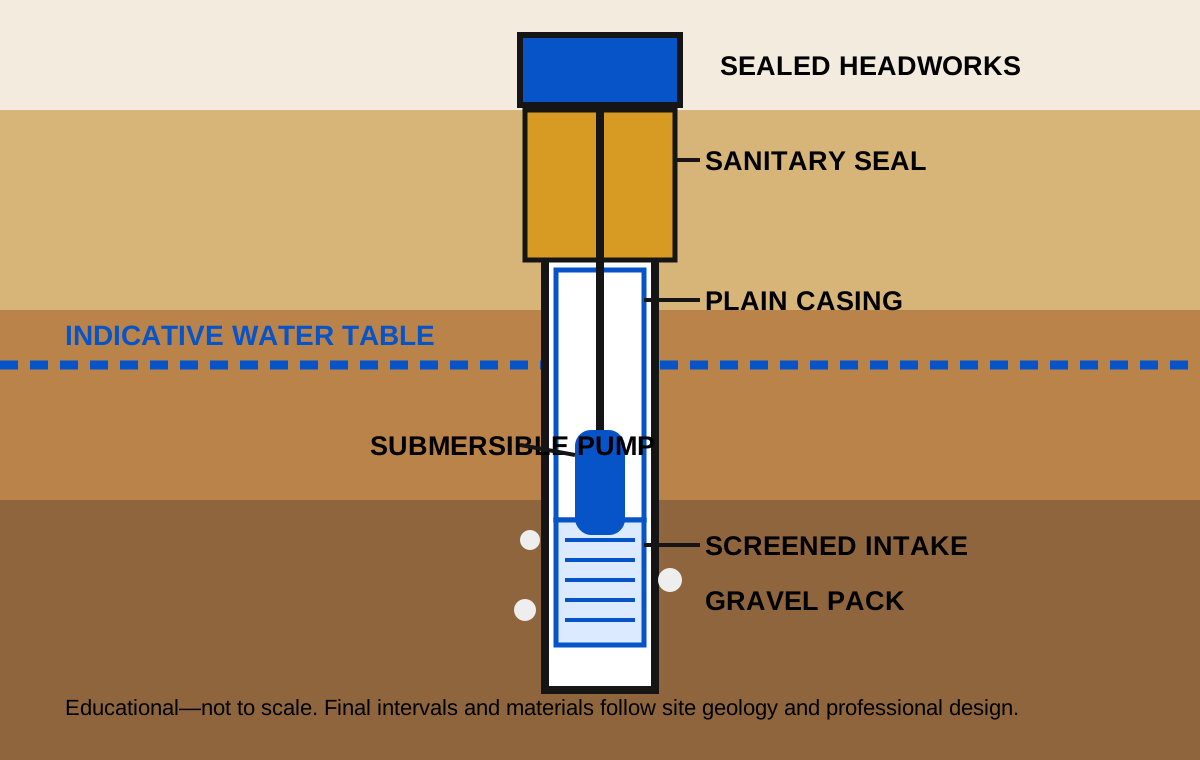
Construction records help the closure professional understand the borehole geometry and identify uncertainty. See borehole casing in Kenya for why permanent construction records matter and borehole headworks in Kenya for the visible wellhead components that should be inspected before work.
Site inspection and access planning
A professional borehole decommissioning Kenya inspection should document the area around the source before intrusive work begins. Note access for appropriate equipment, nearby structures, drainage, buried services information available to the owner, overhead constraints, security and the condition of the wellhead.
The owner should keep people, livestock and vehicles away from controlled work areas. Do not open electrical panels, pull pumps, enter pits or attempt to probe an unknown borehole. Those tasks can expose workers and bystanders to serious hazards and should remain under qualified professional control.
If the property will be redeveloped, coordinate the closure record with the site plan so the final borehole location is not lost after reinstatement.
Water-quality evidence can affect the closure plan
If borehole decommissioning Kenya follows a suspected water-quality problem, preserve the laboratory reports and sampling locations. A professional may need to understand whether the issue was observed at the raw source, after storage or after treatment before deciding what the evidence means for closure planning.
Use borehole water testing and treatment in Kenya to keep source testing separate from treatment performance. Do not infer contamination pathways from color, taste or odor alone.
Where additional sampling is required, the scope should state who collects the sample, which laboratory analysis is requested and how results are recorded. The borehole decommissioning Kenya file should retain those reports with the closure documentation.

Professional closure specification and quality control
The technical specification for borehole decommissioning Kenya should be written for the actual source rather than copied from a generic checklist. It should identify the known construction, uncertainties, equipment recovery, closure objective, site controls, materials or methods selected by the responsible professional, quality checks and final documentation.
This article intentionally does not provide a DIY sealing procedure or material recipe. A borehole is a deep groundwater structure, and incorrect intervention can create safety, environmental and future land-use problems. Engage competent professionals and verify current project requirements before work.
The owner can still ask useful commercial questions: what records were reviewed, what uncertainty remains, how completion will be verified, how the site will be reinstated and what final records will be supplied.
Recovered equipment and site reinstatement
borehole decommissioning Kenya may involve equipment that is recoverable, damaged or no longer serviceable. The contractor should identify how pumps, cables, pipework, control equipment and other removed items will be accounted for. The owner should know which items are returned, reused, recycled or disposed of through appropriate channels.
Site reinstatement should also be part of the scope. Define the final ground condition, drainage, removal of temporary works and any permanent marker or record required by the project. If new construction will follow, coordinate the closure location and record with the development team.
A tidy surface is not the same as a complete borehole decommissioning Kenya record. Preserve the location, source identity and close-out documentation after the visible work is finished.
Worked example: closure decision quality
Consider three illustrative projects. The first covers an old borehole with no investigation. The second reviews records and site condition. The third adds professional closure design, site control, verification and final documentation. The values below are illustrative data only and do not score any real project.
| Illustrative closure approach | Planning-quality index |
|---|---|
| Cover only | 24 |
| Records + inspection | 61 |
| Professional closure + records | 100 |
The borehole decommissioning Kenya lesson is that permanent closure is a documented engineering and site-management decision, not merely a surface repair.
Features of our borehole decommissioning Kenya assessment
| Feature | What it helps establish |
|---|---|
| Source-history review | Why closure is proposed and what records exist |
| Visible-site inspection | Headworks, access and surrounding site condition |
| Repair-versus-closure review | Whether permanent decommissioning is the appropriate outcome |
| Closure-scope planning | Responsibilities, professional method and quality checks |
| Equipment accounting | What is recovered and how it is recorded |
| Reinstatement planning | How the site is left after closure |
| Handover record | Location, work summary and final verification documents |
Advantages of a structured borehole decommissioning Kenya process include:
- Better decision quality because repair and rehabilitation are considered before permanent closure.
- Safer site control because intrusive work remains with qualified personnel.
- Clearer scope because construction records and uncertainty are reviewed first.
- Traceable completion because verification and records are part of handover.
- Better redevelopment coordination because the final borehole location remains documented.
- Cleaner commercial comparison because equipment recovery and reinstatement are visible line items.
borehole decommissioning Kenya pricing
borehole decommissioning Kenya pricing depends on source depth and construction records, equipment recovery, site access, professional closure requirements, testing, reinstatement and documentation. Because no universal verified price applies to every borehole, the table uses $— until a site-specific scope is assessed.
| Scope | Indicative price | Confirm before approval |
|---|---|---|
| Records and condition assessment | $— | Source history, inspection and closure decision |
| Equipment recovery assessment | $— | Pump, pipe, cable and access requirements |
| Professional closure work | $— | Site-specific specification and verification |
| Water-quality work if justified | $— | Sampling point, laboratory scope and reporting |
| Site reinstatement and handover | $— | Final ground condition and close-out records |
Current approvals and project records
Before borehole decommissioning Kenya work begins, verify the current approval, notification and record requirements that apply to the specific source and project. Requirements can depend on the source, site and reason for closure, so do not assume that an old permit or an unrelated project sets the current process.
Use WRA borehole permit process in Kenya for the site’s broader permit-planning context, then confirm the current closure requirements with the responsible professionals and relevant authority for the actual project.
Keep correspondence, approvals, method statements, inspection records and completion documents in the property file. Future owners should be able to identify that a borehole existed and how it was closed.
When rehabilitation is a better option
Not every failing source needs borehole decommissioning Kenya. If the borehole has a useful location, suitable construction and a recoverable performance problem, rehabilitation may be worth assessing before permanent closure. Evidence can include historical yield, water-level response, sediment behavior, camera observations where available and maintenance history.
A rehabilitation decision should also consider the complete water system. A failed controller, blocked treatment unit or damaged pump can make a functioning source appear unusable. Diagnose the problem before closing an asset permanently.
If professional assessment shows the source is no longer appropriate for use or conflicts with the site’s future plan, the project can proceed to a documented borehole decommissioning Kenya scope.
Common borehole decommissioning Kenya mistakes
- Assuming a failed pump means the borehole itself should be abandoned.
- Covering an old opening without reviewing the source record.
- Attempting pump removal or closure work without qualified professional control.
- Ignoring water-quality records when contamination concern is part of the decision.
- Failing to document recovered equipment and final site condition.
- Using a generic closure description without acknowledging unknown construction.
- Not confirming current approval and reporting requirements.
- Completing surface reinstatement but losing the final borehole location record.
How to get started with borehole decommissioning Kenya
Gather the property location, drilling and construction records, pump information, maintenance history, water-quality reports and the reason closure is being considered. Photograph the visible headworks from a safe position and describe current access and redevelopment plans.
Ask the contractor or technical professional to compare repair, rehabilitation and permanent borehole decommissioning Kenya options before intrusive work starts. The final proposal should explain scope, uncertainty, site controls, verification, reinstatement and records.
When closure is complete, retain the final source location, work record and handover documents with the property file.
borehole decommissioning Kenya FAQs
When is borehole decommissioning Kenya appropriate?
It can be considered when a source is permanently redundant, unsuitable for future use, damaged beyond the chosen recovery strategy or conflicts with redevelopment. Professional assessment should confirm the reason.
Can I close an old borehole myself?
No DIY closure method is recommended here. Boreholes are deep groundwater structures, and intrusive closure work should be planned and carried out by competent professionals under the applicable project requirements.
Should a failed pump lead to borehole closure?
Not automatically. Diagnose the pump, controls, source performance and distribution system first. The borehole may still be serviceable.
What records are useful before closure?
Collect drilling and construction records, pump information, water-level or pumping-test data, water-quality reports, repair history and the source location.
What should the owner receive after closure?
Keep a completion record describing the source, work performed, final site condition, recovered equipment where relevant, verification and any approvals or professional reports.
Can a borehole be rehabilitated instead of decommissioned?
Sometimes. If professional diagnosis shows the source remains suitable and the problem is recoverable, rehabilitation may be considered before permanent closure.
How much does borehole decommissioning Kenya cost?
Cost depends on the actual source, access, equipment, professional closure scope, testing, reinstatement and records. Obtain a site-specific quotation rather than relying on a universal figure.
Make borehole decommissioning Kenya a documented professional decision
borehole decommissioning Kenya works best when the owner first confirms that permanent closure is necessary, preserves the source history and appoints competent professionals to design and verify the work. The objective is not merely to hide an old wellhead; it is to close the source responsibly and leave a clear property record.
A strong borehole decommissioning Kenya handover explains why the source was closed, what was known about its construction, what work was completed and how the site was left. That record protects future maintenance, redevelopment and land-management decisions.