
borehole gravel pack is a selected granular material placed around suitable screened sections of some boreholes to support the intake zone and help control movement of formation material. It is not ordinary backfill, and it should not be specified from price alone. This guide explains its purpose, grading, placement, common mistakes, testing implications and the records a Kenyan borehole owner should receive.
What a borehole gravel pack does
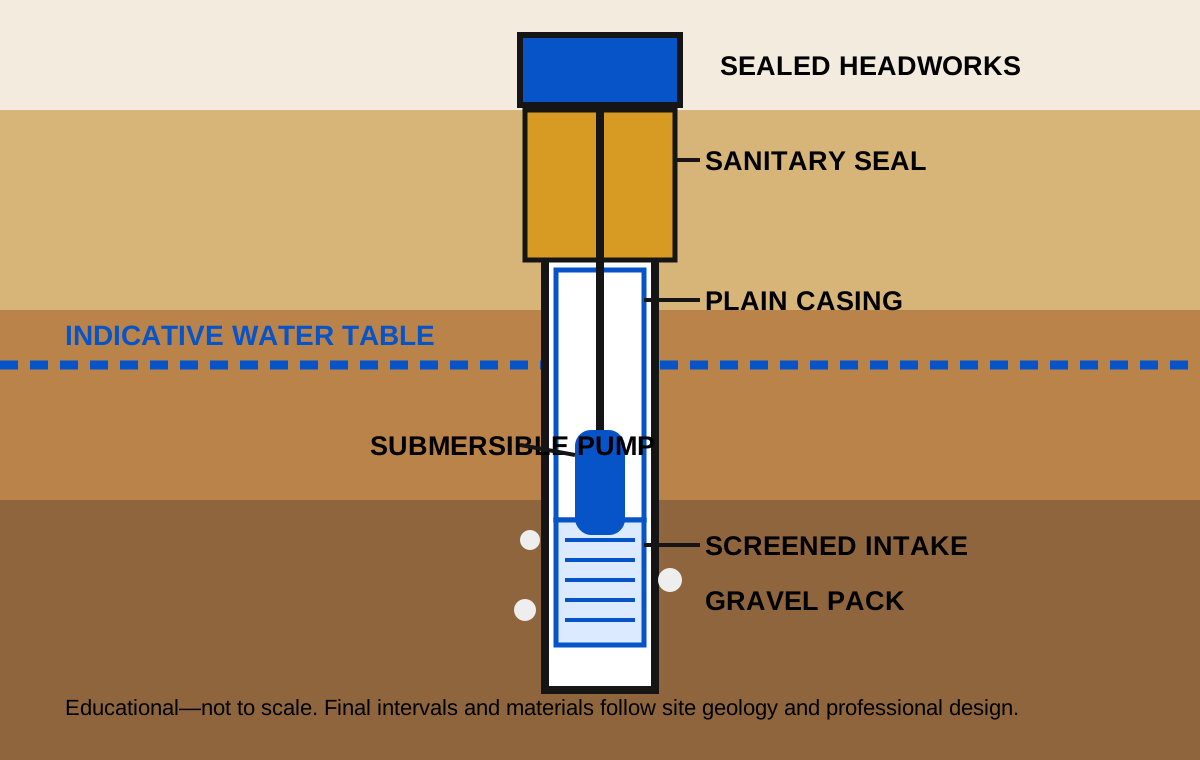
A borehole gravel pack is used where the adopted construction includes screened intervals and surrounding granular material is needed to support the intake design. Its job is not simply to fill the annular space. The material should work with the screen opening and formation so water can enter while excessive formation particles are controlled.
The exact construction depends on geology, drilling method, borehole diameter, screen design and the formation encountered. Some boreholes use screened and gravel-packed sections; other competent formations may use a different construction approach. That is why a borehole gravel pack should never be added automatically to every quotation as though all boreholes are identical.
Our borehole casing in Kenya guide explains how casing, screen and open-hole decisions fit together. This article focuses on the selected granular envelope around a screen.
Why borehole gravel pack material is not ordinary site gravel
A properly selected borehole gravel pack needs appropriate grain size, cleanliness, durability and uniformity for its intended role. Random construction aggregate may contain fines, weak particles, unsuitable grading or contamination that can undermine development and water quality.
The material should be handled so that soil, oil, waste and other site contaminants are not introduced into the borehole. If material is stored on site before installation, it should remain protected. The construction record should identify what was installed rather than using only a generic word such as “gravel.”
Owners comparing drilling quotations should ask for the proposed borehole gravel pack specification, unit of measurement, estimated quantity and how actual installed quantities will be documented.
How borehole gravel pack grading relates to formation and screen
The borehole gravel pack, screen opening and surrounding formation should be considered as a system. A pack that is too fine can restrict flow or be difficult to develop properly. A pack that is too coarse may not provide the intended control of formation material. Screen slots that do not correspond with the selected pack can create the same mismatch.
Grain-size selection should therefore follow appropriate design evidence rather than a universal number copied from another borehole. Where formation samples and sieve information are used, the designer can select a compatible screen and borehole gravel pack based on the actual material around the target intake.
Do not treat a grain-size ratio as a substitute for qualified design. The formation can vary with depth, and the constructed intake may span more than one material. The final decision should be documented in the construction record.
Borehole gravel pack and screen placement
The screen must be positioned in the intended water-bearing interval before the borehole gravel pack can perform its role. Screen length and depth should follow drilling observations, the adopted construction design and the formations encountered. Blindly screening a fixed percentage of total depth can expose the borehole to unwanted formations or create unnecessary cost.
Centralisation also matters because an uneven annular space can make pack placement more difficult. If the screen lies against one side of the hole, the borehole gravel pack may not form the intended envelope uniformly.
Record final screen intervals, casing intervals and top/bottom depths of the packed zone. These details become important if the borehole later develops sand problems or requires rehabilitation.
How borehole gravel pack is placed
Placement method should minimize bridging, segregation and uncontrolled dumping. The driller needs to understand the annular geometry, drilling fluid condition, depth and expected quantity. A borehole gravel pack that bridges high in the annulus can create an apparent full volume while leaving the screen interval inadequately packed.
Installation should therefore be controlled and monitored. The team can track added volumes, expected annular capacity and pack level where practical. If the installed quantity differs substantially from the estimate, investigate the reason rather than simply assuming the borehole accepted more material.
Good documentation should record the borehole gravel pack material, estimated and installed quantity, placement method and packed interval. This turns a hidden underground construction step into an auditable part of the project.
Simple annular-volume calculation for borehole gravel pack
A theoretical annular volume helps estimate how much borehole gravel pack might be required before allowances for actual hole condition, washouts, settling and installation losses.
In plain English, theoretical annular volume V equals the cross-sectional area between the borehole diameter D and screen/casing outside diameter d, multiplied by packed length L. Use consistent units.
The calculation assumes a regular cylindrical hole. Real boreholes can have enlargement or irregularity, so measured installation quantities may differ. The theoretical value is a construction-control tool, not proof of successful placement.
In plain English, estimated mass M can be related to bulk density ρ multiplied by required volume V. Use the actual material supplier’s information and project method rather than assuming one universal density.
Borehole gravel pack and drilling fluids
Where drilling fluids are used, the construction and development plan should account for material remaining around the intake. A borehole gravel pack cannot perform as intended if the screen and surrounding zone remain plugged with drilling-related fines or fluid residues.
That is why development after construction is critical. Development helps remove fine material and improve hydraulic connection between the formation, pack and screen. The appropriate method depends on construction and site conditions.
A quotation should therefore show development as a defined stage rather than treating borehole gravel pack placement as the end of construction.
Development after borehole gravel pack installation
After the borehole gravel pack and screen are installed, the borehole should be developed to remove fines and improve inflow. Development may use controlled pumping, surging, airlifting or other appropriate methods depending on the borehole design and equipment.
The objective is not simply to make water look clear for a few minutes. The team should observe sediment behavior, discharge and other relevant indicators as development progresses. Incomplete development can leave a new borehole producing sand or turbidity even where the basic construction is otherwise sound.
If a new borehole continues to produce sand, use why a borehole pumps sand in Kenya to review development, pump setting, construction and operating rate.
Borehole gravel pack and sanitary sealing
A borehole gravel pack is not a substitute for sanitary protection. The packed intake zone and the upper annular space have different functions. Where sealing is required, the seal helps limit pathways by which poor-quality shallow water or surface contamination could move down the annulus.
The finished construction should clearly document where the borehole gravel pack ends and where sealing materials begin. At the surface, headworks and drainage should protect the wellhead. See borehole headworks in Kenya.
Do not allow an unspecified mixture of cuttings and random backfill to replace a designed construction simply because the components are hidden underground after completion.
How borehole gravel pack can relate to sand pumping
Sand in pumped water can have several causes, and a borehole gravel pack issue is only one possibility. The screen may be mismatched, the formation may be unstable, development may be incomplete, the pump may be set too close to an intake, the operating rate may be excessive, or the construction may have deteriorated.
Diagnosis should start with the drilling and construction record. Identify screen intervals, pack specification, installed quantities and pump setting. Then compare current flow, water levels and sediment behavior with the original baseline.
A technician should not assume that adding more material from the surface will repair a suspected borehole gravel pack problem. The construction needs to be understood before intervention.
Borehole gravel pack versus natural development
Not every borehole requires an artificial borehole gravel pack. In some formations and designs, a naturally developed intake or open-hole construction may be appropriate. The decision belongs to the site-specific borehole design, not to a marketing checklist.
This is important when comparing quotations. A contractor who omits a borehole gravel pack may not necessarily be cutting corners if the proposed construction is technically different and justified. Conversely, including “gravel pack” as a line item does not prove that the material, grading or placement method is appropriate.
Ask the provider to explain the intended intake construction in plain language and document the actual construction at handover.
What to check in a borehole gravel pack quotation
| Quotation field | What to look for | Why it matters |
|---|---|---|
| Material description | Selected, clean granular material with stated grading/specification | Separates engineered pack from random aggregate |
| Unit | Bag, tonne, cubic metre or another clear measure | Makes quantities auditable |
| Estimated quantity | Basis linked to annular dimensions and packed length | Allows cost planning before installation |
| Placement method | How bridging and segregation will be controlled | Construction quality depends on placement |
| Screen relationship | Screen slot and pack grading basis | The two components should work together |
| Development | Defined post-construction development stage | Helps remove fines and establish inflow |
| Handover record | Actual material, quantity and intervals | Supports future diagnosis and maintenance |
Worked example: theoretical versus installed borehole gravel pack
Suppose the theoretical annular calculation suggests a certain borehole gravel pack volume for the screened interval. During installation, the actual material used is significantly higher. That difference does not automatically mean the contractor overcharged or that the design is wrong; it may indicate hole enlargement, irregularity or another site condition.
The correct response is to review the drilling record, hole dimensions, placement observations and quantity tracking. If the actual use is substantially lower than theory, investigate possible bridging or whether the packed interval differs from the planned interval.
Construction control is strongest when quantities are recorded while the work happens, not reconstructed from memory after the borehole is finished.
| Illustrative construction control | Relative index |
|---|---|
| Theoretical annular volume | 70 |
| Installed volume | 82 |
| Development verification | 100 |
Features of our borehole gravel pack construction approach
| Feature | What it supports |
|---|---|
| Construction review | Confirms whether screened and packed construction is appropriate |
| Material specification | Defines grading, cleanliness and intended role |
| Quantity planning | Uses annular dimensions and packed interval for estimating |
| Controlled placement | Reduces risk of uncontrolled dumping and bridging |
| Development stage | Helps establish inflow and remove fines after construction |
| Installed-record handover | Documents screen, pack and sealing intervals for future reference |
Advantages of a documented borehole gravel pack process include:
- Better construction transparency because material and quantity are recorded.
- Better screen compatibility because pack and slot decisions are considered together.
- Better development planning because the intake construction is understood.
- Better sand diagnosis because future technicians have the original records.
- Better cost control because theoretical and installed quantities can be compared.
Borehole gravel pack pricing in Kenya
borehole gravel pack pricing depends on material specification, quantity, transport, packed depth, borehole geometry, placement method and the overall construction contract. A line-item price should not be interpreted separately from the screen and development design.
| Scope | Indicative price | What to confirm |
|---|---|---|
| Selected pack material | $— | Grading, cleanliness, source and unit |
| Transport and handling | $— | Delivery, protected storage and site conditions |
| Placement | $— | Method, packed interval and quantity tracking |
| Development | $— | Post-placement development method and verification |
Borehole gravel pack records to request at handover
- Final drilled depth and borehole diameter information.
- Casing and screen material, diameter and installed intervals.
- Borehole gravel pack specification or grading description.
- Estimated and actual installed quantity.
- Top and bottom of the packed interval where recorded.
- Sanitary seal or other annular construction details.
- Development method and observations.
- Test-pumping data and water-quality results.
- Pump model and installation depth.
Keep these records together. They become especially useful if sand, declining flow or rehabilitation questions arise years later.
Borehole gravel pack and pump setting
The pump should not be positioned without understanding the completed intake. A borehole gravel pack and screen sit within a specific depth interval, while the pump is selected and set using tested borehole performance, construction and operating needs.
Final pump setting should consider pumping water level, intake intervals, borehole depth and manufacturer requirements. For the broader process, see borehole pump sizing in Kenya.
Borehole gravel pack maintenance and rehabilitation
The borehole gravel pack itself is underground and is not a routine replaceable service item. If the borehole later loses performance or produces sand, diagnose the entire system first. Pump wear, operating rate, screen condition, deposits, source changes and distribution faults can create overlapping symptoms.
Use borehole maintenance for the system checklist and borehole rehabilitation Kenya when evidence suggests deterioration within the borehole.
Common borehole gravel pack mistakes
- Using random construction aggregate with no grading basis.
- Selecting pack size without considering formation and screen.
- Allowing contaminated material to be introduced during handling.
- Dumping material too rapidly without monitoring placement.
- Ignoring potential bridging or unexpected quantity differences.
- Failing to record actual packed intervals and quantities.
- Skipping proper development after construction.
- Assuming every borehole needs the same artificial borehole gravel pack design.
How to get started with a borehole construction review
If you are planning a new borehole, send the site location, survey report, intended use and any proposed drilling/construction quotation. We can help you identify where the borehole gravel pack, screen, casing, development and testing responsibilities appear in the scope.
If the borehole already exists and is producing sand or reduced flow, send the drilling log, construction record, pump details and recent performance information. Diagnosis should come before attempting corrective work.
Borehole gravel pack FAQs
What is a borehole gravel pack?
It is selected granular material placed around suitable screened sections of some boreholes to support the intake design and help control movement of formation material.
Does every borehole need a gravel pack?
No. Construction depends on geology and design. Some boreholes use artificial gravel-packed screens while others use different intake constructions.
Can ordinary building gravel be used?
The pack should have an appropriate specification for the borehole design. Random aggregate can have unsuitable grading, fines, weak particles or contamination.
How is borehole gravel pack size selected?
Selection should consider formation material, screen opening and construction design rather than one universal grain size.
Why does actual pack quantity differ from the estimate?
Real boreholes can be enlarged or irregular, and placement conditions can differ from the theoretical cylinder. Large differences should be reviewed and documented.
Can a gravel pack stop all sand?
No single component can guarantee that. Sand control depends on formation, screen, pack, development, pump setting, operating rate and condition of the completed borehole.
What records should I keep?
Keep screen intervals, casing details, gravel-pack specification and quantity, sealing details, development record, pumping-test data and pump setting.
Make borehole gravel pack a documented construction decision
borehole gravel pack should be selected, placed and recorded as part of the complete borehole intake design. Match it with the formation and screen, control installation, develop the borehole properly and keep the final construction record so future testing and maintenance start with evidence.