
borehole water sampling Kenya work can produce a laboratory report that looks precise but is difficult to trust when the sample point, container, timing or system condition was not documented. This guide shows you how to plan representative sampling, prepare a useful laboratory brief, record the source-to-tap context, compare repeat results and turn testing into a defensible water-management decision.

Why borehole water sampling Kenya matters
borehole water sampling Kenya is not simply filling a bottle. The sample should represent the water condition you are trying to understand. A raw-source investigation, a storage check, a treatment-performance test and a downstream tap investigation can require different sample points and different interpretation.
Start with borehole water testing and treatment in Kenya. The purpose of sampling is to support a decision. When the question is clear before collection, the laboratory result becomes more useful for design, maintenance and verification.
Field-record tip: write down the sample point, date, time, water-system condition and whether treatment was operating. A result without context is harder to compare later.
borehole water sampling Kenya: step-by-step method
A repeatable borehole water sampling Kenya method separates planning, collection, laboratory analysis and interpretation. The laboratory should provide the specific collection, container, preservation and delivery instructions for the requested tests.
- Define the decision. State whether you are characterizing raw water, checking storage, diagnosing a complaint, selecting treatment or verifying existing treatment.
- Select the sampling point. Identify the exact source point, tank point, treatment inlet, treatment outlet or distribution point.
- Agree the laboratory package. Tell the laboratory the intended water use and the question the analysis should answer.
- Follow the laboratory collection instructions. Use the correct containers and handling requirements supplied for the requested analysis.
- Record the operating condition. Note whether the pump, storage and treatment system were in normal operation.
- Label and document clearly. Keep point names consistent across the field sheet and laboratory submission.
- Review the complete report. Do not isolate one result from the rest of the relevant chemistry or microbiology.
- Plan repeat testing. Where verification is needed, reuse defined points and comparable conditions where practical.
How to define borehole water sampling Kenya points
borehole water sampling Kenya points should map to the question. If you need raw-source information, use a point that truly represents untreated borehole water. If you need to assess a treatment unit, identify the inlet and outlet. If you are investigating storage, define points before and after the tank where the system layout allows.
Draw a simple system sketch. Mark the borehole, pump, raw-water storage, treatment stages, treated-water storage and distribution. This prevents a sample labelled “borehole water” from actually representing water that has already passed through several components.
Start with the intended water use
A borehole water sampling Kenya plan should state how the water will be used. Domestic supply, drinking-water use, livestock, irrigation, process water and institutional supply can lead to different testing questions. The laboratory and technical team need that context before recommending an analysis package.
Do not assume the same short list of tests is correct for every borehole. Use the water-use objective, site history and observed concerns to define the scope. For a new borehole, retain the test report with the construction and commissioning records.
Separate raw-water and treated-water questions
borehole water sampling Kenya becomes confusing when raw and treated results are mixed. A raw sample helps characterize the source. A treatment-outlet sample helps assess the treatment stage. A tap sample may include the influence of storage and distribution after treatment.
Give each sample a unique name rather than calling every bottle “borehole.” Clear naming allows later comparisons to show where a change occurred.
Use the laboratory’s collection instructions
For borehole water sampling Kenya, the laboratory should tell you which container is required, how the sample should be handled, and how quickly it should reach the laboratory for the requested tests. Those details can vary with the analysis.
Do not improvise with an unknown household bottle or transfer water between containers unless the laboratory specifically instructs you to do so. If a test requires professional sampling, arrange it rather than creating uncertainty that makes the result less useful.
Document the borehole operating condition
A useful borehole water sampling Kenya field note describes what the system was doing at the time of collection. Record whether the borehole had been operating, whether treatment was online, which tank was in service, and whether recent maintenance or repairs could affect interpretation.
If the test will be repeated, that note helps the next sample approximate the same system condition. Consistency does not guarantee identical results, but it makes comparison more defensible.
Plan the number of samples from the question
borehole water sampling Kenya should not use more samples merely to look thorough. Each sample should have a purpose. A source-characterization question may need a different plan from a treatment-troubleshooting question that compares inlet, outlet and final distribution.
Ask the laboratory or technical team to explain what each proposed point will tell you. This keeps testing focused and prevents unnecessary duplication.
Connect sampling to flow and daily demand
Water-quality results help treatment design, but borehole water sampling Kenya is only one part of the design brief. A treatment system must also match how much water the site needs and how quickly it must be delivered.
A simple daily-demand relationship is:
In plain English, daily demand is built from each use’s flow and operating duration. Give the treatment designer both the laboratory report and the demand brief.
Use sample IDs that remain meaningful
A good borehole water sampling Kenya project might label points in a way that remains understandable months later: raw borehole, raw tank, treatment inlet, treatment outlet, treated tank and final distribution. Use the same names on the field sheet, bottle label and project records.
Avoid labels such as “sample 1” without a location description. If there are several tanks or taps, add the site-specific identifier.
Photographs and sketches improve the record
For borehole water sampling Kenya, a photograph of the sampling point or a simple diagram can make later interpretation easier. The image should document the system, not replace the written sample label.
Keep photographs with the laboratory report and field sheet. If the plumbing changes later, the old image helps explain why repeat results may represent a different location.
Do not diagnose treatment from appearance alone
borehole water sampling Kenya is valuable because water appearance does not describe the complete quality picture. Clear water can still require analysis, while colour, taste, odour or sediment can have more than one possible explanation.
Use borehole water treatment systems in Kenya to connect laboratory evidence with professional treatment design instead of choosing a filter from appearance.
Choosing the right borehole water sampling Kenya approach
| Sampling objective | Useful point concept | Record to keep |
|---|---|---|
| Raw-source characterization | Defined untreated source point | Borehole condition and laboratory report |
| Storage investigation | Points that isolate the tank where practical | Tank condition and system sketch |
| Treatment verification | Treatment inlet and outlet | Equipment status and paired results |
| Distribution investigation | Defined downstream location | Pipework route and operating condition |
| Repeat monitoring | Consistent defined point | Comparable field notes and reports |
The best borehole water sampling Kenya approach is the one that answers the intended question with the fewest ambiguous assumptions.
Understand concentration and system loading
When borehole water sampling Kenya supports treatment design, concentration must be considered together with flow and operating time. A simplified relationship is:
In plain English, the amount of a constituent passing through a system depends on concentration, flow and time. Professional treatment sizing uses consistent units, complete laboratory data and equipment-specific criteria.
Plan sampling around storage and treatment layout
borehole water sampling Kenya can be misleading if a sample point does not match the system diagram. Water can pass through storage, dosing, filtration, softening or other treatment before reaching the final tap. The record should say which stages occurred before the sample.
Review borehole water tank size Kenya when storage is part of the treatment design. Tank volume and turnover can affect how the system is operated and where representative monitoring points are placed.
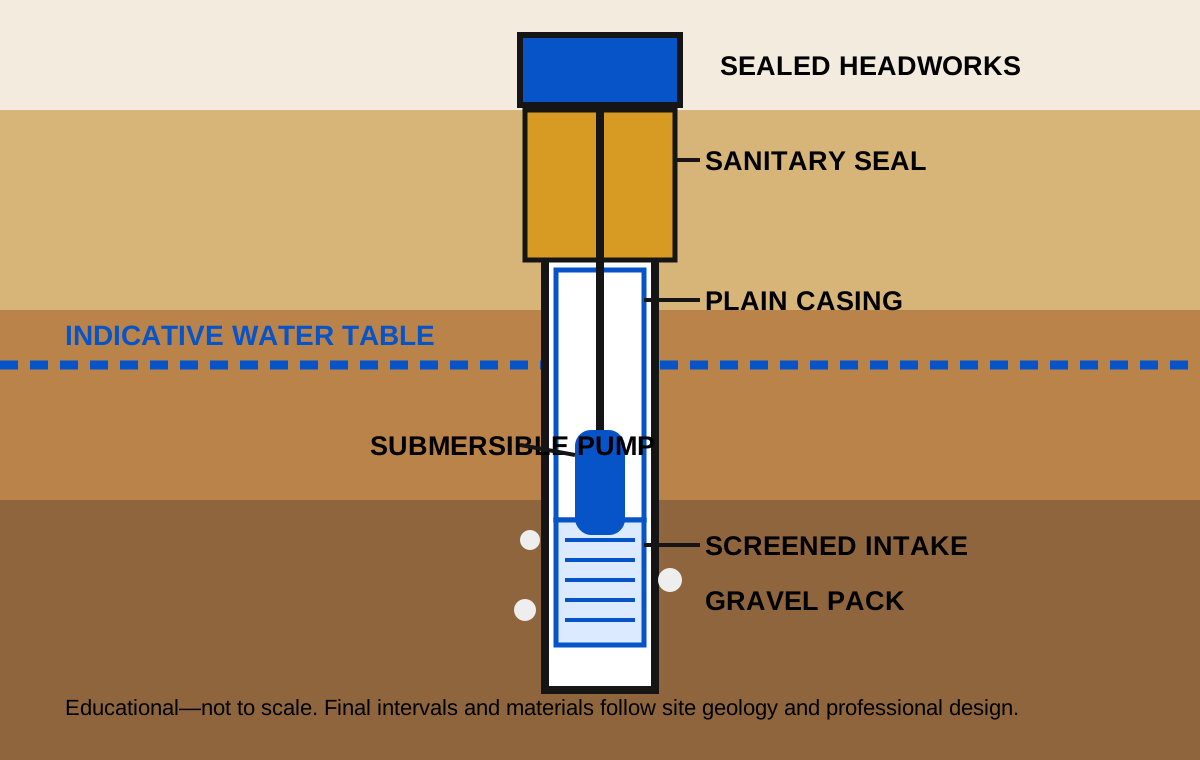
Worked example: three sampling plans
Imagine three borehole water sampling Kenya approaches. Plan A takes one unlabelled bottle from a convenient tap. Plan B labels the tap but does not record treatment status. Plan C defines the decision, maps the system, uses laboratory instructions, labels each point and keeps the field sheet with the report.
The chart below is illustrative only. It compares documentation completeness, not laboratory accuracy.
| Illustrative sampling approach | Documentation index |
|---|---|
| Convenient sample | 30 |
| Labelled point | 62 |
| Defined plan + record | 100 |
Features of our borehole water sampling Kenya support
| Feature | What it helps establish |
|---|---|
| Testing objective review | The decision the sample needs to support |
| Sampling-point map | Raw, storage, treatment and distribution locations |
| Laboratory brief | Intended use and requested analysis context |
| Field-record structure | Point, date, time and operating condition |
| Demand brief | Flow and daily volume for treatment design |
| Repeat-test plan | Comparable points for verification |
| Handover record | Reports and system notes kept together |
Advantages of a structured borehole water sampling Kenya plan include:
- More useful laboratory results because the sample represents a defined question.
- Clearer treatment design because raw and treated samples are not confused.
- Better repeat comparisons because points and operating conditions are recorded.
- Less unnecessary testing because each sample has a purpose.
- Stronger handover records because field notes remain with laboratory reports.
- Faster troubleshooting because future technicians can understand the system state.
borehole water sampling Kenya pricing
borehole water sampling Kenya pricing depends on the sampling points, laboratory package, site access, whether professional collection is required, travel, reporting, repeat testing and whether the work is part of a wider treatment project. No verified universal price applies to every job, so the table uses $— until the scope is defined.
| Project line | Indicative price | Confirm in quotation |
|---|---|---|
| Sampling-plan review | $— | Objective, points and site information |
| Professional sample collection | $— | Number of points and collection scope |
| Laboratory analysis | $— | Requested package and reporting |
| System mapping | $— | Source, tanks, treatment and distribution |
| Interpretation support | $— | Decision brief and treatment context |
| Verification sampling | $— | Repeat points and laboratory scope |
Build a chain-of-custody style project record
Even when a formal chain-of-custody process is not required, borehole water sampling Kenya benefits from a clear record of who collected the sample, where it came from, when it was collected and how it was submitted. Follow the laboratory’s own forms and instructions where provided.
Keep a copy of the submission information with the final report. That reduces uncertainty when the result is reviewed months later.
Repeat sampling after maintenance or treatment changes
If a borehole, tank or treatment system changes, borehole water sampling Kenya can provide a before-and-after record. Plan the verification point before the work so everyone agrees what success will be checked against.
For wider maintenance planning, use borehole maintenance in Kenya. Sampling should fit into the system’s maintenance history rather than exist as disconnected reports.
Keep sample records with commissioning documents
A new system should not lose its borehole water sampling Kenya information after handover. File the laboratory reports, sampling-point diagram, treatment specification and commissioning record together.
This gives the owner a baseline for future troubleshooting. If a complaint appears later, the team can compare current conditions with documented earlier conditions.
How to get started with borehole water sampling Kenya
First, define the question you need the laboratory to answer. Then map the borehole-to-tap route and identify whether you need raw, storage, treatment or downstream samples.
Next, contact the laboratory for the correct collection instructions and analysis package. During borehole water sampling Kenya, label every point clearly and record the operating condition.
Finally, review the complete report in context, keep it with the field notes, and schedule verification sampling when corrective work or ongoing monitoring requires it.
borehole water sampling Kenya FAQs
What makes a borehole sample representative?
A representative sample comes from a point and operating condition chosen to answer a defined question, using the laboratory’s collection and handling instructions.
Can I use any clean bottle for borehole water sampling Kenya?
Do not assume so. Ask the laboratory which container and handling method are required for the requested analysis.
Should raw and treated water use the same sample label?
No. Keep raw, treatment-inlet, treatment-outlet, storage and distribution points clearly distinct so results can be interpreted correctly.
What information should I write down?
Record the point, date, time, system operating condition, treatment status and any relevant recent maintenance, then keep the notes with the report.
When should sampling be repeated?
Repeat sampling can support confirmation, monitoring, troubleshooting or post-treatment verification. Use defined comparable points where practical.
Does a laboratory report replace a treatment design?
No. The report is an important design input, but treatment also depends on flow, daily demand, storage, existing equipment and the intended water use.
How do I compare borehole water sampling Kenya quotations?
Compare the same number of points, laboratory package, collection scope, travel, reporting and any interpretation or verification work.
Make borehole water sampling Kenya repeatable
borehole water sampling Kenya is most valuable when someone can repeat the process and understand what changed. Define the question, map the system, follow laboratory instructions and preserve the field context with the report.
That simple discipline turns a one-time laboratory result into a useful baseline for treatment design, commissioning, maintenance and future water-quality decisions.
Create a long-term borehole water sampling Kenya schedule
Once the first borehole water sampling Kenya exercise is complete, decide whether the site needs a repeat schedule. The schedule should come from the water use, treatment arrangement, operational risks and any professional or regulatory requirements that apply to the project. Avoid inventing a universal calendar for every borehole; instead, document why each future test is being performed and which points it will use.
A useful monitoring sheet can show the planned sample point, the question being checked, the laboratory package, the person responsible for arranging collection, and where the final report will be stored. If a treatment unit is serviced or a tank is cleaned, note that event alongside the testing record. This gives future borehole water sampling Kenya results a maintenance context rather than leaving them as isolated files.
For shared, institutional or commercial systems, name the person or role responsible for retaining reports and notifying the technical team when results need review. Keep the sampling map current when plumbing, storage or treatment changes. That way, the next borehole water sampling Kenya round can use the same defined points or clearly document why a point changed. Consistent records reduce avoidable confusion and make long-term comparison more useful.
Use the sampling record during troubleshooting
When users report a change in taste, appearance, odour or system performance, the previous borehole water sampling Kenya file provides a baseline. The technical team can compare the current system layout, recent maintenance and new results with earlier documented conditions before recommending additional testing or treatment changes.
Review the laboratory report as a complete document
After the laboratory issues results, keep the report together with the field sheet instead of forwarding only selected numbers. The point description, collection date, analysis package and laboratory notes can be important when a technician compares results later. If a result is unexpected, confirm the point and collection context before ordering new equipment.
For repeat monitoring, use a simple naming convention that survives staff changes. A property manager or facility team should be able to identify the same raw-water, treatment and distribution points without relying on the person who collected the first set of samples. If the plumbing changes, update the diagram and explain the change in the next field note.
Use monitoring to support maintenance
Sampling records become more valuable when they are linked to pump service, tank work, treatment maintenance and commissioning. A change in a later report can then be reviewed alongside what happened physically in the system. This helps the technical team decide whether the next step is another test, an inspection, maintenance or a treatment review rather than jumping directly to a purchase.
Documentation note: Keep the laboratory contact details, report reference, field sheet and system sketch together. A future technician can then see exactly what was tested and how the water moved through the property at the time. This small administrative step improves continuity when staff, contractors or treatment equipment change.
Store the monitoring plan where facility managers and future service teams can find it, and record any system changes before the next laboratory visit.