
borehole water smells like rotten eggs is a warning that deserves proper diagnosis before you buy treatment equipment or assume the borehole itself has failed. This guide shows you how to separate the likely source of the odor, collect useful evidence, compare treatment options safely, and plan a site-specific solution without relying on guesswork.

Why borehole water smells like rotten eggs matters
When borehole water smells like rotten eggs, the practical problem is not simply the smell. You need to know whether the odor is present at the borehole outlet, after storage, only at selected taps, or only after water passes through a heater or treatment unit. Those observations change the investigation and help prevent money being spent on the wrong component.
Start by treating odor as a water-system problem rather than a filter-shopping problem. The borehole, pump, rising main, storage tank, pipework, treatment equipment and building plumbing can all affect what reaches the user. A useful diagnosis therefore follows the water from source to point of use and records where the change first appears.
The safest starting point is a representative test combined with a sanitary and system inspection. See borehole water testing and treatment in Kenya for the wider testing framework. Do not taste water to investigate an unusual odor, and do not add treatment chemicals based on smell alone.
Technical tip: if the odor appears only after a tank, heater or treatment stage, isolate that stage in the investigation instead of assuming the borehole source is the only cause.
borehole water smells like rotten eggs: step-by-step method
A disciplined process makes borehole water smells like rotten eggs easier to diagnose. The purpose is to document where the odor occurs, what operating conditions make it stronger, and which test results or inspections are needed before treatment is selected.
- Map the water path. Identify the borehole outlet, pump, storage, treatment stages, heaters, pressure system and main points of use.
- Compare locations. Note whether the odor is present before storage, after storage, at cold taps, at hot taps, or only at one building.
- Record operating conditions. Note whether the odor changes after the system sits unused, after heavy pumping, after a tank refill, or after maintenance.
- Inspect the wellhead and storage system. Look for obvious sanitation, sealing, drainage, cleaning or maintenance issues that should be corrected professionally.
- Arrange representative testing. Use the intended water use and the observed problem to define the sampling and laboratory brief.
- Separate source treatment from plumbing treatment. A whole-site problem and a single-point problem should not automatically receive the same solution.
- Compare treatment by duty. Check design flow, contact requirements, media or process suitability, maintenance needs and how waste or backwash will be managed.
- Verify after corrective work. Retest and record whether the odor, operating performance and water-quality indicators have improved.
For planning, the required treatment or contact-system flow can be expressed without pretending that one universal package fits every site:
In plain English, the design flow depends on the volume the site needs and the realistic number of hours the system can operate. That is why a treatment quotation should be linked to demand, not only to an odor description.
How to evaluate borehole water smells like rotten eggs without guessing
If borehole water smells like rotten eggs, compare observations from several points in the same water system. A sample taken only after a storage tank may not represent water leaving the borehole, while a sample taken at the borehole may not explain a problem created later in the building. The investigation should match the location where the problem appears.
Keep a simple record with date, sampling point, whether the water was hot or cold, recent pumping activity, tank condition, treatment status and any maintenance performed. This makes later comparisons more useful and gives a technician or laboratory a clearer brief.
Choosing the right approach when borehole water smells like rotten eggs
The right response to borehole water smells like rotten eggs depends on evidence. A whole-site odor present directly from the source calls for a different investigation from an odor that appears only in one hot-water line. Likewise, a problem that begins after storage should trigger inspection of the tank, ventilation, cleaning and downstream treatment rather than an immediate assumption about the aquifer.
| Observation | Useful next check | Avoid this mistake |
|---|---|---|
| Odor at borehole outlet and throughout the site | Representative source testing and complete-system review | Buying a small point-of-use filter first |
| Odor appears only after storage | Tank condition, turnover, cleaning history and downstream sample | Assuming the borehole alone is responsible |
| Odor appears only at hot-water outlets | Compare hot and cold samples and inspect the hot-water system | Treating the entire borehole without isolating the hot-water issue |
| Odor appears only at one building | Compare branch plumbing and local equipment | Changing the borehole pump or source treatment without evidence |
| Odor changes after maintenance | Review what was changed and verify water quality | Adding another treatment process before checking the previous work |
A second useful formula connects treatment selection to the real delivery requirement:
In plain English, the pump and treatment system must work against lift, elevation, pipe friction and the pressure needed at the destination. Read borehole pump sizing in Kenya before changing pump equipment as part of an odor project.
Where the odor first appears changes the diagnosis
When borehole water smells like rotten eggs, location is one of the most valuable pieces of evidence. Ask someone familiar with the system to trace water from the borehole headworks to storage, through treatment and into the distribution network. The objective is not to prove a cause from smell alone; it is to find the first point where the condition becomes noticeable.
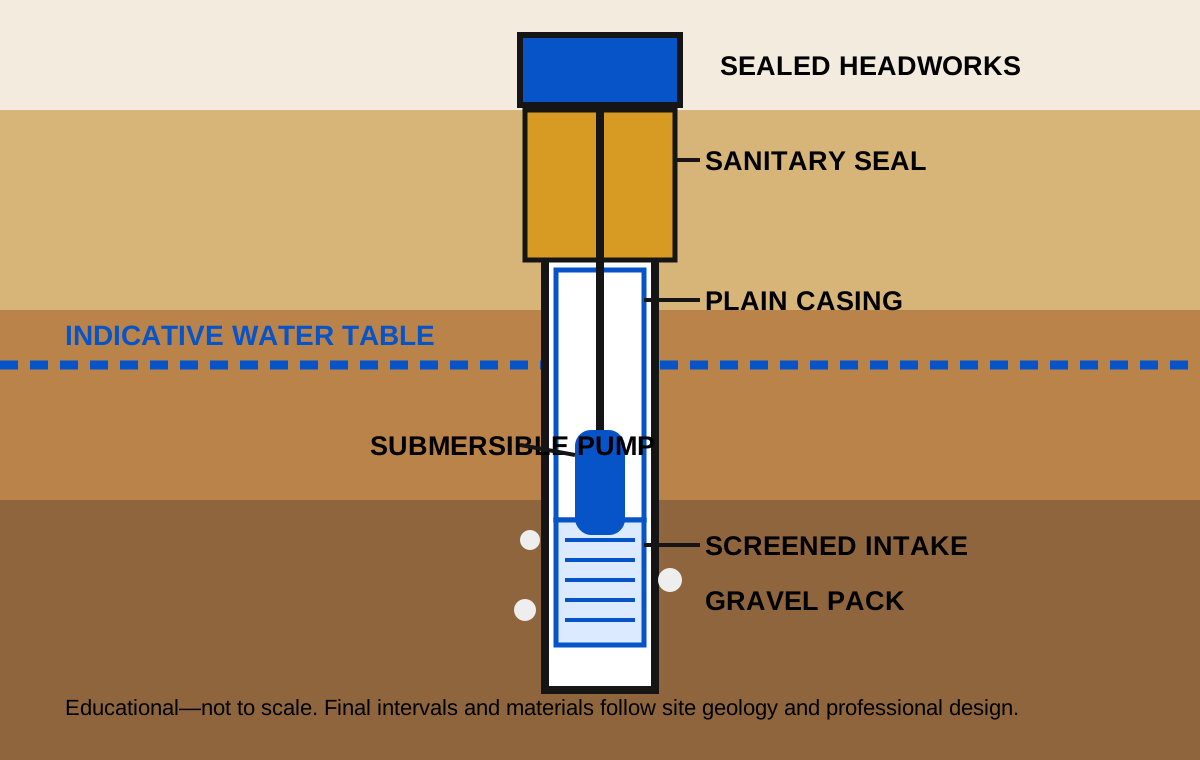
At the borehole, confirm that the wellhead is protected, service openings are secure, drainage does not pond around the completion and monitoring points are accessible. The borehole headworks in Kenya guide explains why the top of the borehole should remain sanitary and serviceable.
At storage, review tank access, overflow, ventilation, cleaning history, turnover and any dead sections of connected pipework. At treatment equipment, record the media or process type, service history, bypass position, pressure loss and any alarms. At buildings, compare hot and cold water and several branches before deciding the source is uniform across the property.
Water testing when borehole water smells like rotten eggs
Testing should answer the question created by the observation. If borehole water smells like rotten eggs at several points, tell the laboratory where each sample came from and what you observed. Ask the laboratory or qualified water professional to recommend a suitable parameter set for the intended use and suspected water-quality issue rather than ordering an arbitrary package.
Sampling technique matters because a poorly chosen point can answer the wrong question. Source water, stored water and point-of-use water can represent different conditions. If the site uses existing treatment, document whether the sample is before or after each treatment stage. This makes the result easier to interpret and prevents a downstream problem being mistaken for raw-borehole quality.
Use borehole water testing and treatment in Kenya and borehole water treatment systems in Kenya as internal planning references. Treatment should follow measured conditions, intended use and design flow.

Common mistakes when borehole water smells like rotten eggs
Several purchasing mistakes can make borehole water smells like rotten eggs more expensive to solve than necessary. Most happen when the owner skips diagnosis and jumps directly to hardware.
- Buying by odor alone. A smell is a symptom, not a complete treatment specification.
- Testing only one point. One sample may not show whether the issue begins at the source, storage or building plumbing.
- Ignoring flow rate. Treatment performance depends on the duty the equipment must handle.
- Ignoring maintenance. Any selected process should have a realistic service, cleaning, media, monitoring and spare-parts plan.
- Changing the pump first. Pump replacement does not automatically correct a water-quality problem.
- Combining unrelated symptoms. Odor, staining, hardness, low pressure and falling yield can require separate evidence even if they occur at the same site.
If the borehole also has declining output, use borehole water reducing over time to keep source-performance diagnosis separate from water-quality diagnosis.
Worked example: comparing investigation completeness
Consider three approaches after borehole water smells like rotten eggs. Approach A buys treatment from the smell alone. Approach B adds a water test. Approach C maps the water path, compares source, storage and point-of-use observations, obtains representative testing, checks system duty and then selects treatment. The chart does not claim measured performance; it only illustrates how much diagnostic scope each approach includes.
| Illustrative approach | Diagnostic-completeness index |
|---|---|
| Odor-only purchase | 35 |
| Test-only approach | 65 |
| Source-to-tap investigation | 100 |
The lesson is simple: borehole water smells like rotten eggs should trigger a structured investigation that connects the symptom to the water path and the intended use.
Features of our borehole water smells like rotten eggs assessment
| Feature | What it gives you |
|---|---|
| Source-to-tap system review | A clearer picture of where the odor first appears |
| Sampling plan | Testing points matched to the problem rather than one arbitrary sample |
| Demand and flow review | A treatment brief sized around how the site actually uses water |
| Storage inspection | Visibility into tank turnover, cleaning and downstream conditions |
| Treatment comparison | Options evaluated by measured need, maintenance and operating duty |
| Verification plan | A way to confirm whether corrective work has solved the reported issue |
Advantages of a structured approach when borehole water smells like rotten eggs include:
- Less guesswork because the first affected point is documented.
- Better quotations because bidders receive the same water-quality and flow brief.
- More appropriate equipment because treatment is connected to actual duty.
- Easier maintenance because the owner keeps baseline records.
- Clearer verification because post-work results can be compared with the original condition.
borehole water smells like rotten eggs pricing
There is no responsible single price for borehole water smells like rotten eggs before the site, sampling scope, water demand and required treatment are defined. The indicative table therefore uses $— until a site-specific scope is verified.
| Budget line | Indicative price | Confirm before approval |
|---|---|---|
| Site and system assessment | $— | Inspection points, water path and operating brief |
| Representative water testing | $— | Sampling points, parameter set and intended use |
| Storage corrective work if required | $— | Cleaning, access, turnover, fittings and sanitary condition |
| Treatment equipment if justified | $— | Design flow, process, media, controls and installation |
| Commissioning and verification | $— | Operating checks, follow-up observations and retesting plan |
| Maintenance provision | $— | Service intervals, consumables, monitoring and recordkeeping |
How to compare treatment quotations
Once borehole water smells like rotten eggs has been investigated, compare quotations on equivalent scope. Each bidder should state which test results were used, the treatment duty, pretreatment assumptions, storage or plumbing changes, electrical requirements, waste or backwash handling, commissioning, maintenance and exclusions.
A quotation that lists only an equipment name is difficult to evaluate. Ask what problem the component is intended to address and how success will be verified. Also ask what happens if the measured flow, pressure or water quality differs from the design assumption.
Use how to compare borehole drilling companies in Kenya as a broader contractor-comparison framework. Although odor treatment may involve a water-treatment specialist, the same procurement principle applies: compare scope before comparing totals.
Maintenance after the odor problem is corrected
Corrective work is not complete when borehole water smells like rotten eggs is no longer noticeable on one day. Keep the test report, treatment specification, commissioning settings, storage records, maintenance instructions and follow-up observations. That baseline helps you investigate recurrence without starting from zero.
Monitor practical indicators such as changes in odor, tank condition, flow, pressure, treatment pressure loss, alarms and service dates. If the site has multiple buildings, record where any recurrence appears first. See borehole maintenance in Kenya for a broader asset-maintenance checklist.
When to bring in a water professional
If borehole water smells like rotten eggs persists, changes suddenly, appears with other water-quality concerns, or affects a shared supply, use qualified professional support rather than trial-and-error treatment. The same applies when treatment requires process sizing, electrical work, pressure vessels, dosing equipment, significant plumbing changes or interpretation of laboratory results.
Professional involvement is also valuable when you need a written specification for competitive quotations. A clear specification turns an odor complaint into a defined project with sampling points, flow duty, treatment objective, maintenance responsibilities and verification criteria.
How to get started when borehole water smells like rotten eggs
Start with a simple site brief: where the odor appears, when it is strongest, whether hot and cold water differ, which storage and treatment equipment exists, the approximate water-demand pattern, and any recent maintenance. Then arrange representative testing and a system inspection that follows water from source to point of use.
Do not approve final treatment solely from a photograph, smell description or product advertisement. borehole water smells like rotten eggs is best handled as a measured water-system problem with a documented before-and-after record.
borehole water smells like rotten eggs FAQs
Why does borehole water smells like rotten eggs happen?
The odor can arise from conditions at the source or elsewhere in the water system. Because smell alone cannot locate the cause, compare source, storage, treatment and point-of-use observations and use representative testing.
Should I test the water if borehole water smells like rotten eggs?
Yes. A representative testing plan helps define the water-quality problem and provides evidence for treatment selection. Tell the laboratory where the sample was collected and what you observed.
Can a storage tank make the odor more noticeable?
Storage can change water conditions, so compare samples and observations before and after the tank. Inspect turnover, cleaning history, ventilation, access and downstream plumbing as part of the investigation.
Why is the smell stronger at hot-water taps?
If the odor is stronger only in hot water, compare hot and cold outlets and inspect the hot-water system before treating the entire borehole supply. The location of the symptom is important diagnostic evidence.
Can I choose a filter from the smell alone?
No. Treatment should be selected from representative water-quality evidence, design flow, intended use and the complete water-system configuration.
How do I know whether corrective work succeeded?
Repeat the relevant observations and testing after commissioning. Keep the results, operating settings and maintenance plan so future changes can be compared with the new baseline.
Turn borehole water smells like rotten eggs into a measured decision
borehole water smells like rotten eggs becomes easier to solve when you stop treating the odor as a product-selection question and start tracing the complete water path. Map where it first appears, test representative water, inspect storage and plumbing, size any treatment to real demand, and verify the result after commissioning.
The goal is a maintainable water system with evidence behind every corrective decision. That approach protects the project from unnecessary equipment changes and gives you a clear record if the condition returns.