how to measure borehole depth is a practical question when records are missing, a pump is being replaced, or a completed source needs to be checked before new equipment is installed. This guide explains the measurements you should separate, the records to keep, the tools professionals use, and how to avoid confusing total drilled depth with water level or pump setting.
Why how to measure borehole depth matters
how to measure borehole depth matters because several different measurements are often described casually as “the depth.” The final drilled depth is not the same as the static water level. The pump setting is not the same as the pumping water level. If those values are mixed together, pump sizing, cable length, rising-main length and maintenance decisions can all be wrong.
The best starting point is the original drilling and completion record. If that record is available, review it before doing any new measurement. The record should identify the final depth and key construction information, while the pumping-test report should provide water-level observations and discharge information. Our borehole test pumping Kenya guide explains why those measurements matter after drilling.
If records are missing or the source has changed, a professional depth check can create a new baseline. The goal is not only to answer how to measure borehole depth, but to produce a measurement that can be repeated and understood later.
How to measure borehole depth: separate the four numbers
Before choosing a method, define the quantity you need. A useful borehole record separates total depth, static water level, pumping water level and pump installation depth. These values answer different questions and may require different equipment or operating conditions.
| Measurement | Meaning | Typical use |
|---|---|---|
| Total borehole depth | Distance from the selected reference point to the bottom of the accessible borehole | Construction review, rehabilitation planning and equipment checks |
| Static water level | Resting water level after suitable recovery | Groundwater baseline and lift calculations |
| Pumping water level | Water level while pumping at a stated discharge | Drawdown, pump sizing and performance assessment |
| Pump setting depth | Installation position of the pump intake or pump assembly | Cable, rising main, service work and operating margin |
Because these numbers are different, how to measure borehole depth should always begin by naming the target measurement on the job sheet. That simple step prevents a technician from reporting a water level when the client actually needs total depth, or from using a pump-setting figure as if it were the bottom of the hole.
How to measure borehole depth from a consistent reference point
how to measure borehole depth also depends on the reference point. The measurement should start from a clearly identified location at the top of the borehole or headworks. If future measurements start from a different point, the values can appear to change even when the borehole has not changed.
Record the reference point in writing and, where helpful, photograph it. If the top of casing is used, say so. If a different fixed point is used because of headworks design, document that instead. Consistency is more useful than a vague “ground level” description that another technician may interpret differently.
How to measure borehole depth step by step
A professional how to measure borehole depth workflow should be planned before any instrument is lowered. First confirm the borehole identity and available records. Then inspect the headworks and access arrangement. Next define whether the job is measuring total depth, water level, pump setting or several values. Finally, record the measurement method, reference point, date and operating condition.
- Review records. Collect the drilling log, completion record, pumping test and pump-installation details.
- Inspect access. Confirm that the measurement route is suitable and that installed equipment does not obstruct or endanger the instrument.
- Define the target. State whether you need total depth, static water level, pumping water level or pump setting.
- Fix the reference point. Use one identifiable point and record it.
- Measure carefully. Use equipment appropriate to the target measurement and the borehole configuration.
- Repeat the reading. A repeat check helps identify obvious recording or handling errors.
- Document conditions. Note whether the pump was off, recovering or running, and record the discharge where relevant.
- Compare with history. Review previous records before concluding that the borehole has physically changed.
For water-level work, one simple relationship is:
In plain English, drawdown s is the difference between pumping water level and static water level when both are referenced consistently.
Choosing the right method for how to measure borehole depth
Different measurements need different tools. A water-level meter is designed to identify the water surface, while a total-depth measurement requires a method that reaches the bottom reference without being confused by water level. Installed pumps, cables, rising mains and narrow access can also change what is practical. That is why how to measure borehole depth should be handled as a site-specific measurement task rather than a one-tool job.
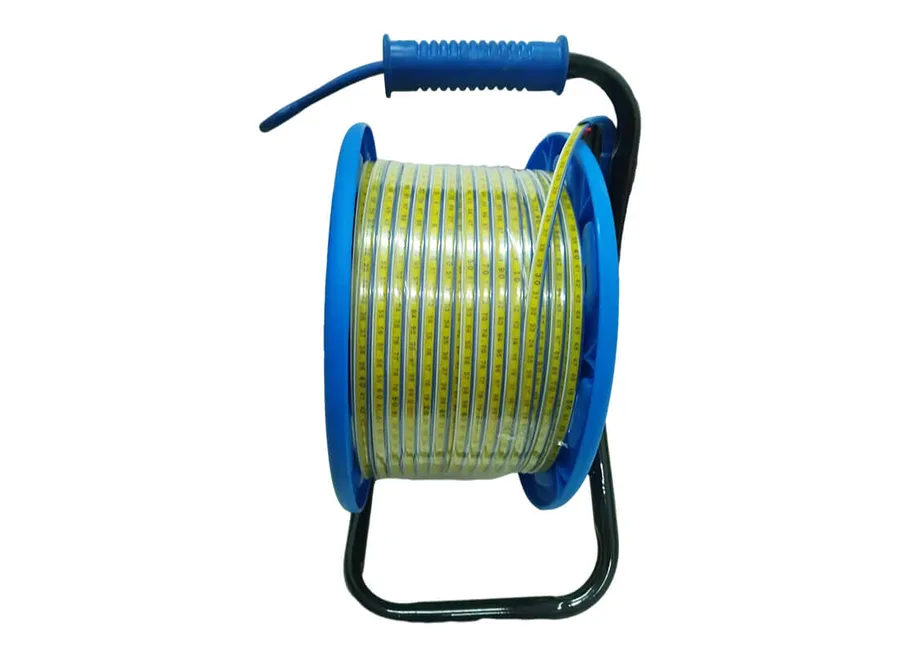
The site currently lists a 100m borehole water-level meter for static and pumping water-level work. That equipment is useful for water-level measurement, but a water-level reading is not automatically the total borehole depth. The distinction is central to a correct how to measure borehole depth record.
When planning pump replacement, the measurement should also be connected to the equipment duty. See borehole pump sizing in Kenya before selecting a pump from depth alone.
In plain English, pump head combines pumping lift, elevation, friction and required delivery pressure. Total borehole depth is only one background measurement.
Worked example: how to measure borehole depth without mixing values
Imagine a borehole with an old invoice that lists one depth, a current pump installed at another depth and a water-level meter showing a much shallower resting level. None of those values is necessarily wrong. They may simply describe different things. A proper how to measure borehole depth exercise labels every value and compares it with the construction record.
If the purpose is pump replacement, the technician should confirm the pump setting, water levels and required delivery duty. If the purpose is rehabilitation planning, total accessible depth and construction details may be more important. If the purpose is long-term monitoring, repeatable static and pumping water levels may provide more value than repeatedly measuring the bottom of the borehole.
| Illustrative record item | Relative priority index |
|---|---|
| Reference point | 100 |
| Measurement type | 92 |
| Operating condition | 84 |
| Historical comparison | 76 |
Features of our how to measure borehole depth service
| Feature | Benefit |
|---|---|
| Record review | Separates original drilled depth from later operating measurements |
| Reference-point documentation | Makes future readings comparable |
| Static water-level measurement | Creates a resting groundwater baseline |
| Pumping water-level measurement | Supports drawdown and pump-duty assessment |
| Pump-setting review | Helps plan cable, rising main and service work |
| Historical comparison | Shows whether a change is real or only a documentation difference |
| Handover sheet | Keeps the measurement useful for future technicians |
Advantages of a documented how to measure borehole depth process include:
- Fewer pump-selection errors because total depth and pumping lift are not confused.
- Better maintenance decisions because current readings can be compared with a baseline.
- Clearer quotations because cable, rising main and pump work can be scoped from known measurements.
- Safer records because each number has a defined reference point and meaning.
- Better rehabilitation planning because accessible depth and construction records can be reviewed together.
- More useful monitoring because water-level changes are separated from physical borehole depth.

How to measure borehole depth pricing
how to measure borehole depth pricing depends on the access arrangement, whether only water level is required, whether installed equipment limits access, whether pump removal is part of the job and whether the visit includes a wider pump or performance assessment. Ask for a scope that identifies exactly what measurements will be reported.
| Scope | Indicative price | What to confirm |
|---|---|---|
| Record and headworks review | $— | Documents, access point and reported measurement targets |
| Static water-level check | $— | Reference point, recovery condition and recorded result |
| Pumping water-level check | $— | Discharge condition, timing and water-level readings |
| Depth and pump-setting assessment | $— | Access limitations, equipment scope and handover sheet |
How to measure borehole depth when the pump is installed
An installed pump can restrict access and can make a simple depth check impractical. Do not force measuring equipment past cables, rising mains or other components. Instead, review the pump-installation record and decide whether the information you need can be obtained from existing documents, water-level measurements or a planned service intervention.
This is especially important when how to measure borehole depth is being asked only because a pump is failing. The actual diagnostic need may be water level, pump setting, electrical performance or flow rather than total depth. Our borehole maintenance guide shows how to define the complaint before dismantling equipment.
How to measure borehole depth for a pump replacement
For pump replacement, record the existing pump model, setting depth, cable length, rising main, static water level, pumping water level and delivery duty. Then compare those records with the pumping-test information. A replacement pump should not be chosen simply because it can fit the known total depth.
A correct how to measure borehole depth file helps the installer distinguish between the physical completion and the hydraulic lift. That distinction can prevent unnecessary oversizing and can reveal whether a reduced water supply is actually caused by source performance, pump wear or downstream restrictions.
How to measure borehole depth for rehabilitation
Rehabilitation planning may need information about accessible depth, sediment accumulation, construction condition and hydraulic performance. If a borehole appears shallower than the original record, do not assume the cause before investigation. Deposits, sediment, obstructions or measurement differences can all affect what is observed.
Use the borehole rehabilitation Kenya guide to connect measurements with a diagnosis. A how to measure borehole depth visit should produce evidence for the next decision rather than automatically triggering cleaning or pump replacement.
How to measure borehole depth and static water level
Static water level should be measured under a defined non-pumping condition after sufficient recovery for the purpose of the assessment. Record the time, reference point and recent pumping history. If the source is used heavily, the reading may not represent a fully recovered condition unless the operating context is documented.
For repeat monitoring, consistency matters more than casual precision. Use the same reference point and a comparable operating condition. Then how to measure borehole depth becomes part of a wider monitoring record rather than a one-time number.
How to measure borehole depth and pumping water level
Pumping water level only makes sense when the pumping condition is stated. Record the discharge or a reliable flow reference, the elapsed pumping time and the water-level reading. A different pumping rate can produce a different drawdown, so comparing readings without operating context can be misleading.
The borehole flow meter prices Kenya guide explains how measured flow supports monitoring. Combined with water-level data, it makes a how to measure borehole depth record more useful for performance assessment.

Common how to measure borehole depth mistakes
- Calling a static water-level reading the total borehole depth.
- Using pump setting as if it were the bottom of the borehole.
- Changing the reference point between visits.
- Comparing pumping water levels taken at different discharge conditions without noting the difference.
- Forcing measurement equipment past installed components.
- Ignoring the original drilling and pump-installation records.
- Buying a pump from total depth alone.
- Recording a number without the date, method or operating condition.
How to get started with how to measure borehole depth
Collect the drilling log, pumping-test report, pump model and installation details first. Decide why you need the measurement. If the goal is pump replacement, the required information is different from a rehabilitation investigation or a routine water-level monitoring visit. Then arrange the measurement around the actual decision.
A well-planned how to measure borehole depth assessment should leave you with a clear handover sheet. That sheet should name each measurement, reference point, operating condition and source document so another technician can repeat the work later.
How to measure borehole depth FAQs
Is static water level the same as borehole depth?
No. Static water level is the resting water surface. Total borehole depth is the distance to the bottom of the accessible completed hole.
Is pump setting the same as total depth?
No. The pump is normally installed above the final bottom and its setting should be recorded separately.
Can a water-level meter measure total borehole depth?
A water-level meter is primarily used to identify the water surface. Do not assume a water-level reading is the total depth.
Why does the reference point matter?
Using the same reference point makes readings comparable. Changing the starting point can create an apparent difference that is only a recording issue.
Should I measure depth before replacing a pump?
Review total depth, pump setting, water levels and the pumping-test record together. Pump replacement depends on hydraulic duty, not total depth alone.
Can borehole depth change over time?
The constructed depth does not normally change, but accessible depth can appear different if sediment, deposits, obstructions or measurement conditions change.
What should be written on the measurement report?
Record the measurement type, reference point, date, method, operating condition and result, plus any relevant historical comparison.
Make how to measure borehole depth repeatable
how to measure borehole depth is most useful when every number has a clear meaning. Separate total depth from water level and pump setting, use a consistent reference point, record the operating condition and keep the result with the drilling and pumping-test documents. That turns one measurement into a reliable technical record for maintenance, pump replacement and future troubleshooting.
Quality checks after you measure borehole depth
After a how to measure borehole depth visit, review whether the reported values are internally consistent. The total depth should be clearly separated from the static water level, pumping water level and pump setting. The report should also identify the reference point, date, measurement method and operating condition. If any of those are missing, the number may be difficult to use later.
Compare the new result with the original drilling log and the latest service records. A difference does not automatically mean the borehole changed physically; it can come from a different reference point, a different measurement target, an obstructed access path or a documentation error. A careful how to measure borehole depth review therefore checks both the field reading and the history before recommending equipment changes.
Finally, store the measurement with the pump and test-pumping documents. Future technicians can then see exactly what was measured and why. That is especially valuable when a pump is replaced years later, because the next installer can distinguish the borehole geometry from the hydraulic conditions that determine pump duty. In this way, how to measure borehole depth becomes part of a repeatable maintenance system rather than a one-off number.