
borehole water for livestock Kenya planning should begin with the herd’s real demand, tested source performance, storage and water quality rather than a pump size chosen from horsepower alone. This guide shows you how to turn animal numbers, farm operations and trough locations into a practical borehole, pump, tank and distribution brief that can be quoted and commissioned properly.

Why borehole water for livestock Kenya matters
A borehole water for livestock Kenya project is a water-delivery system, not simply a drilled hole. Animals may drink in short peaks, cleaning may add demand at different times, and distant paddocks may sit at different elevations. The borehole can perform well yet the farm can still experience slow trough refill, low pressure or pump trips if storage and distribution are poorly matched to the duty.
Start by separating daily volume from peak flow. Daily volume helps you understand how much water the system must produce over the operating period. Peak flow helps you size the tank outlet, distribution pipework and trough controls so short high-demand periods do not force the borehole pump to chase every draw.
Use tested borehole performance as the source limit. The borehole test pumping Kenya guide explains why measured discharge and water-level response are more useful than drilled depth when deciding how the source should operate.
Farm planning tip: design the borehole to refill storage at a sustainable duty, then design storage and distribution to handle the herd’s short demand peaks.
borehole water for livestock Kenya: step-by-step method
A strong borehole water for livestock Kenya plan uses a simple sequence. Each stage converts a farm need into a measurable design input, reducing the risk of buying a pump or tank before the actual duty is known.
- List every water user. Separate animal groups, cleaning, dairy or housing operations, staff use and any irrigation or wash-down demand.
- Map the demand pattern. Note when animals drink, when cleaning happens and which activities overlap.
- Review tested borehole yield. Use pumping-test evidence and water-level behavior to establish the operating basis.
- Choose realistic pumping hours. Consider power availability, solar hours if relevant, maintenance and the storage strategy.
- Size reserve storage. Provide a buffer between steady borehole production and short farm demand peaks.
- Map troughs and pipe routes. Record distance, elevation, branch layout, expected simultaneous use and isolation needs.
- Check water quality. Use representative testing for the intended livestock and farm use rather than judging water only by appearance.
- Commission the system. Verify tank recovery, trough refill, pressure, controls, protection and baseline water-quality records.
A first planning formula for borehole water for livestock Kenya connects daily demand with the pumping period:
In plain English, required average pumping flow equals the daily volume divided by the realistic pumping time. Storage then helps absorb demand peaks that are higher than this steady production rate.
How to evaluate borehole water for livestock Kenya without guessing
For borehole water for livestock Kenya, keep the source, storage and delivery network as separate design questions. The source tells you what can be produced. Storage tells you how much reserve is available. The distribution network tells you whether water can reach each trough at the required flow and pressure.
Record the pump model, installation depth, controller, tank capacity, major pipe sizes, trough locations and any existing flow or pressure readings. If the farm already operates a borehole, compare present tank refill and trough refill with the original commissioning record where available.
Choosing the right approach to borehole water for livestock Kenya
The right borehole water for livestock Kenya arrangement depends on the farm layout and operating pattern. A compact dairy unit, an extensive grazing property and a mixed farm may use the same total daily volume but need very different pipework, pressure and storage arrangements.
| Decision | Use this evidence | Avoid this mistake |
|---|---|---|
| Borehole operating flow | Pumping-test results and water-level response | Sizing from drilled depth alone |
| Pump selection | Required flow plus total delivery head | Choosing by horsepower only |
| Storage | Daily demand, peak demand and interruption tolerance | Using a tank that only matches one short demand period |
| Distribution | Pipe length, elevation, branch flow and trough layout | Using one pipe size everywhere without checking losses |
| Water treatment | Representative test results and intended use | Installing treatment from appearance alone |
A second planning formula shows why delivery head matters in borehole water for livestock Kenya pump selection:
In plain English, the pump must overcome vertical lift, elevation changes, pipe friction and the pressure needed at the delivery point. See borehole pump sizing in Kenya before buying equipment.
Define livestock demand before selecting equipment
A dependable borehole water for livestock Kenya brief should identify each animal group and how the farm operates. Demand changes as herd size, weather, feeding systems, housing and cleaning routines change. Therefore, document the current herd and a realistic expansion case instead of designing only for today.
Separate animal drinking demand from wash-down, dairy operations, staff use, gardens or other uses. This helps you decide which demands are critical and which can be shifted to different times. If several uses overlap, storage and distribution may need to handle a higher short-term flow even when the borehole’s sustainable pumping rate stays constant.
When a farm has more than one water source, define the role of each. A borehole may be the primary source, a backup source, or one part of a combined system. The borehole water for livestock Kenya design should state what happens when one source is unavailable.
Tested borehole yield sets the source limit
For borehole water for livestock Kenya, do not confuse drilled depth with available water. Test pumping provides evidence about how the completed borehole responds while water is being abstracted. That evidence supports the operating rate and the final pump decision.
If the borehole already exists, keep static water level, pumping water level, discharge and recovery records where available. Changes over time can be more useful than one isolated reading. See static water level vs pumping water level for the difference between the two measurements.
If the farm’s demand is greater than the source should provide continuously, the answer is not automatically a bigger pump. Storage, pumping hours, demand management or a wider water-supply strategy may be required.
Storage is the buffer between the borehole and the herd
Storage is central to borehole water for livestock Kenya design because it separates a steady pumping process from short consumption peaks. A correctly planned tank gives the pump time to refill water while the herd drinks at its own pattern.
Use borehole water tank size in Kenya to build the storage decision around daily demand, pumping hours and reserve needs. The tank arrangement should also consider cleaning access, overflow, isolation, level controls and how water reaches the trough network.
Reserve capacity should reflect the consequence of downtime. A farm with no alternative source may need a different resilience strategy from a farm that can temporarily switch to another supply.
Pipework and trough delivery need their own design
A borehole water for livestock Kenya system can have adequate source yield and storage yet still perform poorly because of distribution losses. Long pipe runs, elevation changes, undersized branches and simultaneous trough demand can reduce the flow available at distant points.
Map the route before finalising pipe sizes. Identify high points, low points, isolation valves, branch junctions, trough float controls and future paddocks. If the terrain changes significantly, consider whether one pressure zone is appropriate or whether the network should be divided.
Commission the trough network under realistic demand rather than opening one outlet at a time. Record refill performance at representative locations so later maintenance teams know what normal operation looked like.
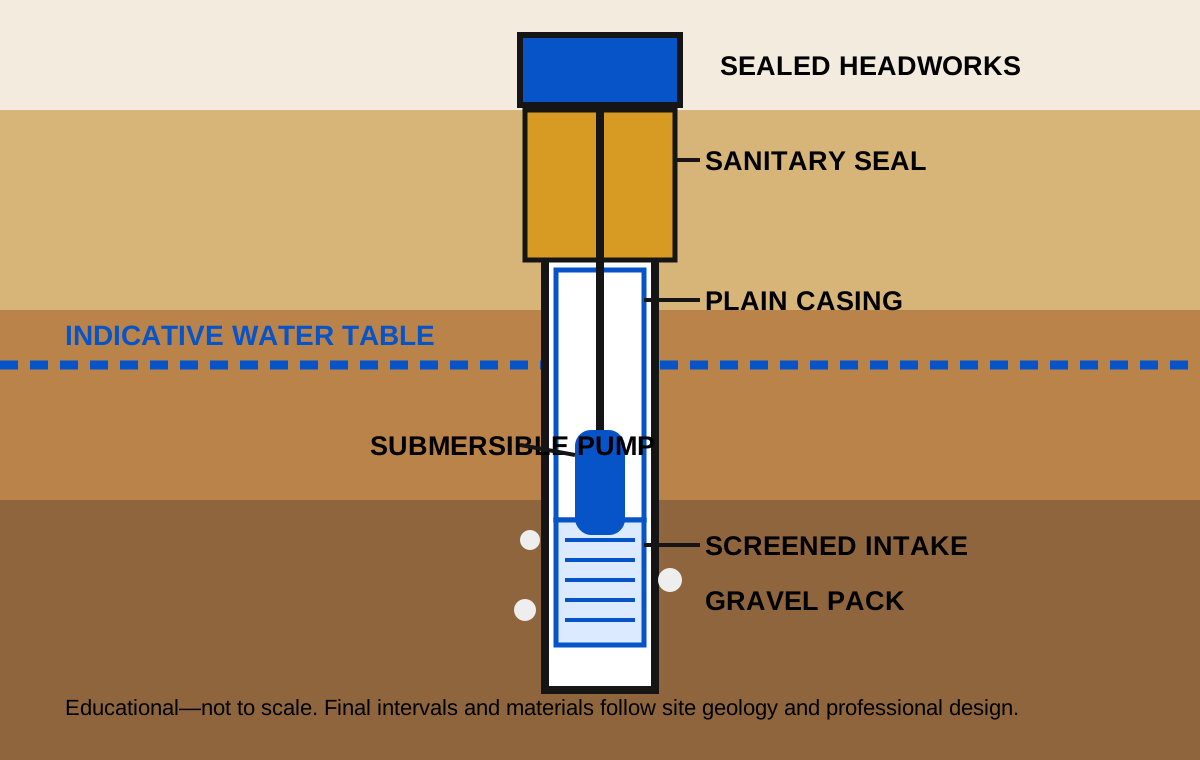
Water quality for livestock use
Water quality remains part of borehole water for livestock Kenya planning. Do not assume clear water is automatically suitable for every intended use, and do not assume a treatment package is needed until representative testing defines the problem.
Tell the laboratory or water professional that the water is intended for livestock and describe any additional uses. Sampling should represent the water actually being supplied. If water passes through storage or treatment before reaching animals, distinguish source-water sampling from delivered-water sampling.
Use borehole water testing and treatment in Kenya for a wider testing framework. Keep laboratory results with the farm’s borehole records so future changes can be compared with a baseline.
Common mistakes with borehole water for livestock Kenya
The most avoidable borehole water for livestock Kenya problems usually come from designing one component in isolation.
- Sizing the pump from horsepower. Pump duty should follow tested yield and total head.
- Skipping storage. Directly matching every demand peak can create poor operation and unnecessary cycling.
- Ignoring long pipe runs. Friction and elevation matter at distant troughs.
- Ignoring water quality. Suitability should be verified for the intended use.
- No expansion allowance. Herd growth can change both daily volume and peak distribution demand.
- No monitoring. Without flow, tank-level or refill records, gradual changes are difficult to spot.
Worked example for borehole water for livestock Kenya
Imagine three farm-water approaches. The first connects a pump directly to the trough network. The second adds storage. The third combines tested source performance, storage, mapped distribution, controls, water testing and commissioning. The chart is illustrative data only and does not represent measured farm performance.
| Illustrative approach | Planning-completeness index |
|---|---|
| Pump + troughs | 40 |
| Pump + storage | 70 |
| Complete farm-water plan | 100 |
The borehole water for livestock Kenya lesson is that a working source is only one part of dependable farm water. Storage, delivery and controls determine whether the water reaches animals when they need it.
Features of our borehole water for livestock Kenya service
| Feature | What it gives you |
|---|---|
| Farm-demand brief | Current and planned animal and operational water needs |
| Test-led source review | Operating duty linked to measured borehole performance |
| Pump-duty calculation | Flow and head considered together |
| Storage planning | Reserve and peak-demand buffering |
| Trough-network review | Pipe routes, elevation and simultaneous use considered |
| Water-quality baseline | Testing linked to the intended farm use |
| Commissioning record | Tank recovery, controls and delivery performance documented |
Advantages of a structured borehole water for livestock Kenya plan include:
- More reliable trough refill because distribution is checked under realistic demand.
- Better pump protection because operating duty follows source evidence.
- Useful reserve storage because tank capacity is connected to farm operations.
- Clearer maintenance because the farm receives commissioning records.
- Easier expansion because the original system brief documents capacity and constraints.
borehole water for livestock Kenya pricing
A responsible borehole water for livestock Kenya quotation depends on the site, tested source, herd demand, pump duty, storage, pipe route and water-quality scope. Until those are verified, use $— rather than inventing a farm-wide price.
| Budget line | Indicative price | Confirm before approval |
|---|---|---|
| Assessment and farm-demand brief | $— | Water users, layout, records and site visit |
| Source testing / review | $— | Pumping-test and water-level information |
| Pump and controls | $— | Duty point, installation, protection and commissioning |
| Storage | $— | Capacity, base, fittings, controls and reserve strategy |
| Distribution to troughs | $— | Pipe sizes, route, valves, branches and pressure |
| Water-quality testing / treatment | $— | Representative testing and justified treatment only |
| Handover | $— | Settings, baseline readings and maintenance guidance |
How to compare livestock borehole quotations
For borehole water for livestock Kenya, compare equivalent scope rather than headline totals. Ask each bidder to show the source evidence, pump duty, storage, distribution assumptions, control strategy, water-quality scope, commissioning and exclusions.
If one quotation includes only pump installation while another includes tank controls, long pipe runs, trough valves and commissioning, the totals are not comparable. Put every offer into the same table before making a commercial decision.
Use how to compare borehole drilling companies in Kenya for the wider contractor checklist. Ask how variations are approved if the measured duty or pipe quantities differ from the initial assumptions.
Monitoring and maintenance on the farm
After commissioning borehole water for livestock Kenya, keep a baseline. Record the normal tank refill pattern, representative trough refill, pump run behavior, protection settings, water-quality results and the date of service work.
A flow meter or consistent tank-fill record can help reveal changes. Review borehole flow meter prices in Kenya if ongoing abstraction or delivery monitoring is useful for the farm.
Do not bypass dry-run, overload or level protection simply to keep water flowing. Repeated trips should trigger diagnosis. The borehole dry run protection guide explains why protection should be treated as evidence rather than an inconvenience.

How to get started with borehole water for livestock Kenya
Prepare the site pin, herd groups, farm water uses, trough map, current tank capacity, power source, existing pump details and any pumping-test or water-quality records. Mark future paddocks or herd expansion so the first design does not hide an obvious upcoming requirement.
Then request an itemized borehole water for livestock Kenya scope that separates source review, pump, controls, storage, distribution, testing and commissioning. Unknown items should be labelled as assumptions or provisional rather than silently embedded in one figure.
borehole water for livestock Kenya FAQs
Can borehole water for livestock Kenya be used directly?
Suitability should be based on representative water-quality testing, the intended livestock use and the complete farm system rather than appearance alone.
How do I size a borehole pump for livestock?
Use tested borehole performance, required average flow, total delivery head, realistic pumping hours and the storage strategy. Do not select the pump from horsepower or drilled depth alone.
Does a livestock borehole need a storage tank?
Storage is usually valuable because it separates steady borehole production from short drinking and cleaning peaks and can provide reserve during maintenance or power interruptions.
How should pipes to troughs be sized?
Use route length, elevation, expected simultaneous flow, branch layout and acceptable pressure loss. Long farm networks should be evaluated as distribution systems.
Should livestock borehole water be tested?
Yes. Use representative testing for the intended farm use and keep the result as a baseline for later monitoring.
What should be checked at commissioning?
Verify borehole operating flow, tank recovery, representative trough refill, controls, protection settings and the water-quality baseline.
Make borehole water for livestock Kenya a complete farm-water decision
borehole water for livestock Kenya works best when source, pump, storage, distribution and water quality are planned together. Define the herd and farm demand, use test evidence, buffer peaks with storage, map the trough network, commission under realistic demand and keep the resulting baseline.
The goal is not simply to get water out of the ground. It is to deliver dependable water where the animals need it while protecting the borehole and making future maintenance easier.
Farm water resilience and future expansion
A livestock water system should remain understandable when the herd changes, paddocks are added, or a new cleaning activity increases demand. Keep the original demand brief and commissioning readings so expansion begins from evidence rather than from memory. Before adding another trough branch, compare the proposed simultaneous flow with the existing pipe route, storage recovery, pump duty and source operating limit. This prevents a small extension from creating poor refill performance elsewhere on the farm.
Plan isolation points so one trough or branch can be serviced without unnecessarily stopping the entire network. Keep valves, float controls and monitoring points accessible, and label the main branches where practical. If solar pumping is used, review how seasonal operating hours interact with tank reserve and the farm demand schedule. If grid power is used, define what reserve is needed for expected interruptions and maintenance. The objective is resilience through storage, sensible controls and clear operating responsibility rather than oversizing one component.
When the farm expands, recommission the affected parts of the system. Record tank recovery, representative trough refill and any protection events under the new demand. Update the farm water map and equipment record so the next technician can see what changed. A short, current operating record is especially useful when several workers or contractors share responsibility for the same water system.