
borehole water nitrate Kenya concerns can be difficult to interpret when a laboratory report shows nitrate but the owner does not know what caused it or what to do next. This guide shows you how to plan representative testing, review the borehole-to-tap system, compare treatment approaches, verify performance, and request a scope based on evidence instead of guesswork.

Why borehole water nitrate Kenya needs evidence first
borehole water nitrate Kenya is a water-quality search intent, not a diagnosis by itself. A result needs context: where the sample came from, when it was collected, whether the borehole had been operating normally, and what the water will be used for. Without that context, owners can spend money on treatment that does not address the real source or the full water chemistry.
Start by reviewing borehole water testing and treatment in Kenya. That guide explains why testing should lead treatment selection. For nitrate-focused work, the same principle applies: define the problem, collect useful evidence, and only then specify equipment or corrective work.
Technical tip: do not select a treatment unit from one isolated number. A useful plan links laboratory results, source condition, flow demand, storage, plumbing and the intended water use.
borehole water nitrate Kenya: step-by-step method
A practical borehole water nitrate Kenya workflow separates investigation from treatment. That makes quotations easier to compare and gives you a record that can be repeated after corrective work.
- Define the water use. State whether the supply serves drinking, domestic use, livestock, irrigation, process water or another purpose.
- Identify the sampling point. Record whether the sample represents the borehole outlet, storage, treatment outlet or a downstream tap.
- Inspect the source-to-tap route. Note wellhead condition, storage, pipework and any treatment already installed.
- Use a suitable laboratory plan. Ask the laboratory what sample container, preservation, timing and supporting parameters are required for the requested analysis.
- Interpret the result in context. Review nitrate alongside the rest of the water-quality picture rather than treating it as an isolated equipment-selection number.
- Choose the response. The response may involve source protection, system maintenance, alternative water arrangements, treatment, or a combination depending on the evidence.
- Verify the outcome. Repeat appropriate testing after the corrective work and keep the before-and-after records.
How to plan borehole water nitrate Kenya sampling
borehole water nitrate Kenya sampling should answer a specific question. If you want to understand the raw source, collect from a point that represents untreated borehole water. If you want to verify a treatment system, the plan may need both upstream and downstream samples. If you are investigating changes through storage, separate sampling points can help identify where the change occurs.
Use borehole water testing price in Kenya to understand why a laboratory package should be defined by the decision you need to make, not by the cheapest test list.
Map the complete borehole-to-tap system
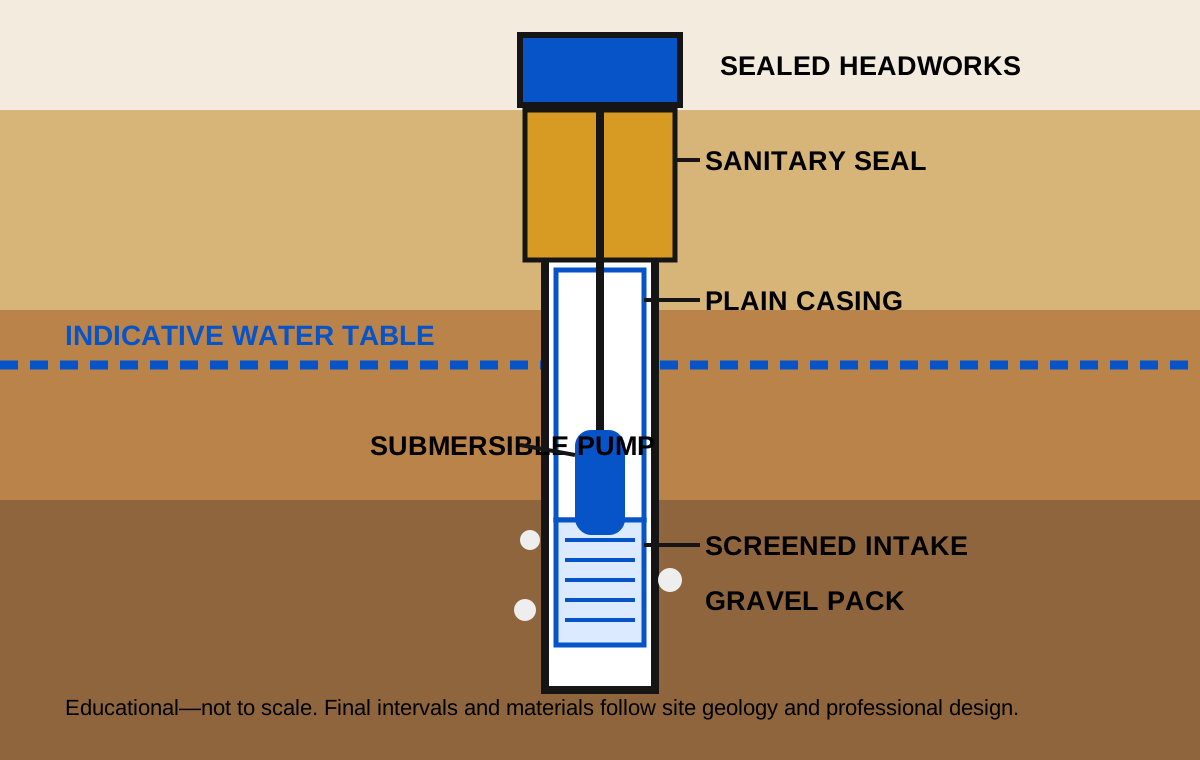
borehole water nitrate Kenya interpretation improves when the physical system is mapped before equipment is ordered. Record the borehole, pump, rising main, headworks, raw-water tank if present, treatment stages, treated-water tank and final distribution. This helps the laboratory result connect to an actual location in the system.
If the borehole has been altered, repaired or recently commissioned, retain the relevant records. A clean diagram also helps a water-treatment contractor identify sensible sampling points and prevents a downstream result from being mistaken for raw source water.
Use representative samples, not convenient samples
For borehole water nitrate Kenya, convenience can reduce the value of a laboratory test. A sample from a rarely used tap, a dirty container or an unknown treatment stage can create uncertainty. The sampling plan should follow the laboratory’s instructions and identify the point clearly.
Record date, time, sampling point, system operating condition and any treatment that was online. If repeat sampling is planned, use the same defined points where practical so the comparison has meaning.
What the laboratory brief should contain
A useful borehole water nitrate Kenya laboratory brief tells the laboratory what decision you are trying to support. Share the intended water use, whether the sample is raw or treated, whether there is an existing treatment plant, and whether the work is initial characterization or post-treatment verification.
Ask for the result units to be clear and retain the original report. Avoid copying only one value into a message and losing the rest of the water-quality context. If a contractor proposes treatment, provide the full relevant report rather than a screenshot of one line.
Turn water demand into a treatment design input
borehole water nitrate Kenya treatment planning is not only about chemistry. The system also needs to handle the required flow and daily volume. A treatment process that works at one flow can be unsuitable when actual peak demand is much higher.
A simple daily-volume relationship is:
In plain English, daily volume is the sum of each water-use flow multiplied by how long that use operates. Your treatment designer should use the real demand profile rather than assuming every site has the same consumption.
Source protection belongs in the nitrate discussion
borehole water nitrate Kenya should trigger a review of the source environment as well as the treatment room. The purpose is not to guess a cause from the nitrate result, but to identify whether the borehole surroundings, wellhead protection, drainage or nearby activities deserve professional investigation.
Use borehole headworks in Kenya to review sanitary wellhead protection. Where site conditions are unclear, a competent groundwater professional can assess the source setting and recommend an appropriate investigation.
Do not confuse nitrate with hardness, salinity or iron
borehole water nitrate Kenya is distinct from other common borehole-water concerns. Hardness can drive scale and softening decisions. Salinity relates to dissolved mineral load. Iron and manganese can cause staining and treatment challenges. Those issues may coexist, but they are not interchangeable.
That is why a full treatment design should use the relevant laboratory data. See borehole water treatment systems in Kenya for a broader test-to-treatment framework.
Choosing the right borehole water nitrate Kenya response
The right borehole water nitrate Kenya response depends on evidence. Some projects need a source-protection review. Some need a treatment process. Some need storage or plumbing changes. Some may need a temporary alternative supply while investigation continues. The objective is to choose a response that fits the tested water and the actual use.
| Decision area | Question to answer | Evidence needed |
|---|---|---|
| Sampling | Does the sample represent the source or treated water? | Defined sampling point and laboratory record |
| Source review | Is there a site condition that needs investigation? | Wellhead and site inspection |
| Treatment | What process is compatible with the full water chemistry? | Laboratory report, flow and daily demand |
| Storage | Can treatment operate steadily while demand varies? | Tank size, peak demand and operating plan |
| Verification | Did the corrective work achieve its objective? | Repeat representative testing |
Use loading, flow and runtime together
For borehole water nitrate Kenya, designers often need to connect concentration, flow and operating time conceptually. A simplified mass-loading relationship is:
In plain English, the amount of a dissolved constituent passing through a system is related to concentration, flow and time. A professional treatment design uses consistent units and equipment-specific design data; this simplified formula is for understanding the relationship, not for selecting a unit by itself.
Storage can make treatment easier to operate
borehole water nitrate Kenya treatment may be easier to manage when source pumping, treatment flow and user demand do not all have to peak at the same moment. Storage can buffer those different operating patterns.
Review borehole water tank size Kenya before changing tank capacity. The right arrangement depends on source production, treatment output, peak use, reserve requirements and how the system is controlled.
Worked example: evidence quality before equipment selection
Imagine three borehole water nitrate Kenya procurement approaches. Option A buys equipment after one unexplained result. Option B repeats the test but does not map demand or sampling points. Option C records the sampling point, reviews the complete chemistry, confirms flow and daily volume, then verifies the selected response after commissioning.
The chart below is illustrative only. It compares planning completeness, not real treatment performance or laboratory values.
| Illustrative approach | Planning index |
|---|---|
| One result + equipment | 35 |
| Repeat test + partial brief | 68 |
| Evidence + design + verification | 100 |
Features of our borehole water nitrate Kenya support
Our borehole water nitrate Kenya support is structured around the decision you need to make rather than a one-size-fits-all product list.
| Feature | What it helps establish |
|---|---|
| Water-use brief | What the supply needs to support |
| Sampling-point review | Where raw and treated samples should represent |
| Laboratory planning | Which questions the testing package should answer |
| System mapping | Borehole, storage, treatment and distribution interfaces |
| Demand review | Flow, daily volume and storage needs |
| Treatment-scope comparison | Whether quotations address the tested water and site |
| Verification planning | How post-work performance will be checked |
Advantages of an evidence-led borehole water nitrate Kenya process include:
- Clearer diagnosis because the sample location and system condition are recorded.
- Better quotations because contractors receive the same laboratory and demand brief.
- Less unnecessary equipment because treatment follows evidence.
- More useful handover records because before-and-after results are retained.
- Better maintenance planning because treatment and storage duties are documented.
- Repeatable verification because future tests can use defined sampling points.
borehole water nitrate Kenya pricing
borehole water nitrate Kenya pricing depends on the testing package, sampling arrangement, site inspection, existing treatment, required flow, daily demand, storage, selected treatment process, installation and verification. No verified universal project price applies to every site, so the table uses $— until the scope is defined.
| Project line | Indicative price | Confirm in quotation |
|---|---|---|
| Sampling and laboratory plan | $— | Sample points, parameters and reporting |
| Source and system review | $— | Wellhead, storage, treatment and distribution scope |
| Treatment design | $— | Water chemistry, flow and daily demand basis |
| Equipment and installation | $— | Defined treatment train, controls and plumbing |
| Commissioning | $— | Operating checks and documentation |
| Verification testing | $— | Post-work sampling and laboratory report |
Compare quotations on the same basis
When you request borehole water nitrate Kenya quotations, give each provider the same information: laboratory report, sampling point, intended use, required flow, daily volume, existing tanks, existing treatment and any space or power constraints. This turns a product comparison into a system comparison.
Ask each quotation to state what is included, what is excluded, what pre-treatment is assumed, what commissioning is included, and what verification is proposed. A low equipment price can be misleading if essential plumbing, controls, consumables or testing are omitted.
Plan maintenance before commissioning
borehole water nitrate Kenya treatment should be handed over with an operating and maintenance plan. The owner needs to know which components require inspection, which consumables are used, what monitoring is expected, and who is responsible for service.
Connect the treatment plan with borehole maintenance in Kenya so source, pump, storage and treatment are managed as one water system rather than separate pieces of equipment.
Retesting is part of the project, not an optional extra
A borehole water nitrate Kenya project is incomplete if no one checks whether the chosen response achieved its objective. Plan verification before the work starts. That means agreeing the sampling points, timing and laboratory scope in advance.
Keep the original and verification reports together. If results change later, the records help your technical team compare conditions rather than starting from memory.
When the result changes over time
If borehole water nitrate Kenya results differ between sampling rounds, do not jump directly to a new treatment purchase. First confirm whether the sampling point, operating condition, laboratory method and system configuration were comparable.
Then review whether anything changed at the borehole, storage, treatment or site. A structured record makes that investigation much more useful than isolated test screenshots.
How to get started with borehole water nitrate Kenya
Start by gathering your latest laboratory report, borehole details, current treatment information and a simple description of how the water is used. Identify where the sample was collected and whether the sample was raw or treated.
Next, request a borehole water nitrate Kenya review that separates investigation, treatment design and verification. If testing needs to be repeated, use a defined laboratory plan rather than collecting an informal sample.
Finally, compare complete scopes, commission the selected solution and keep the verification report with your borehole records.
borehole water nitrate Kenya FAQs
What should I do first after a nitrate result?
Confirm the sampling point, retain the complete laboratory report and define the intended water use before selecting treatment or assuming a cause.
Should borehole water nitrate Kenya be retested?
Repeat testing may be appropriate when the result needs confirmation, the sampling conditions were uncertain, corrective work has been completed, or ongoing verification is part of the management plan. Follow laboratory instructions.
Can I choose treatment from the nitrate number alone?
No single number describes the complete system. A professional design should consider the relevant water chemistry, required flow, daily demand, storage, existing treatment and verification plan.
Where should the sample be collected?
The point depends on the question. Raw-source investigation, storage investigation and treatment verification may require different defined sampling locations.
Does clear water mean nitrate is not a concern?
Appearance alone is not a substitute for laboratory testing. Use representative testing for the parameters relevant to your intended water use.
What should a treatment quotation include?
It should state the design basis, equipment scope, plumbing and controls, installation, commissioning, maintenance assumptions and verification testing.
How do I maintain borehole water nitrate Kenya records?
Keep laboratory reports, sample-point notes, treatment specifications, commissioning records, service history and repeat-test results in one project file.
Build a defensible borehole water nitrate Kenya plan
borehole water nitrate Kenya decisions are stronger when sampling, source review, treatment design and verification are treated as one project. Begin with representative evidence, connect the result to the full water system, and compare providers on equivalent scope.
That approach gives you a clearer technical record, a better basis for spending and a repeatable way to verify the water system after work is completed.
Keep a complete borehole water nitrate Kenya project file
A strong borehole water nitrate Kenya project file should make the next inspection or repeat test easier. Keep the original laboratory report, the sampling-point description, photographs or a simple system sketch, the treatment quotation, commissioning notes, maintenance instructions and the verification report together. If the system is changed later, add the new specification and service record rather than replacing the earlier evidence.
This record matters because borehole water nitrate Kenya decisions may be revisited after a pump change, storage alteration, treatment service or change in water demand. A future technician should be able to see what was tested, where it was tested, what equipment was installed and what the post-work result showed. Clear records also help you compare a new quotation with the original design basis instead of starting from assumptions.
For institutional, rental, commercial or shared systems, assign responsibility for keeping these records and for arranging planned testing. Link the water-quality file to the wider borehole maintenance file so pump, storage, headworks and treatment changes are visible in one place. That makes borehole water nitrate Kenya management a repeatable operating process rather than a one-time purchase.
Use the laboratory record to guide future decisions
Keep the original report in full rather than copying only the line that first attracted attention. Future reviewers may need the surrounding chemistry, the sample description and the laboratory notes to understand whether a later result is truly comparable. Add a simple site sketch and treatment-service history so changes to tanks, plumbing or equipment are visible.
When the property use changes, revisit the water brief as well. A system originally designed for a small household can later serve tenants, a business or another demand pattern. The treatment professional should know that change before recommending equipment or monitoring. A documented baseline makes that review faster and reduces the chance of decisions being made from memory.