dam liner prices Kenya should be compared by HDPE thickness, measured liner area, overlaps, welding, outlet details, ground preparation, anchoring, transport and installation—not by the price per square metre alone. This guide compares the 0.5 mm, 0.75 mm and 1 mm HDPE liner options currently listed by Borehole Drillers Kenya and shows how to turn material pricing into a practical reservoir budget.

Why dam liner prices Kenya vary
A dam or reservoir liner has to cover the floor, side slopes and anchor details. The material may also need extra allowance for overlaps, welding seams, penetrations and site geometry. A buyer who multiplies the water surface area by the liner price can therefore underestimate the required material.
Thickness also changes the price and handling. A thicker liner may offer greater puncture resistance or robustness for demanding sites, but it can cost more and require appropriate welding and handling. The correct specification should follow the reservoir size, ground condition, exposure, expected service and installation method.
Borehole Drillers Kenya currently lists 0.5 mm, 0.75 mm and 1 mm HDPE liner per square metre, plus a reservoir outlet/flange kit supplied by quotation. Those product pages are useful equipment references; final project quantities should come from measured dimensions.
Dam liner prices Kenya: current material prices
| HDPE liner | Current price per m² | Product page |
|---|---|---|
| 0.5 mm HDPE reservoir liner | KES 230/m² | 0.5 mm HDPE liner |
| 0.75 mm HDPE reservoir liner | KES 330/m² | 0.75 mm HDPE liner |
| 1 mm HDPE reservoir liner | KES 430/m² | 1 mm HDPE liner |
These prices are for material per square metre as listed. Installation, welding, ground preparation, anchor trenches, geotextile or cushioning where specified, outlets and transport are separate unless a quotation states otherwise.
Dam liner prices Kenya and measured material area
In plain English, liner area equals the reservoir floor area plus side-slope area plus the material allowance needed for anchoring, overlaps and installation details.
The exact allowance should come from the cutting and welding plan, not a universal percentage. Irregular shapes, steep slopes and multiple penetrations can change material use.
Why side slopes matter
A reservoir that looks modest from above can have a much larger liner area once the side slopes are measured. The steeper or deeper the reservoir, the more material is required beyond the flat floor area. Survey or measure slope lengths directly rather than estimating from plan dimensions alone.
Side-slope stability also matters. A liner does not stabilise a failing embankment. The excavation and slopes should be properly formed and compacted for the intended reservoir before lining.
How thickness changes material cost
In plain English, material cost equals required liner area multiplied by the price per square metre for the chosen thickness.
This calculation is only the material line. Add transport, welding, labour, ground preparation, outlets and any protective layers separately to avoid comparing an uninstalled roll with a complete installed reservoir.
0.5 mm HDPE liner
The 0.5 mm product is the lowest current listed price of the three thicknesses. It can be attractive for budget-sensitive applications where the ground is well prepared and the specification permits it. However, thinner material needs careful handling and should not be selected only because it is cheaper.
Inspect the reservoir for stones, roots, sharp edges and uneven compaction before installation. If the ground poses puncture risk, the project may need additional preparation or protection.
0.75 mm HDPE liner
The 0.75 mm option sits between the 0.5 mm and 1 mm products in both thickness and current price. It may suit projects that want more robustness without moving to the thickest listed option. Final selection still depends on site condition and engineering requirements.
1 mm HDPE liner
The 1 mm liner is the thickest of the three currently listed products and has the highest listed price per square metre. A thicker sheet can be useful where puncture resistance and handling robustness justify it, but the installation team still needs proper welding, ground preparation and anchoring.
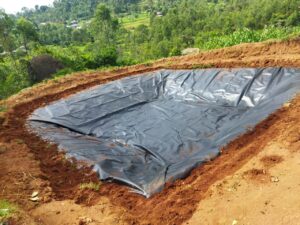
Choosing the right dam liner prices Kenya thickness
| Site factor | Why it matters | Decision question |
|---|---|---|
| Ground condition | Sharp stones or poor subgrade increase puncture risk | What preparation or protective layer is required? |
| Reservoir size/depth | Larger projects increase material and seam length | What cutting and welding plan minimises waste? |
| Livestock/human access | Traffic can damage exposed liner | How will access be controlled? |
| Outlet penetrations | Poor details can leak | What flange/boot detail will be used? |
| Expected service | Risk tolerance affects specification | Which thickness and protection fit the project? |
Worked example: rectangular farm reservoir
Consider a farm reservoir where the owner measures only the top length and width and multiplies those values to estimate liner. That misses the side slopes and anchor trench. When the actual slope lengths are measured, the required liner area is significantly larger than the water-surface footprint.
The project also needs an outlet flange, pipe penetration and welding around the detail. Adding those before ordering avoids a late shortage of material. The owner can then compare 0.5, 0.75 and 1 mm options on the same measured area rather than comparing different assumptions.
| Illustrative component | Relative area index |
|---|---|
| Floor | 55 |
| Side slopes | 75 |
| Anchoring/allowance | 25 |
Features of our dam liner prices Kenya project service
| Feature | Benefit |
|---|---|
| Dimension review | Calculates floor, slopes and anchoring area |
| Thickness selection | Matches material to project conditions |
| Subgrade checklist | Reduces avoidable puncture risk |
| Cutting/welding plan | Controls seams, waste and installation sequence |
| Outlet detailing | Coordinates penetrations with compatible flange arrangements |
| Anchoring plan | Secures perimeter edges and transitions |
| Inspection/handover | Checks seams, visible damage and completion details |
Advantages of comparing dam liner prices Kenya by complete scope include:
- Better budgeting because slopes and allowances are included.
- Lower material-shortage risk because the cutting plan is prepared before ordering.
- Better leak control because welding and penetrations are specified.
- More realistic thickness decisions because site conditions are considered.
- Clearer quotation comparison because material and installation are separated.
Dam liner prices Kenya complete-project pricing
| Scope | Indicative/current price | What to confirm |
|---|---|---|
| 0.5 mm material | KES 230/m² | Current material-only product price |
| 0.75 mm material | KES 330/m² | Current material-only product price |
| 1 mm material | KES 430/m² | Current material-only product price |
| Welding/installation | $— | Seams, labour, tools and testing |
| Ground preparation | $— | Shaping, compaction, removal of sharp material and protection |
| Outlet/flange detail | $— | Compatible assembly, welding/sealing and pipe connection |
Ground preparation before liner installation
The reservoir surface should be smooth, stable and free of sharp objects that can puncture the liner. Remove roots, stones, construction debris and protrusions. Compact and shape the subgrade to the intended geometry before the liner arrives.
Do not use the liner to hide poor excavation. Soft spots, collapsing edges and unstable slopes should be corrected first.
Protective layers and geotextile
Where the ground condition justifies it, a protective cushioning layer may be specified beneath the liner. The material and weight should follow project conditions. This is a separate scope item from the HDPE itself.
Welding and seam layout
HDPE sheets need controlled joining. Seam layout should reduce unnecessary welding while keeping panels manageable. Welding equipment and technique should match the liner material. Weather, dust, moisture and surface cleanliness can affect installation quality.
Ask the installer how seams will be inspected or tested. A visually neat seam is useful, but the project should have an agreed quality-control method.
Anchor trenches
The liner perimeter needs a secure termination. Anchor trenches or another approved detail keep the sheet from pulling into the reservoir or lifting at the edge. Dimensions depend on design and site conditions.
Allow enough material beyond the water line for the anchoring detail. Cutting the liner exactly to the visible slope can leave no practical edge for installation.
Reservoir outlets and pipe penetrations
Penetrations are common leak points if improvised. Plan outlets before the liner is installed. The site lists a reservoir liner outlet and flange kit by quotation. The actual detail must fit pipe size, liner thickness and reservoir design.
Avoid cutting holes in finished liner before the compatible fitting and installer are ready.
Overflow and freeboard
A lined reservoir still needs a safe overflow route. Water should not overtop uncontrolled edges and erode the embankment or undermine the anchor. Define normal operating level and freeboard during design.
Inlet energy and erosion
High-velocity inlet water can scour or move an unprotected liner. Use an inlet arrangement that dissipates energy and avoids directing a strong jet at one point. Similar care is needed where pumped borehole water enters the reservoir.
Planning liner rolls, panels and delivery access
Material area is only one part of ordering. The installer also needs to know available roll widths, roll lengths, panel sizes and the safest way to move material from the delivery vehicle to the reservoir. A remote farm with narrow access may need smaller handling units or additional labour even when the measured liner area is straightforward.
Before delivery, confirm where rolls will be stored and protect them from sharp objects, vehicle traffic and uncontrolled dragging. Arrange the panel sequence so sheets can be placed with minimal unnecessary movement across the prepared subgrade. Every extra drag across stones or unfinished ground adds avoidable damage risk.
For irregular reservoirs, the cutting plan should identify where seams are expected and where larger continuous panels are preferable. This planning can reduce waste and helps the quotation explain why the installed dam liner prices Kenya total is higher than a simple square-metre multiplication.
Installing HDPE liner during Kenya’s wet or windy conditions
Weather can affect installation quality. Strong wind can make large sheets difficult to control, while rain can soften the prepared subgrade, introduce mud into seam areas or leave water trapped beneath the liner. The team should be prepared to pause work when conditions prevent clean, controlled installation.
On sites where rain is likely, shape the excavation so unexpected water can be managed before liner placement and avoid opening more liner than can be secured. If the subgrade is damaged by runoff, repair and recompact it before covering the area.
A realistic programme should therefore include weather contingency rather than forcing welding or panel placement simply because labour and equipment are already on site.
Inspection checklist before filling the reservoir
- Walk the accessible liner surface and mark visible cuts, punctures or suspicious abrasions.
- Check that seams and repair patches have been completed and inspected.
- Confirm outlet and penetration details are fully installed before water covers them.
- Verify perimeter anchoring is complete and protected from erosion.
- Check inlet energy dissipation and the planned overflow path.
- Remove loose tools, sharp offcuts and construction debris from the reservoir.
- Photograph key seams, outlets and anchor details for the project file.
Fill the reservoir in a controlled manner where practical and observe the outlet, pipe connections and exposed perimeter. If the water level changes unexpectedly, investigate valves, pipework and evaporation conditions as well as the liner before concluding there is a membrane leak.
Livestock access
Direct livestock access can damage exposed liner with hooves and can contaminate stored water. Where livestock need the water, pump or gravity-feed separate troughs rather than allowing animals to walk on the liner.
UV exposure and uncovered reservoirs
Outdoor liner should be specified for the intended exposure. Keep unused material stored appropriately before installation and avoid unnecessary mechanical damage during construction.
Cleaning and maintenance
Inspect the reservoir edge, outlets and exposed liner periodically. Remove sharp debris carefully. If water level drops unexpectedly, check pipework and valves before assuming the liner is leaking.
Keep installation drawings and repair material so future technicians know the liner thickness and seam arrangement.
Repairing a damaged HDPE liner
Small damage can sometimes be repaired using compatible HDPE patch material and proper welding technique. The area must be clean and accessible. Do not rely on household adhesives unless the liner manufacturer explicitly supports them.
For a suspected leak, isolate the reservoir from pipes where practical and inspect the system systematically. An outlet fitting or valve can leak while the liner itself remains intact.
How borehole pumping connects to reservoir size
A lined farm reservoir often works as storage between a borehole and irrigation demand. The reservoir capacity should be connected to tested borehole yield and crop water demand rather than selected independently.
Use the borehole irrigation Kenya guide to plan yield, pumping hours, storage and irrigation zones together.
Dam liner prices Kenya: farm-site logistics that affect the installed total
For rural Kenyan projects, transport and handling can materially change the installed cost even when the square-metre rate is fixed. Check whether a truck can reach the reservoir edge, whether rolls must be carried across soft ground, and whether the installation crew needs temporary access tracks or additional labour. Also confirm where welding equipment will be powered and protected from dust or rain.
Order timing matters too. The excavation should be substantially complete before liner delivery so rolls do not sit exposed on site while earthworks continue. Coordinate inlet pipes, outlet sleeves and overflow details before final lining. This reduces rework and helps avoid cutting a finished membrane to accommodate fittings that should have been planned earlier.
When comparing dam liner prices Kenya, ask each supplier to separate material, delivery, unloading, welding, ground preparation, fittings and commissioning. That makes the budget easier to defend and prevents a low material quote from being mistaken for the final installed cost.
Common dam liner prices Kenya mistakes
- Using only the top water-surface area to order material.
- Ignoring side slopes, anchor trenches and overlaps.
- Selecting thickness only from price.
- Installing over sharp stones or unstable subgrade.
- Improvising pipe penetrations after installation.
- Allowing livestock to walk directly on exposed liner.
- Failing to plan safe overflow.
- Comparing material-only price with installed-system price.
- Ordering without a cutting and seam plan.
How to get started
- Measure reservoir floor and slope dimensions.
- Confirm depth and final operating level.
- Photograph ground condition and access.
- Identify inlet, outlet, overflow and drain points.
- Choose thickness from site conditions and intended service.
- Prepare a cutting/welding and anchoring plan.
- Request material, welding, ground preparation and fittings separately.
- Inspect and document the completed installation.
Dam liner prices Kenya FAQs
How much is 0.5 mm HDPE liner in Kenya?
Borehole Drillers Kenya currently lists 0.5 mm HDPE reservoir liner at KES 230 per square metre for material only.
How much is 0.75 mm liner?
The current listed 0.75 mm HDPE price is KES 330 per square metre for material only.
How much is 1 mm HDPE liner?
The current listed 1 mm HDPE price is KES 430 per square metre for material only.
Which liner thickness is best?
There is no universal best thickness. Consider subgrade condition, reservoir geometry, exposure, puncture risk and required service.
How do I calculate liner area?
Measure the floor, side slopes and anchoring/installation allowance. Do not use only the water-surface area.
Does the per-metre price include welding?
No. The listed products are material per square metre; welding and installation are separate unless quoted.
Can I install liner over rocky ground?
Sharp rock can puncture liner. Prepare the subgrade and specify suitable protection before installation.
Compare dam liner prices Kenya from measured area and installed scope
dam liner prices Kenya become useful when the same measured reservoir area and installation scope are used for every option. Calculate floor, slopes and anchoring, choose thickness for the actual ground and service conditions, then budget welding, outlets, subgrade preparation and inspection separately. That produces a reservoir estimate you can use rather than a misleading material-only total.