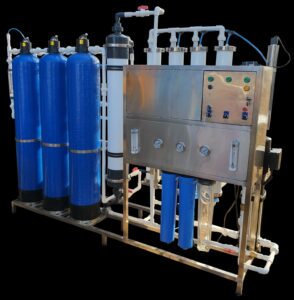
reverse osmosis machine Kenya buyers often start with machine size or price, but the right system starts with your water test, daily demand and installation scope. This guide explains how reverse osmosis works, what a complete RO installation includes, which capacities suit different users, and how to compare a Kenya quotation without buying too little or too much equipment.

Reverse osmosis machine Kenya: key takeaways
- Test first: water chemistry determines pretreatment, membrane duty and whether RO is the right treatment stage.
- Size from litres per day: litres per hour alone can mislead if storage and operating hours are ignored.
- Compare installed scope: tanks, pretreatment, pumps, controls, plumbing, electrical work and commissioning may sit outside an equipment-only price.
- Plan lifecycle cost: cartridges, membranes, dosing chemicals, cleaning and routine monitoring matter after purchase.
- Match the application: a home, hotel, school, clinic, factory and water-refill business do not need the same configuration.
How a reverse osmosis machine works
Reverse osmosis uses pressure to move water across a semi-permeable membrane. Water passes through as the treated stream, while part of the feed remains as a more concentrated reject stream. The membrane stage is therefore a separation process rather than a simple sediment filter.
A commercial system normally begins before the membrane. Sediment, hardness, iron, manganese, chlorine or other conditions can require pretreatment depending on the source water. That is why a representative laboratory test should come before equipment selection. See our borehole water testing and treatment guide before comparing equipment.
The basic RO flow path
| Stage | Purpose | Typical decision |
|---|---|---|
| Raw-water storage/feed | Provides a stable supply | Tank size and feed-pump duty |
| Pretreatment | Protects membranes | Sediment, iron, hardness or chemical conditioning as required |
| Cartridge filtration | Fine particulate protection | Micron rating and replacement monitoring |
| High-pressure pump | Provides membrane operating pressure | Duty matched to membrane array and feed water |
| RO membranes | Separate treated water from concentrate | Membrane type, number and design recovery |
| Post-treatment/storage | Protects and stores product water | UV, remineralisation or storage depending on use |
Why water testing comes before an RO machine
Two boreholes can look clear and still require different treatment trains. Hardness can create scaling risk. Iron and manganese can load pretreatment. High dissolved salts can change membrane pressure and recovery. Turbidity can shorten cartridge life. A design based only on taste or appearance can therefore create avoidable maintenance.
The same principle applies to municipal or tank water. The question is not simply “does RO remove impurities?” but “what does this source water contain, what product-water quality is required, and which pretreatment protects the membrane?” For broader treatment options, compare our borehole water treatment systems in Kenya.
How to size a reverse osmosis machine Kenya project
Start with required treated water per day, then decide how many hours the plant should operate. Storage can buffer short peaks, so a facility does not always need a plant sized to the highest minute-by-minute demand.
In plain English, daily treated-water production equals actual RO product flow multiplied by operating hours.
For example, a 500 L/h plant running for eight productive hours can theoretically produce 4,000 litres during that operating window before allowing for downtime or actual field performance. A treated-water tank can then supply short demand peaks.
Which capacity fits which user?
| User or sector | What to calculate first | Typical design concern |
|---|---|---|
| Home or apartment | Drinking/cooking demand | Point-of-use vs whole-property treatment |
| Office | Staff and visitor drinking demand | Convenience, storage and service access |
| School | Pupils, staff and occupied hours | Peak breaks, storage and simple operation |
| Hotel/restaurant | Kitchen, drinking and process demand | Separate RO-quality demand from total water demand |
| Clinic/hospital | Required use and quality specification | Monitoring, continuity and documented maintenance |
| Laundry | Machine flow and daily cycles | Hardness/TDS control and continuous demand |
| Factory/process | Process specification | Redundancy, instrumentation and uptime |
| Water-refill business | Daily saleable litres | Production hours, storage and product-quality verification |
| Farm/agri-processing | Specific treated-water use | Do not RO-treat water unnecessarily if the use does not require it |
Current commercial RO machine prices on our Kenya catalogue
Borehole Drillers Kenya currently lists four commercial reverse-osmosis plants. These are equipment references; a complete installed project can cost more because pretreatment, site plumbing, storage, electrical works, commissioning and transport vary.
| Capacity | Current equipment price | Product |
|---|---|---|
| 250 L/h | KSh 350,000 | 250 L/h commercial RO plant |
| 500 L/h | KSh 550,000 | 500 L/h commercial RO plant |
| 1,000 L/h | KSh 850,000 | 1,000 L/h commercial RO plant |
| 2,000 L/h | KSh 1,500,000 | 2,000 L/h commercial RO plant |
For a deeper price comparison, see reverse osmosis plant prices in Kenya.
What a complete RO installation should include
A useful quotation should separate the packaged RO plant from the surrounding project. Ask suppliers to identify what is included and excluded so two prices can be compared fairly.
- Raw-water tank and feed pump where required.
- Pretreatment sized from the laboratory result.
- Cartridge filtration and service access.
- RO skid, membranes, high-pressure pump and instrumentation.
- Product-water tank and hygienic post-treatment where required.
- Reject-water discharge or reuse plan.
- Pipework, valves and fittings.
- Electrical supply, protection, controls and interlocks.
- Installation, commissioning and baseline readings.
- Operator handover and maintenance schedule.
RO recovery and reject water
An RO machine produces both product water and reject water. The ratio depends on system design and feed-water chemistry. Recovery should be stated by the designer rather than assumed from a generic percentage.
In plain English, recovery is treated-water flow divided by feed-water flow, expressed as a percentage.
Higher recovery can reduce reject volume, but it can also increase concentration at the membrane surface. The acceptable design depends on water chemistry, membrane selection and scaling control.
Pretreatment: where many RO projects succeed or fail
Membranes perform better when upstream conditions are controlled. Iron treatment, softening, sediment filtration, activated carbon or chemical dosing may be required depending on the water analysis. The sequence should be designed for the specific feed water.
If iron is a concern, see how to remove iron from borehole water. If hardness is the main issue, review water softener prices in Kenya. Our shop also lists a chemical dosing pump and a 20-inch cartridge filter housing for suitable treatment projects.
RO membrane replacement and maintenance
There is no universal replacement interval for a commercial membrane. Life depends on feed water, pretreatment, pressure, recovery, cleaning practice and the product-water requirement. Monitoring trends is more useful than replacing parts only by calendar date.
Record feed pressure, product flow, reject flow and conductivity or TDS at commissioning. Changes from the clean-system baseline can help a technician distinguish cartridge loading, membrane fouling, scaling or another restriction.
Borehole Drillers Kenya currently lists a 4040 commercial RO replacement membrane at KSh 25,000. Verify the exact membrane model and number required by your plant before ordering.
Reverse osmosis machine Kenya installation checklist
- Obtain a current representative water analysis.
- Define the intended use and target product-water quality.
- Calculate daily treated-water demand and peak-use periods.
- Choose practical operating hours and storage capacity.
- Size pretreatment and the RO plant together.
- Confirm power availability, drainage and plant-room access.
- Plan reject-water handling.
- Commission under realistic load.
- Record baseline flow, pressure and product quality.
- Train the person responsible for daily checks.
Common buying mistakes
- Buying the largest litres-per-hour figure without calculating daily demand.
- Comparing equipment-only price with a fully installed quotation.
- Skipping water testing and discovering iron, hardness or salinity after installation.
- Ignoring treated-water storage and oversizing the RO plant.
- Ignoring reject-water handling.
- Failing to budget for cartridges, membranes, dosing chemicals and service.
- Not documenting commissioning readings.
- Assuming all water in a property needs RO-quality treatment.
How RO fits different parts of Kenya
County targeting should follow the actual water source and application rather than copy-and-paste location pages. Coastal and saline-water projects may require a different membrane duty from inland low-TDS sources. Borehole chemistry also varies within the same county, so location alone cannot determine the treatment train.
For Nairobi and surrounding urban areas, common project questions include apartments, offices, restaurants, schools and borehole-fed estates. In Mombasa and other coastal settings, salinity and higher dissolved solids can become a major design factor. In agricultural and institutional projects elsewhere, the decision often centres on which portion of the water genuinely needs RO treatment and how storage supports peak demand.
Reverse osmosis machine Kenya FAQs
How much is a reverse osmosis machine in Kenya?
Price depends on capacity and scope. Borehole Drillers Kenya currently lists commercial equipment from KSh 350,000 for 250 L/h to KSh 1.5 million for 2,000 L/h. Installed project pricing can differ.
Can RO treat borehole water?
Yes, when the system is designed for the tested borehole chemistry and supported by suitable pretreatment.
Do I need a water test before buying RO?
A water test is strongly recommended for commercial and borehole applications because it informs pretreatment, membrane duty and product-water targets.
What size RO machine do I need?
Calculate treated litres required per day, practical operating hours and storage. Then select a plant that meets that duty with maintenance reserve.
Does an RO machine waste water?
RO produces a reject or concentrate stream as part of membrane separation. The amount depends on design recovery and feed-water chemistry.
How often should membranes be replaced?
There is no single interval. Monitor plant performance and follow the membrane and system service requirements.
Can an RO plant serve a hotel, school or hospital?
Yes, provided capacity, storage, product-water specification, monitoring and continuity are designed for that facility.
Plan the whole system, not only the machine
A reverse osmosis machine Kenya project works best when water testing, pretreatment, capacity, storage, membrane duty and installation are treated as one system. Start with the water you have and the litres you genuinely need, then compare equipment and installed scope on the same basis.