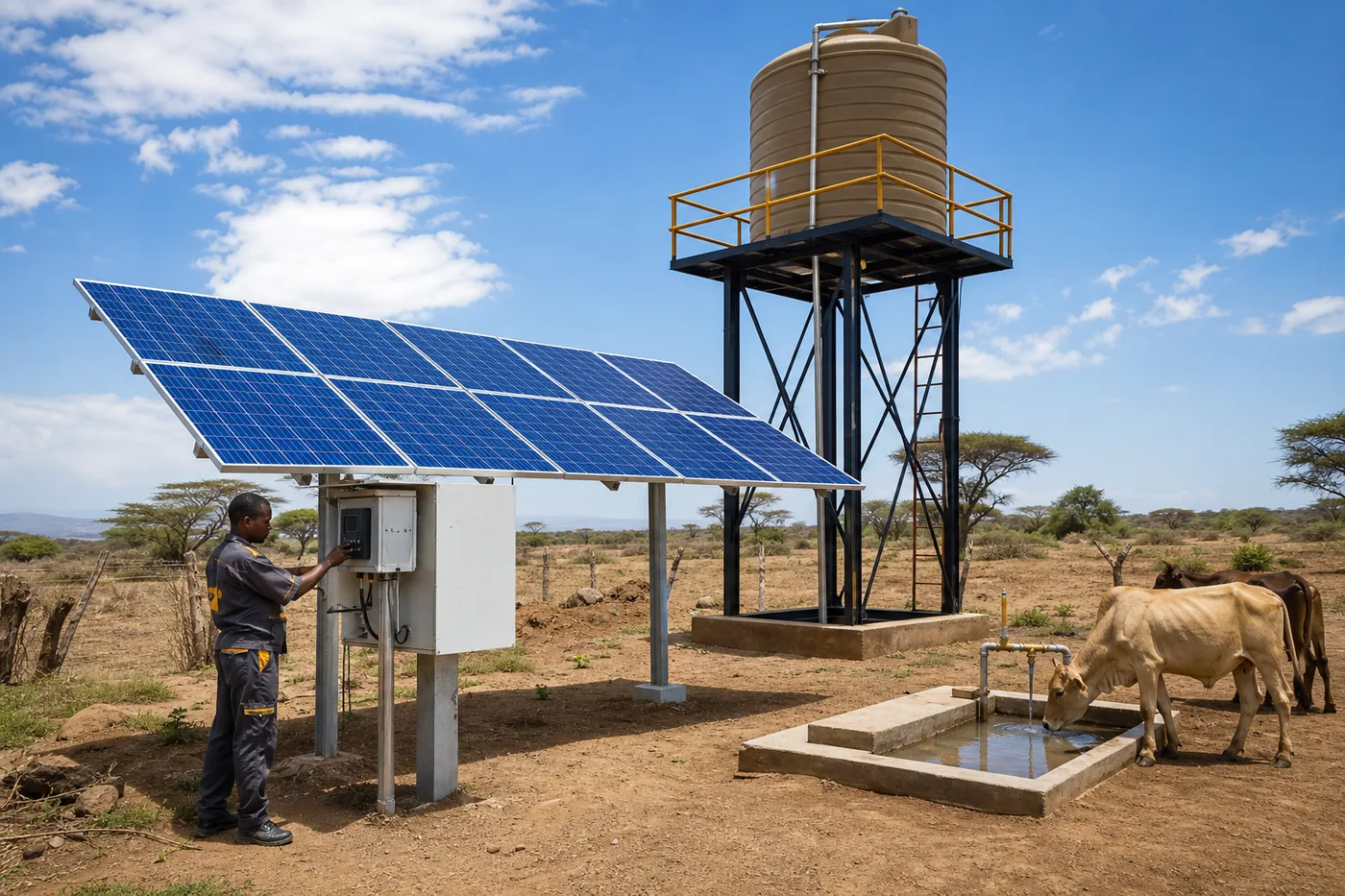
solar borehole pump kit should mean a complete, compatible water-pumping system—not just a pump and a few solar panels bundled under one price. In Kenya, the correct kit depends on tested borehole performance, total dynamic head, daily water demand, storage, operating hours, solar resource, controller limits, cable, protection and installation conditions.

What should a solar borehole pump kit include?
A solar borehole pump kit can include the submersible pump and motor, solar pump controller or inverter, PV modules, mounting structure, DC isolation and protection, earthing, cable, cable joints, level sensors, dry-run protection, rising main, non-return valve and installation accessories. Depending on the supplier, storage and distribution may be included or quoted separately.
That variation is why buyers should not compare package prices by the word “kit” alone. One solar borehole pump kit may stop at the controller. Another may include panels and mounting but exclude borehole cable. A third may include full installation, commissioning and a storage tank.
Ask for a line-by-line bill of materials with model numbers, quantities and warranties. The package should be evaluated as a water-delivery system, not as a list of unrelated components.
Solar borehole pump kit sizing starts with the borehole test
Do not choose a solar borehole pump kit from drilled depth alone. The pump works at the pumping water level, not at the bottom of the borehole, and it also has to overcome elevation, friction and any pressure required at the delivery point.
The completed borehole should be test pumped so the design has evidence for discharge, pumping water level, drawdown and recovery. This information helps establish an operating rate that does not simply force the source to match an oversized pump.
See borehole test pumping Kenya and borehole yield in Kenya. A responsible solar borehole pump kit quotation should request these results or clearly state provisional assumptions if testing has not happened yet.
Calculate total dynamic head before selecting a solar borehole pump kit
Total dynamic head combines the vertical lift and hydraulic losses the pump must overcome at the target flow. For a solar borehole pump kit, that can include pumping water level, elevation to storage, friction in rising main and delivery pipe, fittings and any required pressure.
In plain English, total dynamic head is the sum of pumping lift, elevation, friction and any required outlet pressure. The exact formulation should use one consistent reference and measured site data.
After TDH and required flow are defined, compare the duty point with the manufacturer’s pump curve. A solar borehole pump kit should place normal operation within a suitable part of the pump and controller range.
Daily water demand controls solar borehole pump kit size
The hydraulic duty tells you how hard the pump must work; daily demand tells you how long it must work. A household, school, farm, hotel or livestock project can need very different water volumes even when the borehole depth is the same.
In plain English, daily pumped volume equals the operating flow multiplied by pumping time. A solar borehole pump kit must provide the required volume within realistic solar operating conditions while respecting the tested borehole rate.
Build a daily demand schedule by use. Separate essential consumption from optional irrigation or future expansion. This prevents a kit from being oversized because every possible demand is assumed to happen at the same time.
The pump and motor in a solar borehole pump kit
The submersible pump is the hydraulic heart of the solar borehole pump kit. The selected model should have a published performance curve, clear motor characteristics, suitable materials for the water and borehole, and accessible technical support.
Do not compare pumps only by horsepower. Two pumps with similar motor ratings can have different flow/head curves. Ask the supplier to mark the proposed duty point on the curve and state the expected operating range as solar input changes.
Also record the proposed pump setting depth. It should be determined from borehole construction, pumping levels, intake intervals and manufacturer requirements. Read borehole pump sizing in Kenya for the full hydraulic process.
Controller or inverter in a solar borehole pump kit
A solar borehole pump kit needs an appropriate controller to manage power from the PV array and operate the motor safely. Depending on the pump architecture, this may be a dedicated solar pump controller or another approved drive solution.
Check input-voltage and current limits, motor compatibility, dry-run functions, level-sensor inputs, fault logging, restart behavior and any grid/generator hybrid capability that is being offered. The controller should not be selected merely because its headline kilowatt rating matches the motor.
Request the exact model and manual. If the system later trips or underperforms, the controller’s fault history and settings become part of the diagnostic record.
Solar panels in a solar borehole pump kit
The PV array supplies the energy for the solar borehole pump kit. Module quantity should follow the controller and pump requirements, expected operating window, site conditions and design margins. Panel wattage alone does not establish whether an array is electrically compatible.
The design should check series voltage, current, temperature effects, controller input limits and physical mounting. Ask for the panel make, model, quantity and wiring arrangement instead of accepting “2 kW solar” as the complete specification.
Keep modules clear of avoidable shading and install a mounting structure suitable for the site. Security, cleaning access and cable routing should be planned before the array location is finalized.
Protection and earthing belong in the solar borehole pump kit
A low-priced solar borehole pump kit can omit protection components that become essential during installation. Ask for suitable isolation, overcurrent protection, surge protection, earthing and protection of exposed cabling according to the system design and applicable practice.
Lightning and surge exposure, cable length, site security and the relationship between array, controller and motor all influence the protection approach. Do not reduce the system to a pump-panel bundle with no discussion of electrical safety and serviceability.
Borehole cable and joints
The cable between controller and motor is a major part of the solar borehole pump kit. Cable size should account for motor current, length, voltage drop and installation conditions. The submersible joint must be made using an appropriate water-resistant method and installed carefully.
Ask whether the quoted cable length matches the actual pump setting plus route to the controller. Very low equipment quotes sometimes exclude substantial cable runs, leaving a material cost to appear during installation.
Record cable size and installed length at handover. Future pump retrieval and fault diagnosis become easier when the original specification is known.
Rising main and hydraulic accessories
A complete solar borehole pump kit may include the rising main, non-return valve, wellhead fittings, pressure or flow instruments and delivery pipe to the storage point. These components must be suitable for the pressure, flow and installation depth.
Pipe diameter affects friction. Selecting a smaller pipe only because it is cheaper can increase hydraulic losses and force the pump to operate at a higher head. Include the actual route and length in the design rather than pricing only the vertical borehole section.
Storage is part of solar borehole pump kit planning
Many solar water systems use water storage instead of battery storage. The solar borehole pump kit fills a tank during available solar hours, while users draw water according to demand. This approach can simplify energy storage and provide a practical reserve.
Tank size should follow daily demand, borehole yield, pumping hours, critical reserve and refill strategy. A small tank can force frequent cycling or leave little cloudy-day reserve. An unnecessarily large tank increases structural and capital cost.
Use borehole water tank size Kenya to build the storage calculation.
Level controls and dry-run protection
A solar borehole pump kit should include an operating strategy for both the source and storage. Tank-level control can stop pumping when storage is full. Dry-run or low-water protection can help prevent operation when source conditions are unsafe for the pump.
Protection settings should match actual borehole behavior rather than being left at arbitrary defaults. During commissioning, test the sensors and automatic stop/start logic. Record the settings so later technicians know what was configured.
Solar borehole pump kit comparison table
| Component | What to specify | Common omission |
|---|---|---|
| Submersible pump | Model, curve, motor, materials and duty point | Only horsepower stated |
| Controller | Model, input limits, protections and sensor inputs | Generic “solar inverter” |
| PV modules | Make, wattage, quantity and electrical arrangement | Only total watts stated |
| Mounting | Structure, orientation, foundations and security | Panels supplied loose |
| Protection | Isolation, surge, overcurrent and earthing | Not in equipment-only quote |
| Cable | Size, length and submersible joint | Short allowance only |
| Rising main | Material, diameter, pressure class and length | Excluded from “kit” |
| Sensors | Tank and dry-run/level strategy | No automatic protection |
| Storage | Capacity and operating reserve | Assumed owner-supplied |
| Commissioning | Flow, electrical readings and control tests | No documented baseline |
Worked example: two solar borehole pump kit quotations
Imagine Supplier A offers a low-cost solar borehole pump kit containing a pump, controller and panels. Supplier B is more expensive but includes mounting, protection, cable, rising main, sensors, installation and commissioning. The totals do not represent the same finished water system.
Rebuild both quotations into the component table above. Add realistic allowances for essential excluded items and compare the evaluated complete cost. Supplier A may still be competitive, but the decision is now based on equivalent scope.
| Illustrative kit scope | Relative completeness index |
|---|---|
| Pump, controller and panels | 45 |
| With electrical/hydraulic accessories | 75 |
| Installed and commissioned system | 100 |
Features of our solar borehole pump kit approach
| Feature | What it provides |
|---|---|
| Test-data review | Uses borehole yield and pumping level before final selection |
| Hydraulic duty calculation | Defines required flow and total dynamic head |
| Daily water balance | Links pumping hours with storage and demand |
| Named component schedule | Shows pump, controller, panels, cable and protection models |
| Installation scope | Makes mounting, pipework, wiring and sensors visible |
| Commissioning record | Creates a baseline for flow, electrical readings and controls |
| Handover information | Provides warranties, settings and maintenance guidance |
Advantages of a properly specified solar borehole pump kit include:
- Fewer hidden costs because cable, mounting and protection are visible.
- Better hydraulic performance because the pump is chosen from the actual duty point.
- Better source protection because operating rate follows tested borehole performance.
- Better daily reliability because storage and solar hours are designed together.
- Better troubleshooting because models and commissioning readings are documented.
Solar borehole pump kit price in Kenya
The price of a solar borehole pump kit varies with flow, total dynamic head, motor size, controller, PV capacity, cable length, rising main, protection, storage, installation and site access. A low advertised bundle may serve a different duty from the system your borehole requires.
| Package scope | Indicative price | Confirm before comparing |
|---|---|---|
| Equipment-only kit | $— | Pump, controller and exact PV modules supplied |
| Electrical kit | $— | Protection, cable, sensors and mounting included |
| Hydraulic installation kit | $— | Rising main, fittings, wellhead and delivery route |
| Complete installed system | $— | All equipment, installation, storage interface and commissioning |
Solar borehole pump kit for farms
A farm solar borehole pump kit should start with daily irrigation and livestock demand, not with the number of panels available. Test the borehole, plan storage and decide whether irrigation runs directly or from a tank/reservoir.
If the project will use drip irrigation, include required pressure, filtration and irrigation-zone flow in the hydraulic plan. See can borehole water be used for irrigation and drip irrigation kit prices in Kenya.
Solar borehole pump kit for homes and apartments
Domestic sites often benefit from pumping into storage and using gravity or a separate booster for building pressure. This can keep the solar borehole pump kit focused on moving water efficiently from the borehole to the tank instead of forcing the submersible pump to satisfy variable tap pressure directly.
Where a booster is used, design its controls and pressure vessel separately from the borehole pump. If users report low pressure, distinguish the borehole, storage and building-pressure systems before replacing equipment.
Solar borehole pump kit for schools and institutions
Schools and institutions should define critical daily demand and reserve. A solar borehole pump kit may need to refill storage within the available solar window while allowing for concentrated use during school or operating hours.
Record normal tank refill time at commissioning. If refill becomes slower, that simple baseline helps distinguish changing solar input, pump performance, source conditions and distribution issues.
Common solar borehole pump kit buying mistakes
- Buying the pump before test-pumping the borehole.
- Selecting from horsepower and depth alone.
- Comparing kits without checking cable, mounting and protection.
- Choosing panel count from watts only without controller input checks.
- Ignoring storage and expecting solar pumping to match every demand peak directly.
- Using an undersized rising main that adds unnecessary friction.
- Leaving dry-run and tank controls out of the package.
- Accepting a solar borehole pump kit with no named models or pump curve.
- Finishing installation without commissioning readings or warranty documents.
Solar borehole pump kit handover checklist
- Pump and motor model, serial numbers and performance curve.
- Controller model, settings and fault-reference information.
- PV module make, model, quantity and array configuration.
- Mounting and earthing details.
- Protection-device schedule.
- Cable sizes and approximate installed lengths.
- Rising-main specification and pump setting depth.
- Tank and source sensor arrangement.
- Commissioning flow and available electrical readings.
- Warranty contacts and maintenance guidance.
Keep the solar borehole pump kit handover file together with the drilling log and pumping-test report so future service work starts with evidence.
How to get started
- Send the borehole location and pumping-test report if available.
- State daily water demand and delivery point.
- Provide tank elevation, pipe route and desired pressure where relevant.
- Confirm whether storage already exists.
- Define the required operating schedule and any backup power requirement.
- Request a named solar borehole pump kit bill of materials.
- Compare complete installed scopes rather than equipment bundles.
- Commission the system and retain baseline records.
Solar borehole pump kit FAQs
What comes in a solar borehole pump kit?
Depending on the scope, it can include the pump, controller, PV modules, mounting, protection, cable, sensors, rising main and installation accessories. Always request a line-by-line list.
How do I size a solar borehole pump kit?
Use tested borehole yield and pumping level, required flow, total dynamic head, daily water demand, solar operating hours and storage strategy.
Can I choose the kit from borehole depth?
No. Drilled depth alone does not establish pumping water level, flow, elevation, friction or daily demand.
Do solar borehole systems need batteries?
Many systems store water instead of electricity. Batteries may be justified for specific operating requirements but add cost and replacement needs.
Does the kit include a water tank?
Some packages do and others do not. Treat storage as a named line item and size it from demand and pumping strategy.
How many solar panels are needed?
The array depends on the selected pump/controller, electrical limits, duty, desired pumping window and site conditions—not one universal panel count.
What should I check before paying?
Confirm the exact pump and controller models, panel quantity, cable, protection, pipework, installation, commissioning, warranties and all exclusions.
Buy a solar borehole pump kit as a complete water system
A solar borehole pump kit should be selected from measured borehole performance and the water service you need. Define flow and head, calculate daily volume, include electrical and hydraulic accessories, plan storage, commission the controls and keep a complete handover record.