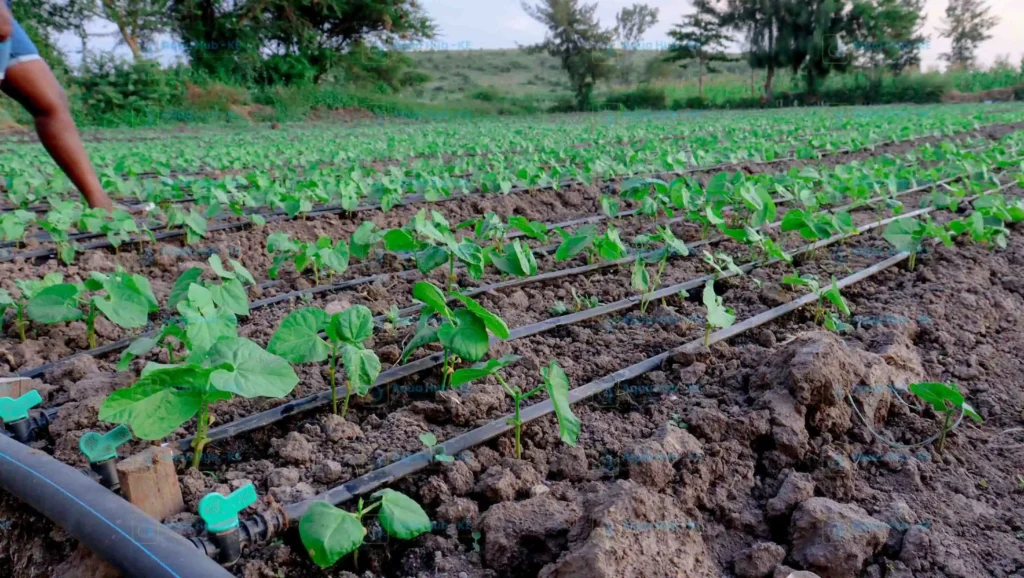
drip irrigation kit prices Kenya should be compared by irrigated area, crop spacing, water source, filtration, pressure, zone layout, fertigation and installation—not by kit price alone. This guide compares the quarter-acre, half-acre and one-acre kits currently listed by Borehole Drillers Kenya and shows how to match a kit to borehole yield, storage and farm operating conditions.
Why drip irrigation kit prices Kenya vary
A kit can include drip lines, headers, connectors and selected fittings, but the farm may still need a pump, storage, filter, pressure regulation, mainline, valves, fertigation equipment and installation. Crop spacing can also change how much drip tape or lateral pipe is required inside the same acreage.
Before selecting a kit, confirm the water source. If the farm uses a borehole, use the borehole yield in Kenya guide to understand how much water is available and how storage can buffer irrigation peaks. Irrigation should be designed around the source, not added after the pump has already been selected.
Drip irrigation kit prices Kenya: current kit references
| Kit | Current equipment price | Product page |
|---|---|---|
| Quarter-acre drip irrigation kit | KES 35,000 | Quarter-acre kit |
| Half-acre drip irrigation kit | KES 65,000 | Half-acre kit |
| One-acre drip irrigation kit | KES 145,000 | One-acre kit |
These are current listed equipment prices. Confirm what each kit includes before comparing. Water source, filtration, pump, storage, mainline, fertigation and labour may be separate.
Drip irrigation kit prices Kenya and crop spacing
A quarter-acre tomato layout and a quarter-acre orchard do not use identical lateral spacing. Row spacing, plant spacing, emitter spacing and bed layout determine how much drip line is needed. The kit must therefore be checked against the crop plan.
Borehole Drillers Kenya also lists a 1,000 m drip tape roll with 15 cm emitter spacing at KES 8,240. That product can be useful for expansions or crop-specific layouts, but emitter discharge and operating pressure should be confirmed before design.
Calculate irrigation-zone flow
In plain English, zone flow equals the number of operating emitters multiplied by the flow from each emitter. Use the actual emitter specification.
If one zone demands more water than the borehole, pump or filter can supply, divide the farm into smaller zones. Zoning can make a moderate water source useful without forcing the pump to meet the entire acreage at once.
Calculate irrigation volume
In plain English, irrigation volume equals flow multiplied by run time. This lets the farmer compare zone demand with storage and borehole pumping hours.
The daily crop requirement should come from agronomic planning, weather, soil and crop stage rather than a universal run time. Drip equipment controls delivery; it does not decide how much water the crop needs.
Filtration is not optional in drip design
Small emitter passages can clog. Borehole water can contain sand, iron or other material that needs control before the laterals. The filter type and mesh/micron rating should match emitter requirements and water quality.
The shop lists a Magnar 1-inch disc filter, 120 mesh / 130 micron at KES 2,320. Confirm that its flow capacity and filtration rating match the selected kit and emitter requirement.

Pressure and pump selection
Drip systems need pressure within the operating range of the emitters and fittings. Too little pressure can cause poor distribution; too much pressure can damage tape or fittings. The pump, elevation difference, pipe losses, filter loss and pressure regulator all influence the final pressure.
If the farm uses a borehole, do not buy the largest pump to “ensure pressure.” Use borehole pump sizing in Kenya and design the irrigation zones around a suitable duty point.
Storage between the borehole and irrigation
A tank or lined reservoir can separate borehole pumping from irrigation timing. The borehole can refill storage steadily while irrigation uses higher flow for shorter zone periods. This is especially useful for solar borehole pumps that operate mainly during daylight.
See borehole water tank size Kenya and dam liner prices Kenya when planning farm storage.
Fertigation through drip irrigation
Fertigation injects soluble nutrients into irrigation water. The system needs appropriate filtration, chemical compatibility, pressure differential and backflow protection. Fertiliser should be fully soluble and managed according to crop and agronomic requirements.
Borehole Drillers Kenya lists a 1-inch Venturi fertigation injector at KES 5,500. The product description notes that tank, source pump, bypass pipework and installation are separate.
Choosing the right drip irrigation kit prices Kenya option
| Farm condition | Decision question | Planning response |
|---|---|---|
| Quarter acre | Does crop spacing match the kit layout? | Confirm rows, emitter spacing, water and filtration |
| Half acre | Can the source supply one or more zones? | Calculate zone flow and storage |
| One acre | Is full-acre simultaneous flow practical? | Use zoning where needed |
| Borehole water | Is sand/iron present? | Choose suitable filtration and treatment |
| Solar pumping | Can daytime pumping fill storage? | Coordinate tank/reservoir with irrigation schedule |
Worked example: one acre supplied by a moderate borehole
Imagine a one-acre vegetable farm whose borehole cannot support the entire drip network at once at the desired emitter pressure. Instead of buying a much larger pump, the farmer divides the kit into four irrigation zones. The borehole pump fills a tank during the day, and each irrigation zone runs separately.
This reduces instantaneous flow while preserving the daily irrigation volume. The filter is sized for one zone rather than the entire acreage. The farm also keeps a simple schedule showing which zone runs and for how long.
| Illustrative case | Relative flow index |
|---|---|
| Whole acre at once | 100 |
| One of four zones | 25 |
| Storage buffer | 55 |
Features of our drip irrigation kit prices Kenya project service
| Feature | Benefit |
|---|---|
| Crop/layout review | Matches lateral spacing to the actual farm |
| Water-source calculation | Coordinates borehole, river, tank or other supply |
| Zone-flow design | Prevents the kit from demanding more flow than available |
| Filtration sizing | Protects emitters at the intended flow |
| Pressure review | Coordinates pump, regulator and pipe losses |
| Fertigation option | Integrates a suitable injector and bypass where required |
| Commissioning | Checks pressure, flushing and zone operation |
Advantages of comparing drip irrigation kit prices Kenya as complete systems include:
- Lower emitter-clogging risk because filtration is included.
- Better water use because zone flow matches the source.
- Better pressure uniformity because pipe and regulator sizing are considered.
- Easier expansion because the farm layout and water balance are documented.
- Clearer cost because the kit, pump, storage and labour are separated.
Drip irrigation kit prices Kenya complete-project pricing
| Scope | Indicative/current price | Notes |
|---|---|---|
| Quarter-acre kit | KES 35,000 | Current listed equipment price |
| Half-acre kit | KES 65,000 | Current listed equipment price |
| One-acre kit | KES 145,000 | Current listed equipment price |
| Filter/mainline/storage | $— | Depends on water source and zone flow |
| Installation and commissioning | $— | Farm layout, trenching, fittings and labour |
Mainline and submain sizing
Mainline pipe carries water from the source or tank to irrigation zones. If the pipe is too small, friction loss can consume the pressure needed at emitters. If it is very large, cost rises without necessarily improving the crop outcome.
Size pipe from zone flow, route length and allowable pressure loss. Long farms and elevation changes need particular attention.
Pressure regulation
Many drip products operate within a defined pressure range. A regulator or controlled pump arrangement can prevent excessive pressure. Check the actual emitter/tape manufacturer specification.
Flushing laterals
End flush points allow sediment to be removed from laterals. Include flushing in the operating routine, especially after installation and after fertigation. A system without accessible flush points becomes difficult to maintain.
Emitter spacing and crop spacing
The listed 15 cm drip tape may suit some closely spaced crops, while other crops need wider spacing or different lateral layout. Match emitter spacing to the crop and soil wetting pattern. Do not force the crop plan to fit leftover tape.
Water quality and iron
Iron can oxidise and clog small emitters. If the borehole test shows iron, design treatment or maintenance accordingly. See remove iron from borehole water Kenya before relying on a disc filter alone.
Sand in borehole water
Continuous sand should be investigated at the borehole rather than accepted as normal irrigation water. Use borehole pumping sand Kenya to diagnose source sediment before it destroys filters and emitters.
Solar pumping for drip irrigation
Solar borehole pumping can work well with daytime irrigation or storage. The pump array and controller should be sized from the hydraulic duty, while the irrigation schedule should fit the available water. See solar vs electric borehole pump Kenya for the power comparison.
Reservoir versus tank storage
Small farms may prefer a tank; larger irrigation projects may use lined reservoirs. Storage choice depends on volume, land, elevation and budget. If gravity pressure is used, storage elevation matters.
Quarter-acre kit planning
A quarter-acre kit is attractive for market gardens and smaller blocks, but verify the crop rows and water supply. A small kit can still perform poorly if the source has no filter or if pressure is excessive.
Half-acre kit planning
A half-acre project may be operated as one or multiple zones depending on emitter flow and the source. Zoning can make the same borehole serve the farm with a smaller instantaneous flow.
One-acre kit planning
The one-acre kit price is only one component of a complete farm system. Calculate the full-acre emitter demand before deciding whether to operate simultaneously. Many farms gain flexibility from multiple zones.
Fertigation safety and backflow
Fertigation should be arranged so fertiliser solution does not flow backward into the water source. Use suitable backflow protection and follow agronomic recommendations for nutrient concentration and timing.
Field pressure checks after installation
A drip system should be commissioned at the actual operating zones rather than judged from water appearing at the end of the tape. Measure pressure at the start and representative downstream points of a zone, then check that the values stay within the product’s working range. Large differences can point to undersized mainline, excessive zone size, elevation effects, a loaded filter or a poorly regulated pump.
Walk the zone while it operates and look for leaking connectors, kinked laterals, blocked emitters and sections that inflate or collapse unusually. Flush the system before taking final observations because construction debris can distort the first run. Record the valve positions and zone sequence so farm workers can reproduce the commissioned arrangement.
This check is especially useful when comparing drip irrigation kit prices Kenya. A cheaper hardware package that requires major pipe or pump corrections after installation can become more expensive than a system designed around the farm’s actual pressure and flow from the beginning.
Planning crop rotation and future extensions
Farm layouts change. A grower may rotate from closely spaced vegetables to wider rows, add a nursery, extend by another quarter acre or divide one block into several crops with different irrigation schedules. When laying the mainline and valves, consider practical connection points for those likely changes instead of building every section as a dead end.
Future-proofing does not mean oversizing every component. It means documenting the current zone flows and leaving a clear method for recalculating the system when acreage or emitter count changes. If an extension increases demand beyond the borehole or filter capacity, add zones or storage rather than assuming the existing pump can simply run harder.
Keep a simple farm plan showing valve numbers, lateral spacing, emitter type and irrigation duration by zone. That record makes seasonal troubleshooting and expansion much easier.
Seasonal maintenance
- Clean filters according to pressure loss and condition.
- Flush mainlines and laterals.
- Repair leaks and damaged connectors.
- Check emitter distribution.
- Inspect pump, valves and pressure regulation.
- Clean fertigation equipment after use.
- Record irrigation zones and run times.
- Recalculate demand when crop or acreage changes.
Drip irrigation kit prices Kenya: planning for dry-season operation
During dry periods, a farm may depend more heavily on the borehole than it does during the rainy season. That makes the water balance especially important. Record the tested borehole operating rate, the usable storage volume and the planned irrigation duration for each zone. Then check whether the source can replace the water withdrawn from storage within the available pumping window.
Do not solve a seasonal shortfall only by extending every zone’s run time. First inspect emitter condition, filter pressure loss, leaks and soil wetting. If crop demand has increased because of growth stage or weather, update the schedule deliberately. If the borehole cannot support the revised daily volume, consider smaller zones, more storage, irrigation at cooler times or agronomic changes rather than operating the pump outside its tested envelope.
For solar-powered farms, track whether storage reaches its expected level by late afternoon under normal weather. A tank that repeatedly fails to recover can indicate higher irrigation demand, pump performance changes, lower source output or solar-system issues. This operating record makes drip irrigation kit prices Kenya part of a complete farm water plan rather than a one-time hardware purchase.
Keeping a simple irrigation log
A basic farm log can record the date, zone, start time, run time, filter condition, storage level and any abnormal pressure or leaks. The record does not need specialised software. Its value is consistency: when a crop block begins receiving less water, you can compare recent operation with the earlier baseline instead of guessing whether the problem is the pump, filter, valves or laterals.
During Kenya’s hotter or windier periods, add a short note about crop stage and unusual field conditions so run-time changes have context. Also record when the filter was cleaned, when laterals were flushed and whether the tank reached its normal recovery level after irrigation. Over several weeks, this simple record helps distinguish a genuine water-source or pump problem from a temporary change in crop demand, clogged filtration or an altered irrigation schedule.
Common drip irrigation kit prices Kenya mistakes
- Buying by acreage without checking crop spacing.
- Ignoring the water-source flow.
- Skipping filtration.
- Running the entire farm at once when the source cannot support it.
- Using an oversized pump instead of zoning.
- Ignoring elevation and pipe losses.
- Adding fertigation without backflow protection.
- Failing to flush laterals.
- Comparing kit-only price with a complete installed system.
How to get started
- Provide farm acreage and crop layout.
- Provide row and plant spacing.
- Provide water-source flow or borehole test.
- Identify storage and elevation.
- Calculate zone flow and filtration.
- Choose quarter, half or one-acre kit based on layout.
- Request mainline, valves, filter, fertigation and installation separately.
- Commission pressure, flushing and zone operation.
Drip irrigation kit prices Kenya FAQs
How much is a quarter-acre drip kit in Kenya?
Borehole Drillers Kenya currently lists the quarter-acre kit at KES 35,000 for the equipment described on the product page.
How much is a half-acre kit?
The current listed half-acre kit price is KES 65,000.
How much is a one-acre drip kit?
The current listed one-acre kit price is KES 145,000.
Does the kit include a pump?
Confirm the product scope. Pump, filtration, storage, mainline and installation can be separate depending on the project.
Can I use borehole water for drip irrigation?
Yes, if the borehole yield, water quality, filtration and pump duty are suitable. Continuous sand or iron should be addressed.
Do I need a filter?
Drip emitters need appropriate filtration. Match filter rating and flow to the emitter specification and water quality.
Can one acre be divided into zones?
Yes. Zoning is often useful when the source or pump cannot supply the full-acre flow at once.
Compare drip irrigation kit prices Kenya from the farm water balance
drip irrigation kit prices Kenya become useful when crop spacing, zone flow, borehole or storage capacity, filtration and pressure are known. Use the quarter-, half- or one-acre kit as a starting hardware package, then design mainline, filter, zones, fertigation and installation around the actual farm.